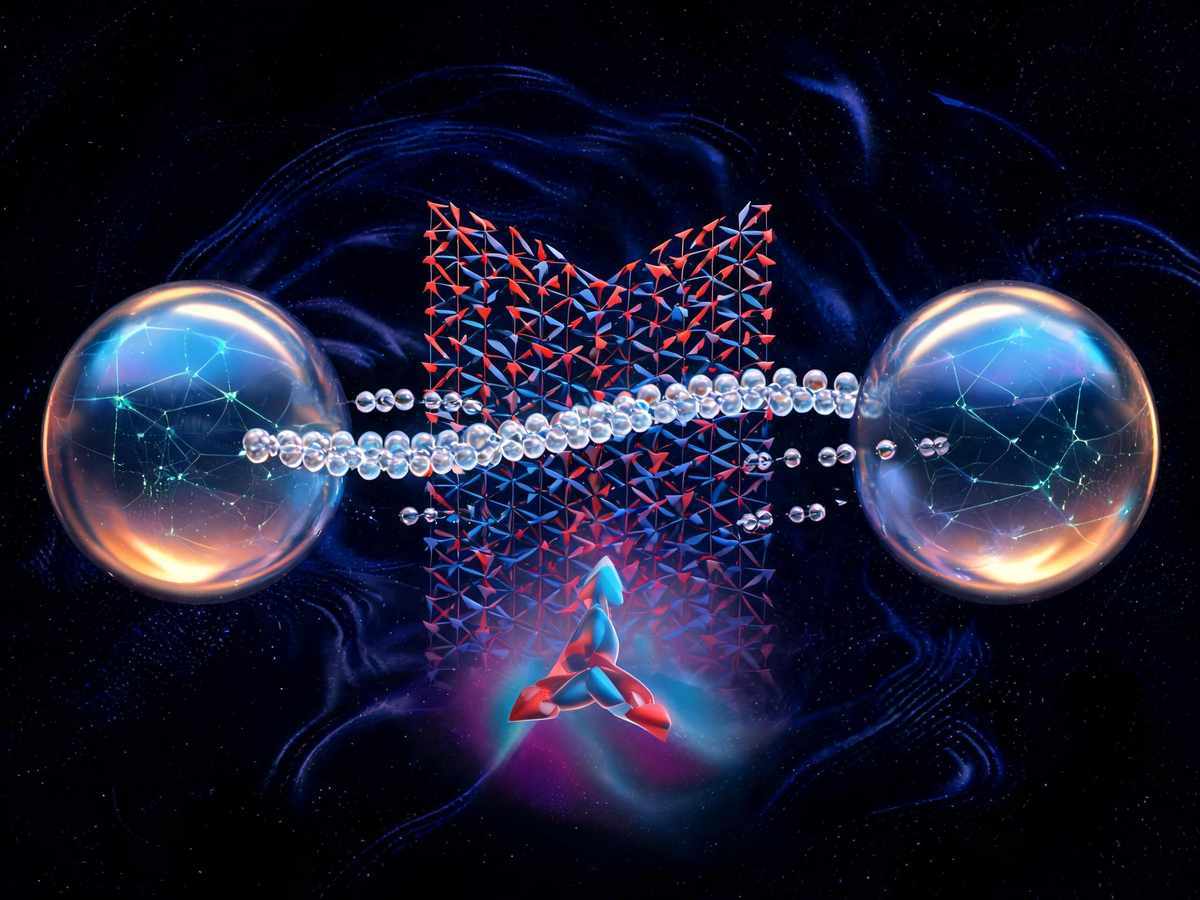
For as long as physicists have studied superconductors, they’ve treated the flow of supercurrent – the resistance-less glide of paired electrons – as a profoundly democratic affair: leftwards and rightwards are treated exactly the same. The copper-oxide planes, the iron-pnictide layers, the ultracold atomic gases – they all seemed content to let their zero-resistance currents run equally well in any direction. Changing that, giving a supercurrent a preferred one-way street, has been a prize pursued with spin‑orbit coupling, the relativistic twist that ties an electron’s motion to its spin. But what if you could get that asymmetry without invoking relativity at all? A new preprint (arXiv:2510.25756) by Grayson R. Frazier and Yi Li at Johns Hopkins University shows that frustrated magnetic textures – spins locked in a communal state of indecision – can teach a supercurrent to flow one way and refuse the other. This is the Josephson diode effect, engineered not by spin‑orbit coupling, but by the sheer quantum geometry of the magnetic barrier itself.
The standard picture is tidy: in a Josephson junction – two superconductors separated by a thin barrier – the supercurrent tunnels through, its magnitude equal for both polarities. To favor one direction, you need to break both inversion symmetry (swapping left and right) and time-reversal symmetry (running the movie backwards). Spin‑orbit coupling can do that, but it is weak, material‑specific, and often complicates the superconducting state. The work of Frazier and Li, however, reveals a different route, and it’s almost embarrassingly simple once you appreciate the inner life of a frustrated magnet.
The twist that loves asymmetry
Spin triplet superconductors – where the electron pairs carry spin one – are described by a “d‑vector,” a little arrow in spin space that encodes the pairing state. When you bring two such superconducting grains close together, their d‑vectors couple, much like two bar magnets trying to align. Normally, this Josephson coupling is Heisenberg‑like: it loves collinear, parallel arrangements, and it treats left‑flowing and right‑flowing supercurrent identically.
But Frazier and Li identified something deeper. When the barrier between the grains is laced with frustrated spins – local moments that cannot all settle into a comfortable parallel or antiparallel arrangement – the tunneling electrons experience an effective exchange field that depends on how those spins are twisted. The mathematics mirrors a famous twist in magnetism itself: the Dzyaloshinskii‑Moriya (DM) interaction, which tilts adjacent spins away from perfect alignment and creates spirals and skyrmions. Here, in the superconducting context, the DM‑like Josephson coupling emerges: it pulls the d‑vectors away from collinearity, breaking inversion symmetry in a way that a simple Heisenberg coupling cannot. Think of it like a pair of compass needles that, instead of settling perfectly north‑south, are forced by the local magnetic texture to point at an angle – and that angle is different for a current flowing left than for a current flowing right.
This symmetry breaking is not a metaphor. It is a direct consequence of the T‑matrix expansion the team employed, a method that tallies up all the ways an electron can scatter off the frustrated spins as it tunnels from one grain to the other. Each scattering event imprints a phase, and when you sum them, the effective hopping between grains becomes direction‑dependent. It’s a quantum puzzle reminiscent of an extra‑hard escape room: the electron’s path is not a simple tunnel, but a sequence of spin‑mediated detours, and the exit sign reads differently depending on which way you entered. This is not willful behavior – just interference, woven into the fabric of the barrier.
The missing ingredient: spin chirality
The DM‑like coupling alone can tilt the d‑vectors, but to get a true diode effect – where the critical supercurrent in one direction differs measurably from the other – you need one more piece: a breaking of time‑reversal symmetry. And here, the frustrated spins offer an elegant gift: spin chirality. If the barrier hosts a noncoplanar arrangement of moments, say, three spins that cannot be drawn on a single plane but instead form a twisted tripod, the product (\chi_{ijk} = \mathbf{s}_i \cdot (\mathbf{s}_j \times \mathbf{s}_k)) is nonzero. This scalar spin chirality acts like a built‑in magnetic handprint, breaking both inversion and time‑reversal simultaneously. An electron traversing such a chiral barrier picks up a Berry phase that discriminates between forward and backward motion. The result is a Josephson diode: (I_c^+) is not equal to (I_c^-), and the supercurrent becomes a one‑way valve.
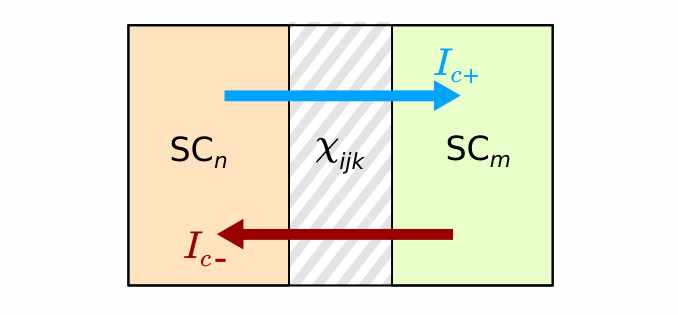
A frustrated magnetic texture in the barrier flips the critical current depending on flow direction. This asymmetry creates a superconducting diode, allowing efficient one-way current. (Source: arXiv:2510.25756)
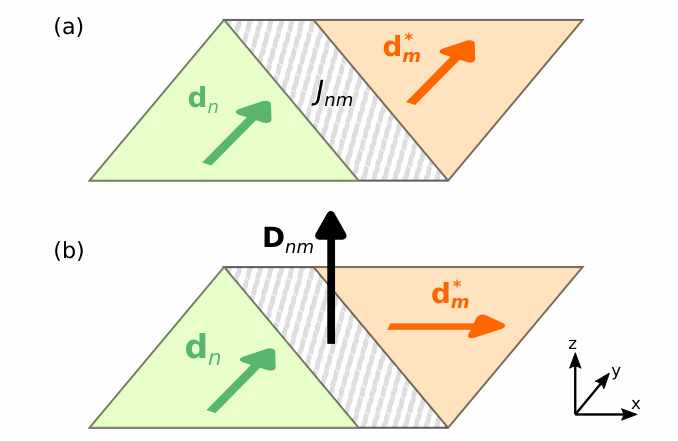
Unlike standard couplings, a chiral magnetic interaction forces the superconducting order into twisted, pliable configurations. This twist enables the Josephson diode effect, where supercurrent flows only in one direction. (Source: arXiv:2510.25756)
This mechanism is fundamentally different from spin‑orbit‑coupled designs. It does not rely on heavy atoms or delicate band inversions, but on the collective geometric frustration of magnetic moments – a property that arises in many lattices, from the kagome to the triangular, where spins simply cannot all satisfy their neighbors. In those materials, a diode effect might be waiting to be uncovered, hiding in the way the spins negotiate their mutual discomfort.
From consensus shift to new openings
The crux of the tale is the switch in understanding from “you need spin‑orbit coupling to break inversion symmetry in a Josephson junction” to “frustrated magnetism alone can alter the way a supercurrent chooses its path.” And while some of the early Josephson diode experiments relied on spin‑orbit active materials, a lot of the design constraints remain today – but now we have a new theoretical lever. The framework Frazier and Li have built suggests that rather than fighting with weak relativistic effects, one can sculpt the magnetic barrier at the atomic scale to engineer the diode directly, using the very geometry of the spin configuration.
There is more. The d‑vector textures that emerge from these DM‑like Josephson couplings are themselves spatially inhomogeneous, a kind of superconducting “pliability” that competes with the superfluid stiffness. This could stabilize new modulated pairing states, where the very nature of the superconducting order – its spin‑triplet symmetry – varies from grain to grain. The T‑matrix approach, by making the tunneling amplitudes depend on the underlying spin arrangements, provides a clean, controllable language to design such textures.
The road ahead, on solid ground
The preprint does not promise a device tomorrow, nor does it sidestep the challenges of measuring such a diode effect in real materials. But the direction is clear. The work reveals that in the interplay of triplet superconductivity and frustrated magnetism, Nature has left a doorway open – one that does not require invoking relativity. Perhaps, when experimentalists design next‑generation Josephson junctions on kagome or triangular lattices, they will not need to worry about spin‑orbit coupling at all. They will simply pattern the spins, and let frustration do the symmetry breaking for them.
What Frazier and Li have done is show us that a supercurrent’s democratic character is not intrinsic. It is a contingent fact, born from collinear thinking. Once the spins refuse to align, the supercurrent learns to choose. And that, in the end, is not a matter of preference – it’s a matter of phase.
References
- Grayson R. Frazier et al., Spatially Inhomogeneous Triplet Pairing Order and Josephson Diode Effect Induced by Frustrated Spin Textures, arXiv:2510.25756