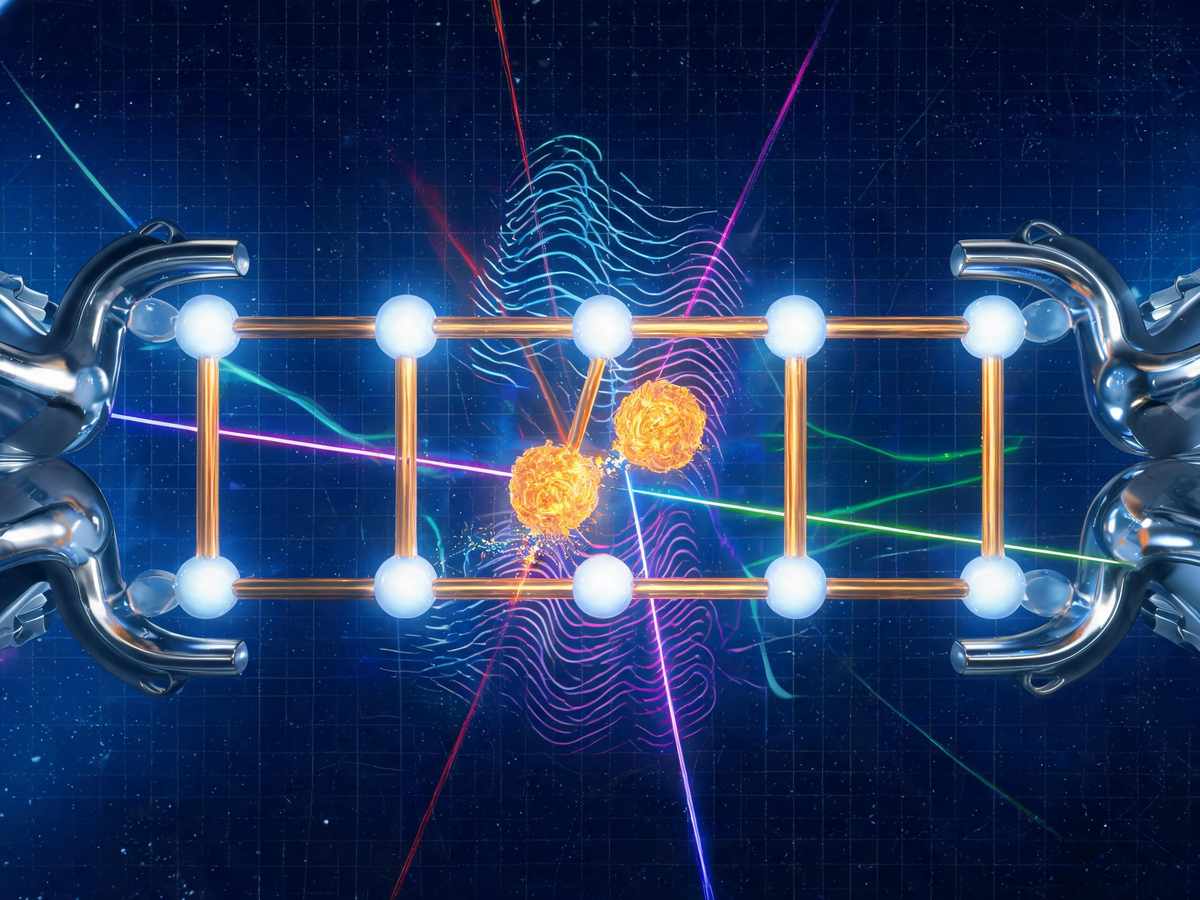
Imagine a prison where the guards are not free to roam, but are shackled in chains that mirror those of the inmates they watch. Every guard wears a chain, and when two guards collide, their chains can snap, setting off a cascade of broken links. This is not a scene from a dystopian novel, but a metaphor for the world inside a proton. The strong nuclear force, which binds quarks together, is itself carried by particles—gluons—that are charged, and thus can interact among themselves. In such a non-abelian gauge theory, the force that holds things together can tear itself apart.
A team led by Manuel John at Universität Innsbruck, collaborating with researchers from the Austrian Academy of Sciences and the Universidad Autónoma de Madrid, has now watched this happen on a tiny scale. In a preprint (arXiv:2605.05841), they report the first quantum simulation of string breaking in a pure SU(2) lattice gauge theory, an achievement that probes dynamics heretofore inaccessible to classical computation.
The problem of confinement has haunted physics for decades. Quarks are never found alone; they cluster into bound states like protons and neutrons, forever tethered by flux tubes that stretch like unbreakable rubber bands. In abelian theories, such as quantum electrodynamics, these strings can only snap if a particle-antiparticle pair pops out of the vacuum to absorb the energy, like a magician pulling a rabbit out of a hat. But in non-abelian theories, the gauge fields themselves carry charge, and this self-interaction allows strings to break even when no dynamical matter is present. It is a subtle, quantum-mechanical phenomenon that classical simulations struggle to compute, because the number of possible states grows exponentially with the system size.
The team’s experiment used a trapped-ion quantum computer, encoding the gauge field degrees of freedom into qudits—quantum digits with up to eight levels—carved from the internal states of individual calcium ions. By engineering the Hamiltonian in a bubble-chain basis, they could directly represent the truncated SU(2) electric fluxes and the non-abelian fusion rules: the mathematical grammar that dictates how flux lines can split or merge. The simulation ran on a ladder geometry with a handful of plaquettes, but the physics it captured was rich.
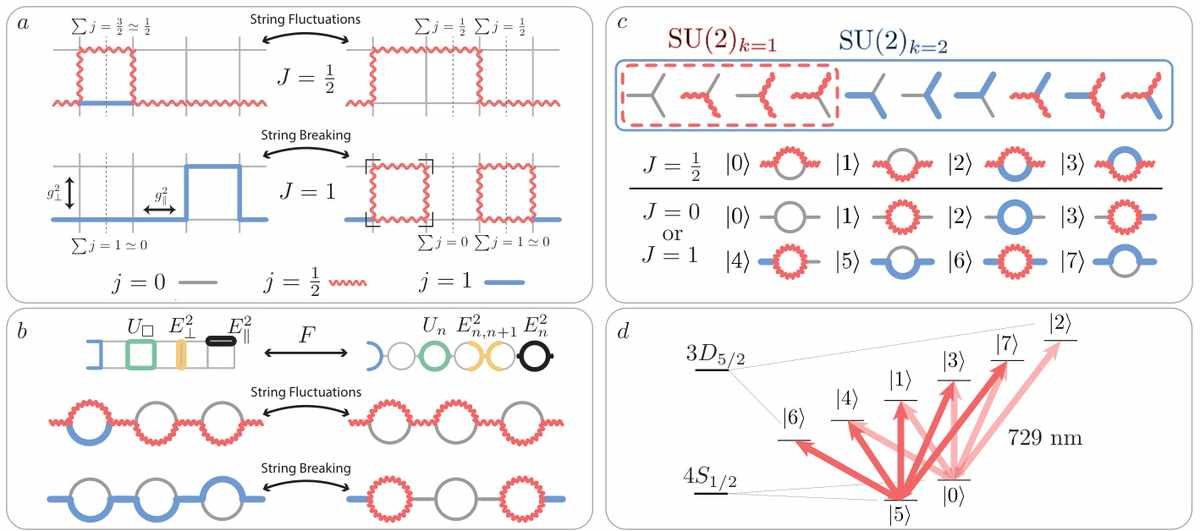
Non-abelian strings break into gluelumps only when the total flux is integer. This shows how qudit quantum computers can simulate the strong nuclear force that binds matter. (Source: arXiv:2605.05841)
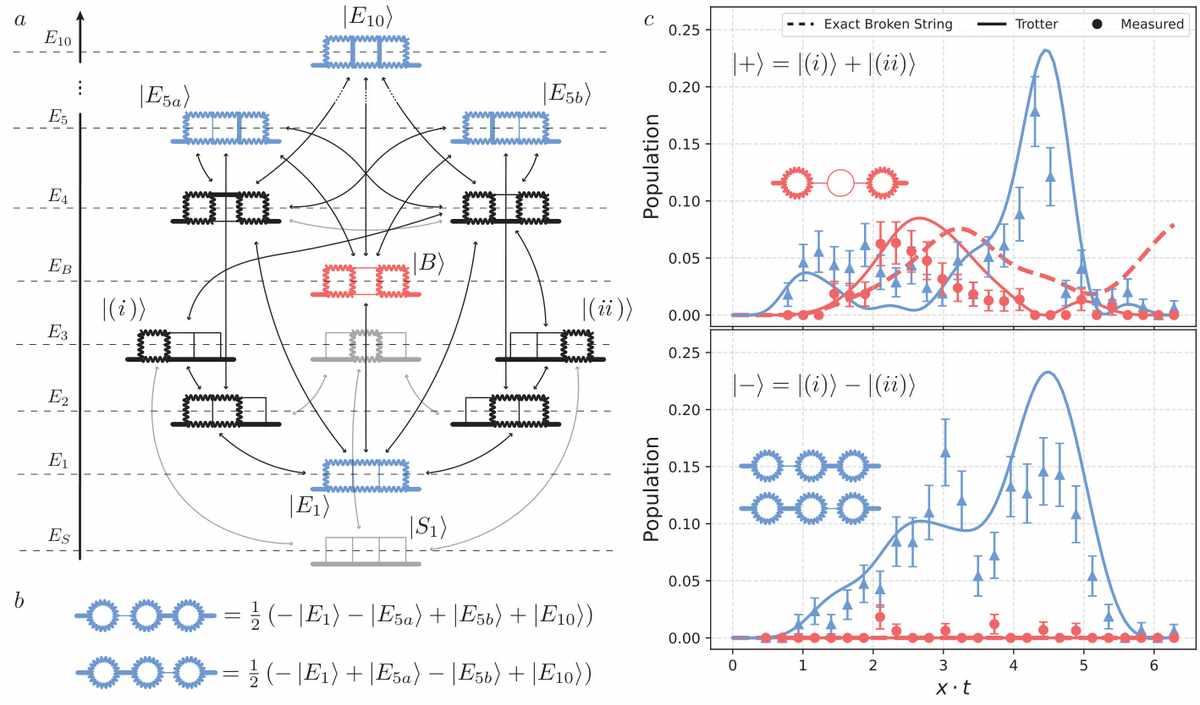
A non-Abelian flux string dynamically breaks into two glueballs through coherent quantum transitions. This first observation of such string breaking on a quantum computer verifies key predictions of non-Abelian gauge theories. (Source: arXiv:2605.05841)
At first glance, the simulation seems straightforward: prepare a state, let it evolve, and measure the outcome. But in a quantum world, the art lies in what you measure and how you interpret the results. The team employed a second-order Suzuki-Trotter decomposition to approximate the continuous time evolution with a sequence of discrete gate operations, each step a careful choreography of laser pulses on the calcium ions. The qudit encoding allowed them to implement multi-level entangling gates directly, avoiding the need to compile the gauge theory into a larger number of qubits—a trick that reduced the error-prone overhead by more than an order of magnitude.
However, Trotterization, like any approximation, accumulates errors that grow with the simulation time, like a clock that loses a second every hour until noon becomes midnight. The team compared their experimental data to exact diagonalization of the truncated model, finding qualitative agreement but quantitative deviations that grew over time. These deviations, they argue, stem partly from experimental noise and partly from the Trotter step size, but also hint at the residual effects of the truncation itself. In a resonance scan, where they varied the ratio of coupling strengths, the experimental peak shifted from the exact theoretical position, a clear sign that the truncated theory and the real hardware conspire to paint a picture that is both faithful and distorted.
To see the physics at work, consider the two sectors they explored. With fundamental static charges, the total flux parity pinned the system into an unbreakable string sector, where the string could oscillate but not snap. Here, they prepared superpositions of different string configurations and observed interference-controlled fluctuations, a delicate ballet of energy flowing between neighboring states. But with adjoint static charges, the parity shifted, and the string could break. The fusion rule ½ ⊗ ½ = 0 ⊕ 1—a rule that is inherently non-abelian—allowed a flux string to fragment into two glueballs, creating broken-string configurations that grew in population over time. By reconstructing the dynamics from a series of measurements, the team watched the breaking process unfold, a first glimpse of a force tearing itself apart.
Yet, as with any prison break, the details matter. The SU(2) gauge theory has infinitely many flux states in the continuum; to fit it into a finite quantum processor, the team truncated to a q-deformed version called SU(2)₂, which retains only the three lowest flux values: j = 0, ½, and 1. This is the smallest truncation that exhibits non-abelian character, but it is a drastic simplification. An important question, sharpened by earlier work on such truncations by González-Cuadra and colleagues, is whether k=2 captures the true dynamics or whether higher angular momentum states, such as j=3/2, would alter the resonance condition for string breaking. In the experiment, the resonance peak was broadened and shifted relative to the exact theory, due in part to Trotter errors and experimental noise, but the qualitative signature—enhanced string breaking near the expected resonance—was clear.
This raises a deeper issue: when we simulate fundamental physics, we are not just performing a calculation; we are constructing a model. The strings that snapped in an Innsbruck ion trap are not the same strings that bind quarks inside a proton, any more than a weather simulation is a real storm. But a faithful simulation can illuminate the essential processes, like a map that captures the contours of a landscape even if it omits every tree. The team’s use of qudits, which compress the required quantum resources, points to a hardware-efficient future, where larger systems may bridge the gap between model and reality.
In a sense, the quantum simulator is a modern-day Plato’s cave: we see only the shadows of the true gauge fields, cast on the wall of a truncated, noisy processor. Yet even shadows carry information, and from them, we can infer the structures that cast them. The team’s ability to distinguish unbreakable from breakable strings, to see interference control the breaking rate, and to map the resonance condition, convinces us that the shadows are not random but are cast by a genuine non-abelian sun.
The achievement also sits in an interesting tension with earlier quantum simulations of gauge theories, which often focused on abelian models or required mapping non-abelian symmetries to auxiliary systems. For instance, recent work on Rydberg atom arrays has explored baryonic excitations in simplified settings, but the intrinsic non-abelian self-interactions remained elusive. By directly encoding the fusion rules in native multi-level ions, the Innsbruck team bypassed many of the overheads that plague qubit-based simulations. However, the truncation remains a sword of Damocles: the k=2 theory may be a qualitative playground, not a quantitative benchmark for continuum physics.
What makes non-abelian string breaking so enticing is that it speaks to the heart of quantum field theory. It is a process driven by vacuum fluctuations, where the zero-point energy of the gauge field creates particles that screen the original charges. In the simulation, the broken-state population peaked at around eight percent, a small but significant signal that relied on coherent superposition. When the team prepared an antisymmetric initial state, destructive interference suppressed the breaking, confirming that the dynamics are not random but rooted in the quantum rules of the fusion algebra. It is a reminder that even the vacuum is not empty but seething with possibility.
From a philosophical standpoint, this work confronts us with the limits of what can be known. The Standard Model is a triumph of human reason, but it leaves many questions unanswered. We cannot calculate the mass of the proton from first principles using classical computers; the sign problem blocks our path. Quantum computers offer a way forward, but they too are finite machines, and every simulation is a compromise between fidelity and feasibility. The Innsbruck experiment is a step, a first stamp in a passport to a land we have barely begun to explore.
The road ahead is clear, even if the exact timeline remains uncertain. To truly simulate non-abelian dynamics, we will need error-corrected quantum processors with many more qudits, and truncation schemes that converge to the continuum limit. The team’s framework is a foundation, not a finished cathedral. Perhaps one day, when physicists want to understand the interior of a neutron star or the earliest moments after the Big Bang, they will run a simulation on a quantum computer that speaks the language of SU(3) QCD directly. For now, we have a glimpse—a fleeting, beautiful image of a force turning upon itself, witnessed in a calcium ion shivering in an electromagnetic trap.
In the end, the string that breaks itself is a metaphor for the act of simulation itself. We model reality with tools that are part of reality, and in doing so, we change the meaning of understanding. The gauge fields on that quantum chip are not the fields of the cosmos, but they are close enough to teach us. And that, perhaps, is the most profound lesson of all: that knowledge emerges not from perfect replication but from the creative act of mapping one domain onto another, finding in the shadows the shapes of the truth.
References
- Manuel John et al., Non-Abelian String-Breaking Dynamics on a Qudit Quantum Computer, arXiv:2605.05841