In classical signal processing, the price of fidelity is measurement. To faithfully reconstruct a signal, you must sample it at a rate at least twice its highest frequency—the famous Nyquist-Shannon theorem, grounded in Claude Shannon's 1948 theory of information. For decades, that was the rule. Then, in 2006, compressed sensing rewrote it: for a signal that is sparse—mostly silent, with only a few active tones—you don’t need nearly so many measurements. A small number of carefully chosen ones can suffice. The catch? A stubborn logarithmic factor, K log(N/K), still tied the measurement count to the signal’s full dimension. The logarithm was a lingering ghost of Nyquist’s old limit. Now, a team led by Suotang Jia at Shanxi University, with Jianyong Hu as the lead author, reports in a preprint (arXiv:2605.15784) a framework that exorcises that ghost entirely—using a single quantum probe.
For Jia and his colleagues, the question was not how to squeeze the log factor with ever more clever algorithms; it was whether quantum physics could re-encode the whole measurement problem so that the logarithm never appears at all. Their answer is quantum compressed sensing (QCS), a paradigm that shifts the labour of signal recovery from the classical computer to a physical quantum evolution.
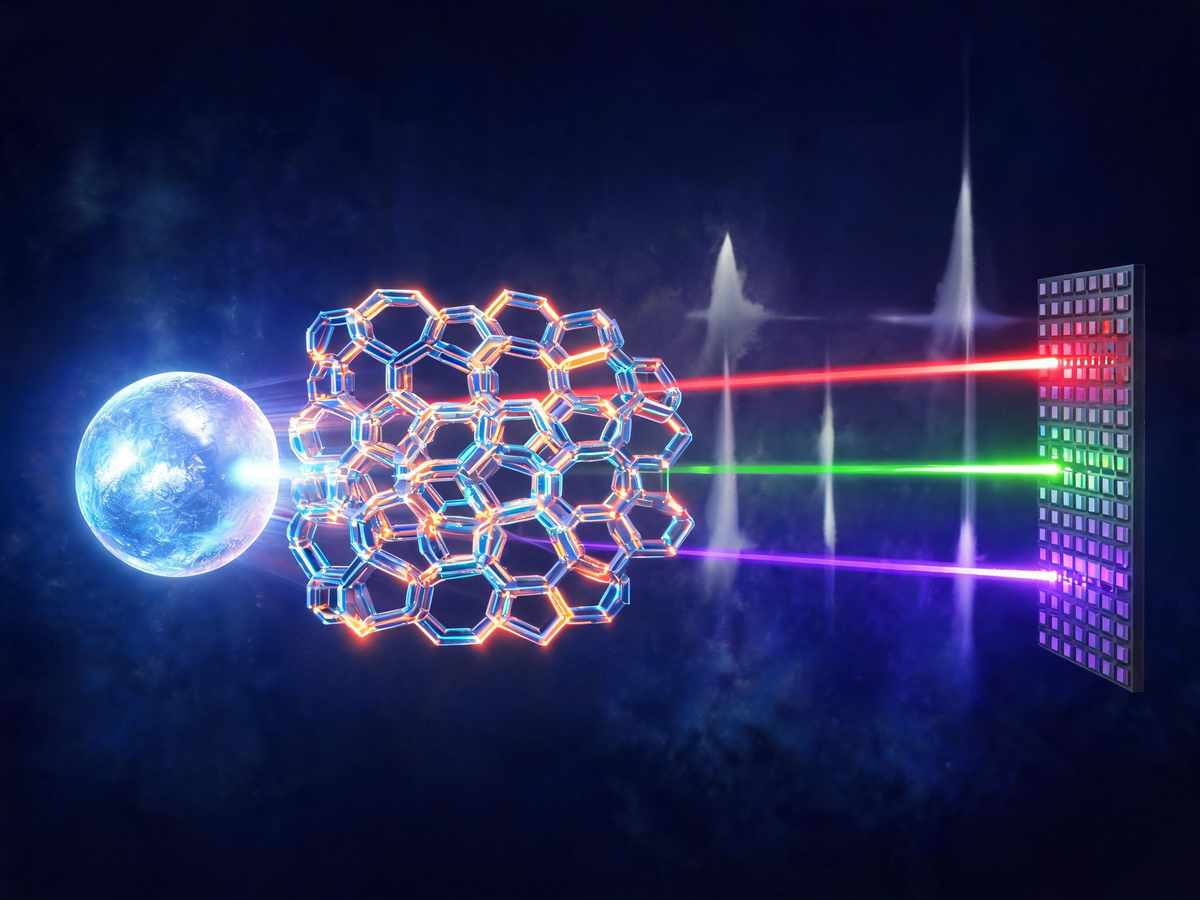
Think of a room full of people whispering in a hundred different languages, but only a handful are actually speaking. A classical sensor must, in effect, ask enough questions to locate those active speakers among the crowd. The Shanxi team’s quantum probe, however, is like a single, exquisitely tuned ear that hears all voices simultaneously. Through a unitary transformation—what they call domain-alignment evolution—the probe projects the sparse structure directly onto a set of detectors, each sensitive to exactly one active “voice.” No scanning, no guesswork. This is not mere parallelism; it is a reshaping of the information before a single measurement click. The quantum state encodes the entire high-dimensional signal, and the unitary evolution aligns the sparse basis with the measurement basis. The result: the support set—the list of which components are non-zero—appears at the quantum level, with no measurement trials wasted.
The key insight, the one that makes the logarithm vanish, is that the evolution is tailored to the domain in which the signal is sparse. If the signal is sparse in frequency, the unitary is a time lens that maps each frequency component to a distinct photon arrival time. If it is sparse in time, the unitary encodes temporal structure into quantum correlations. In both cases, the measurement no longer probes raw signal values but directly reveals the active sparse components. The price per component is one measurement unit, not one scaled by the logarithm of the dimension.
The team validated QCS first with frequency-domain sparse signals. They injected a single pure tone at 16.2 GHz into their photonic setup: the QCS scheme recovered its frequency and amplitude without error. Scaling up, they fed in a signal containing 830 distinct frequency components spread over a bandwidth of 8.3 GHz—a dense spectral forest. Again, the reconstruction remained accurate. The identification of which tones were present did not degrade as the total bandwidth grew; the measurement count depended only on the number of active tones, not on how many empty slots existed between them.
The real test came in the time domain, with signals of astronomical length. The team worked with sequences containing roughly a million samples—an information landscape far too vast for naive sampling. There, they watched the measurement count M march upward only linearly with the sparsity K, completely decoupled from the gargantuan signal dimension N. The classical compressed-sensing lower bound of K log(N/K) would have demanded thousands of measurements for such a long array, yet QCS succeeded with just a few dozen shots. The error fell to parts per million, confirming that the quantum protocol delivers not only minimal measurement numbers but also high fidelity.
Where does the advantage come from? An earlier preprint by some of the same authors (Jia et al., arXiv:2604.25480) had already shown that quantum compressed sensing could classify images using a single photon. That prototype, however, drew part of its power from adaptive sampling—a strategy that is, in principle, available classically. The new work generalises the framework and isolates the genuinely quantum ingredient: the domain-alignment evolution, a unitary that physically transforms the measurement basis. It is this physical step, not a clever choice of which questions to ask, that erases the logarithmic penalty.
There is, of course, an important subtlety. The experimental scaling hovered around M ≈ 2K, not the idealised lower bound of exactly K. A factor of two is a harmless constant—it does not reintroduce any dependence on N—but it invites the question whether improved quantum control, perhaps using squeezed probe states or photon-number-resolved detection, could press the measurement count all the way down to K. The team acknowledges that the gap is an engineering target, not a fundamental barrier. In the language of compressed sensing, the constant is the cost of imperfect measurement resolution; with enough quantum finesse, it may become arbitrarily close to one.
The implications ripple across sensing, imaging, and communication. A spectrometer that identifies chemical traces with a handful of photon counts. A camera that reconstructs a scene from light that arrived as a quantum probe. A lidar system that maps the world without scanning every pixel. All are now nearer because the logarithmic overhead is gone.
At the heart of the result lies a profound shift in perspective. Shannon’s theory gave us the fundamental limits of information; compressed sensing bent those limits with the cleverness of algorithms. Quantum compressed sensing now steps outside the algorithm box entirely, showing that measurement itself—the physical act of coupling a sensor to a signal—can be engineered at the quantum level to extract information with ultimate efficiency. The logarithm does not vanish because we compute faster; it vanishes because the laws of quantum mechanics allow us to encode and transform the signal in ways no classical sensor can. It is not merely a new technique; it is a new way of thinking about what a sensor can be.
Editorial Note: The critical analysis in this article was informed by a structured review of related work cited by the paper’s authors. No independent experts were interviewed.
References
- Jianyong Hu et al., Quantum compressed sensing, arXiv:2605.15784
- Jia et al., Quantum Compressed Sensing Enables Image Classification with a Single Photon, arXiv:2604.25480