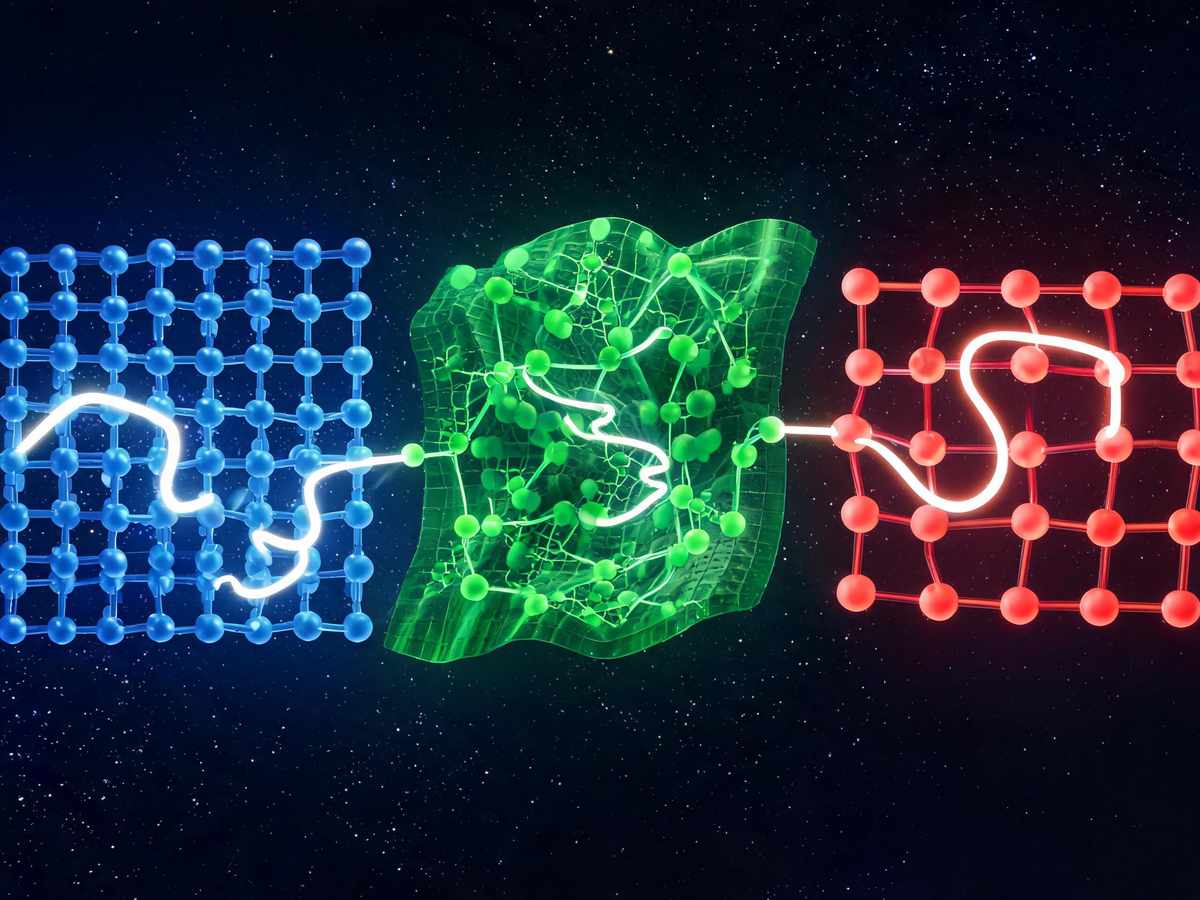
The great promise of quantum sensors is that they can measure the world with a precision no classical instrument can match. By weaving delicate threads of entanglement through a system of spins, physicists have learned to “squeeze” uncertainty — shrinking the noise in one observable at the expense of another, pushing past the standard quantum limit that would otherwise hold every measurement hostage. It is a trick that underpins the most sensitive atomic clocks, magnetometers, and interferometers ever built. But there is a catch. The quantum correlations that enable this wizardry are famously fragile; the slightest imperfection — a missing coupling, a noisy neighbour, an awkwardly shaped lattice — can unravel them before any useful squeezing takes hold.
For decades, the instinct has been to fight imperfection with more control: cooler temperatures, better shielding, more homogeneous interactions. Yet a preprint (arXiv:2605.03032) from a team led by Andrea Solfanelli at the Max Planck Institute for the Physics of Complex Systems — working with Augusto Smerzi, Peter Zoller, and Nicolò Defenu across institutions in Italy, Austria, and Switzerland — suggests we may have been asking the wrong question. What if the real bottleneck is not noise per se, but the very shape of the network on which the spins sit? What if, hidden in the tangle of connections, there is a single number that decides — with ironclad universality — whether scalable squeezing is even possible?
Geometry, they argue, is destiny. And the invisible judge is something called the spectral dimension.
The Wrong Question
Regular readers will know that one-neatly-summarised spin squeezing has often been understood through a toy model known as one-axis twisting, or OAT for short. In that framework, every spin talks to every other spin with equal strength, producing a collective, all-to-all quantum ballet that squeezes beautifully. The OAT model is a theorist’s delight — exactly solvable, rich in intuition, and a reliable compass for designing sensors. The problem, of course, is that the real world doesn’t look like a perfectly connected cocktail party. In trapped ion chains, Rydberg atom arrays, or networks of nitrogen-vacancy centres, the interaction graph is lumpy, site-diluted, and full of missing edges. Does squeezing survive in such inhomogeneous terrain?
It is tempting to treat the imperfections as a nuisance to be overcome by brute-force engineering. Solfanelli and colleagues, however, flipped the perspective. Instead of asking “how much noise can we eliminate?”, they asked: “what does the network’s connectivity actually permit?” Their answer draws on a concept borrowed from condensed matter physics and the theory of random walks: the spectral dimension, a number that captures how the graph “feels” to a particle wandering across it.
Think of a photon set loose on a spiderweb of connections. If the web is dense enough — like a three-dimensional tangle of fibres — the photon will wander far and rarely return to its starting point. The spectral dimension ds, in this case, exceeds 3. This is the mean-field world, where OAT-like squeezing reigns supreme: the collective zero mode dominates, and spin-wave excitations are irrelevant on the timescale of optimal squeezing. In short, the network is effectively infinite — and the squeezing scales ever larger with system size.
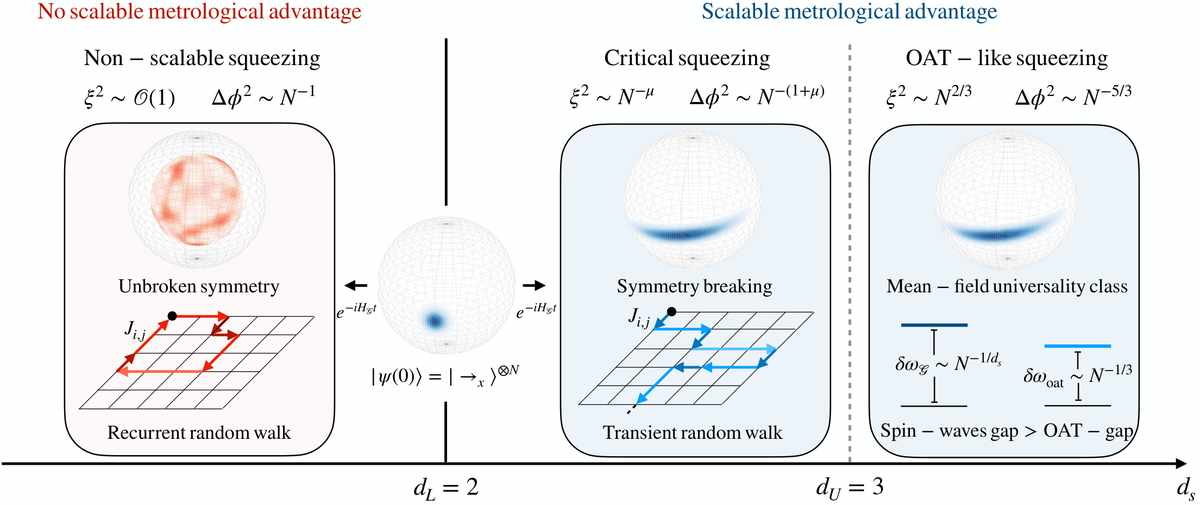
The spectral dimension of a quantum network must be greater than 2 for scalable spin squeezing. This identifies which network geometries can achieve quantum-enhanced measurements beyond standard limits. (Source: arXiv:2605.03032)
Now imagine a web that is sparser — a crumpled sheet that is more than a line but less than a plane. The photon can still escape, but with greater effort. Here, 2 < ds < 3. This is where the story gets dramatic. In this intermediate regime, the random walk is transient — the photon doesn’t inevitably come home — and the network can support a phase transition: the spontaneous emergence of xy-ferromagnetic order. Squeezing, in this setting, becomes critical. It blossoms near the symmetry breaking point like a resonance tuned to the edge of catastrophe. The squeezing parameter plunges, the metrological gain soars, but only if the network is perched precisely on the threshold where long-range order becomes possible.
Finally, picture a web so threadbare it is essentially a one-dimensional thread. The photon keeps returning; order cannot take hold. This is ds < 2 — the realm of recurrent random walks and disordered phases. Here, no amount of cooling or control can summon scalable squeezing. The geometry itself forbids it.
The Dimensions of the Possible
What makes this vision so powerful is its universality. The spectral dimension is not some esoteric detail of a particular experimental apparatus; it is an emergent, coarse-grained property that can be computed from the graph’s Laplacian — the matrix that encodes how nodes connect. The team shows that the entire physics of spin squeezing in an arbitrary inhomogeneous network collapses onto this single index, organising the behaviour into three clean universality classes.
For ds > 3, the mean-field class, the squeezing works like OAT — a textbook case of collective enhancement. For 2 < ds < 3, the critical class, squeezing hinges on a conspiracy between the spectral gap and the anisotropy that drives the ferromagnetic transition. And for ds < 2, the absence of long-range order renders any hope of beating the standard quantum limit futile.
But this geometry-driven verdict comes with a sharp asterisk. Even if ds lies in the favourable territory, there is an additional prerequisite: the network must possess a giant percolating cluster — a connected backbone that spans the system. If too many links are broken, the graph fractures into isolated islands, and the whole argument collapses. The necessary condition is percolation; the sufficient condition is the spectral dimension together with the symmetry breaking order. The interplay between percolation universality and xy-ferromagnetic universality is the hidden engine that determines the scaling of the squeezing critical point.
In practice, this means that for a site-diluted long-range lattice — exactly the kind of structure realised in many quantum simulation platforms — one can predict precisely how much dilution the system can tolerate before squeezing disappears. The team maps out phase diagrams as functions of the interaction exponent alpha, the anisotropy Delta, and the bond probability C. They find that when the network is pushed to the percolation threshold, scalable squeezing retreats to a razor-thin window near the Heisenberg point — a warning that experimentalists ignore at their peril.
A Diagram for Every Platform
The versatility of the framework is breathtaking. The researchers apply it to three broad classes of systems: long-range interacting lattices with randomly removed sites (the realistic scenario for trapped ions and Rydberg atom arrays); engineered graph geometries whose connections are deliberately patterned (think programmable networks inside optical cavities); and networks with spatially correlated disorder, such as those arising from distance-dependent gate errors in digital quantum simulators. In each case, the spectral dimension and the percolation criterion provide a unifying lens.
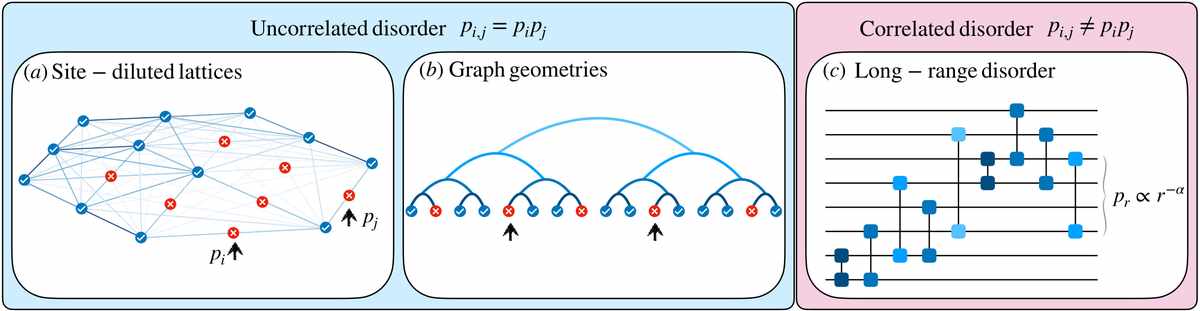
Spin-squeezing withstands three classes of real-world imperfections in quantum networks. This robustness makes quantum sensors feasible despite experimental flaws. (Source: arXiv:2605.03032)
Consider a one-dimensional chain with power-law decaying interactions. For an interaction exponent alpha of 1.2 in a diluted one-dimensional lattice, the spectral dimension reaches 10 — deep in the mean-field regime. Here, even a 20% dilution barely dents the squeezing: the optimal squeezing parameter drops steadily as the system size increases, and the dynamics closely track the OAT benchmark, adjusted for the effective system size. By contrast, for alpha equal to 2.8, the spectral dimension plummets to roughly 1.1, below the critical threshold of 2. No scalable squeezing emerges, regardless of how pristine the remaining bonds are. The network’s shape, once again, overrules all.
In the intermediate alpha range, where ds hovers between 2 and 3, the team observes the signature of critical squeezing: a sudden plunge of the squeezing parameter near the transition, accompanied by the emergence of a finite xy-magnetisation. The disorder, far from being an enemy, becomes a tuning knob — by adjusting the bond probability, one can steer the system toward the sweet spot where the geometry just barely permits order, and the squeezing becomes exquisitely sensitive.
This is not the story of a perfectly ordered crystal. It is the story of a broken, messy network that, against all intuition, knows how to squeeze better than its clean siblings — provided it walks the tightrope of the percolation threshold.
The Geometry That Speaks
What does it mean, really, for a network’s shape to dictate quantum advantage? The philosophical resonance runs deep. For a century, physicists have treated geometry as a passive stage — the fixed background on which the actors perform. General relativity taught us that spacetime itself is dynamical, but even there, the feedback is gravitational, not quantum-informational. Here, in the unassuming setting of spin ensembles, geometry emerges as an active governor of entanglement. The spectral dimension is not a mere descriptor of the graph; it is a law of permission. It says to the squeezing operator: you may scale, or you may not, with the calm finality of a thermodynamic limit.
This is not will, but how networks encode possibility. If the spectral dimension falls below 2, the universe of that network cannot sustain the long-range correlations that squeezing demands — much as a one-dimensional system at finite temperature cannot sustain ferromagnetism. It is a geometrical veto power, a cosmic zoning ordinance.
The team’s findings also challenge a deeply held assumption in quantum metrology: that the path to enhanced sensing runs through ever-more-perfect isolation from the environment. The critical squeezing regime, by contrast, thrives on structured imperfection — a network that is neither too connected nor too broken, but poised precisely at the brink. In this sense, the work aligns with a broader modern theme: that complexity, far from being an adversary, can be the crucible in which new quantum functionalities are forged.
The Road Ahead
What this research ultimately shows is that no amount of experimental finesse can overturn what the geometry forbids. But the converse is equally hopeful: if the network’s spectral dimension lies in the right window, robust, scalable squeezing is achievable even in the presence of substantial disorder. The conditions are sharp, universal, and experimentally testable. One can envisage a new design principle for quantum sensors: not “eliminate every defect,” but “engineer the spectral dimension to be larger than 2, and tune the percolation into the safe zone.”
Critics might argue that the spectral dimension is an abstract, asymptotic concept, hard to intuit and harder to measure in a noisy lab. Yet the team provides concrete recipes — based on the graph Laplacian gap, the random-walk return probability, and the spin-wave spectrum — that can be extracted from numerical simulations or even, in some platforms, from spectroscopic data. The bridge from mathematical universality to experimental guidance is under construction.
Perhaps one day, when experimentalists design next-generation ion traps or Rydberg arrays, they will consult a phase diagram whose axes are not temperature and magnetic field, but spectral dimension and percolation probability. And they will arrange their atoms — not to be as uniform as possible, but to hit that delicate, critical geometry where squeezing flourishes. The quantum world, it seems, has a hidden blueprint, and it is written in the very shape of the connections that bind its smallest constituents.
References
- Andrea Solfanelli et al., Robust spin-squeezing on quantum networks: the lesson from universality, arXiv:2605.03032