What does it mean for a quantum system to forget — not just lose track of individual facts, but systematically erase the topological scar that defined it at birth? For decades, physicists have studied how many-body systems thermalize by measuring the explosive growth of entanglement after a sudden change, or quench. But a new protocol, the crosscap quench, invites a stranger question: what if the initial state was already fundamentally alien — a quantum web woven not on ordinary space, but on a surface that refuses to be oriented, like a Klein bottle? In a recent preprint (arXiv:2412.18610), Zixia Wei at Harvard University and Yasushi Yoneta at RIKEN propose exactly this: a quench from a crosscap boundary condition, where the system’s points are paired as antipodes, to watch how entanglement unfurls and, perhaps, learns to forget.
The crosscap state is a thermal pure state born of topology rather than temperature. Picture a Klein bottle — a surface where a loop that travels straight ends up on the other side, reversed in orientation, because opposite points have been identified. The quantum version of this twist creates an entangled-antipodal-pair state, in which any bipartite cut yields nearly maximal entanglement. The quench removes the constraint, letting the system evolve unitarily; not unlike a sprung trap, though the trap is only a mathematical correlation. What follows is a dance of conversion, where one kind of entanglement morphs into another.
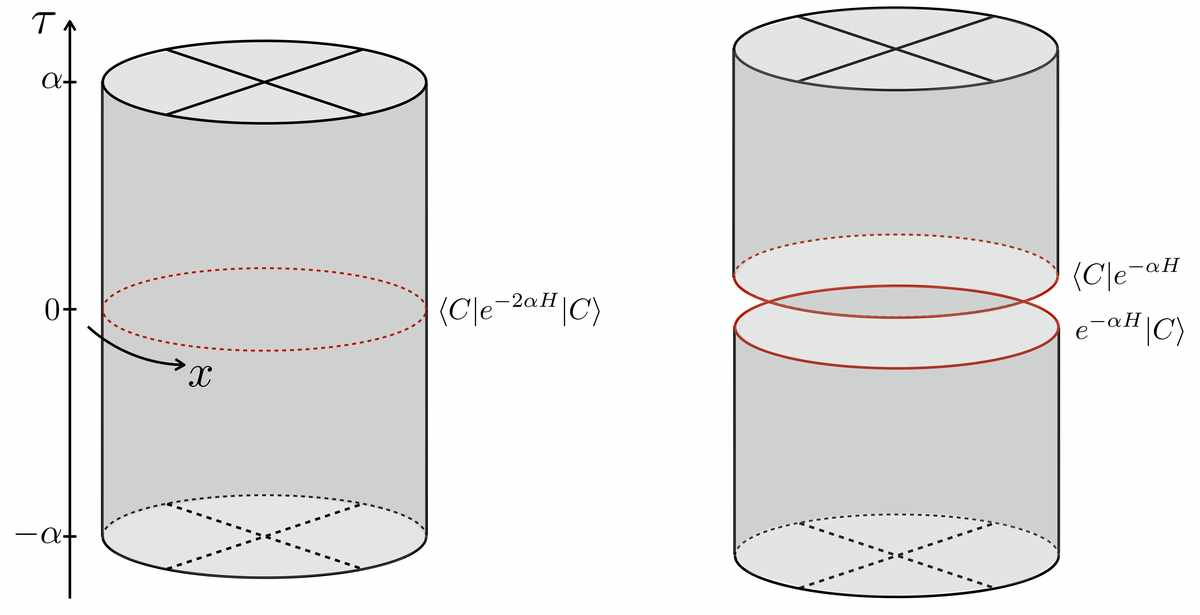
A Klein bottle splits into two matching halves, each representing a quantum state. This shape reveals how entanglement grows after a sudden change, connecting geometry to information flow. (Source: arXiv:2412.18610)
Wei and Yoneta then calculate the time evolution of the entanglement entropy for various subsystems using conformal field theory (CFT). The signature result is striking: for spatial intervals that respect the antipodal pairing — that is, intervals chosen symmetrically on opposite halves — the entanglement entropy grows linearly in time, at a rate that does not depend on the interval size. This is reminiscent of the ballistic spread of entanglement after a global quench, but here the crosscap geometry imposes a universal rigidity. The team also verified the pattern in numerical simulations of critical spin chains, including the Heisenberg model with next-nearest-neighbor interactions and the transverse-field Ising chain. For antipodal double intervals, the linear growth is unmistakable, though single intervals behave differently.
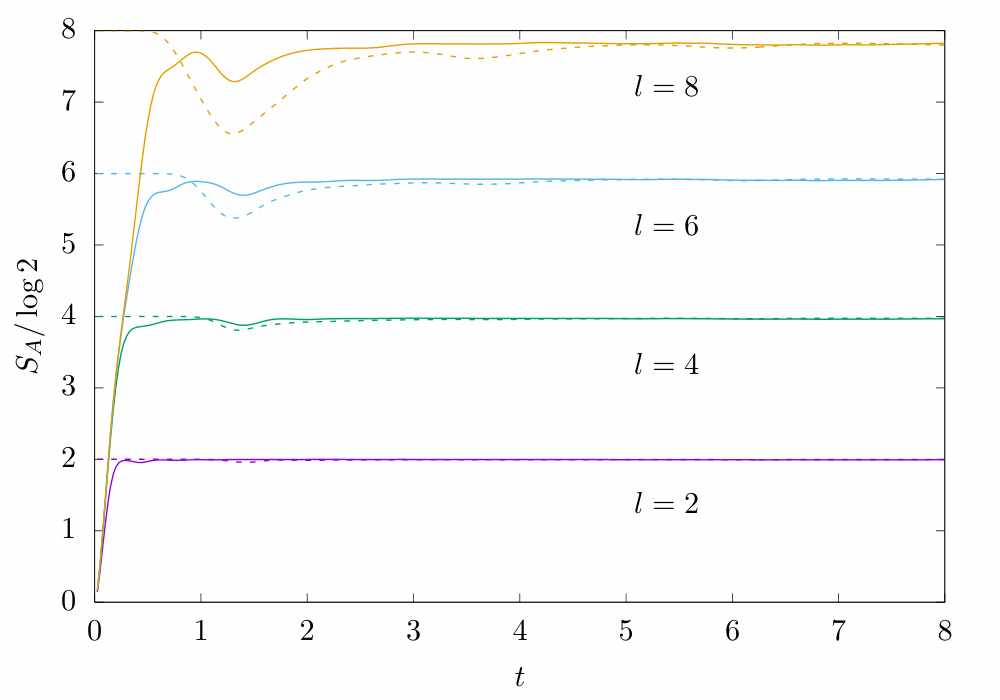
Entanglement grows steadily over time, but spreads more slowly between two opposite regions than within a single uninterrupted block. This difference shows how quantum information travels after a sudden disturbance, helping scientists design better quantum devices. (Source: arXiv:2412.18610)
For a physicist accustomed to watching entanglement balloon after a quench, the crosscap quench offers a twist: the initial state is already fully entangled, but with a topological flavour. The subsequent growth isn’t the arrival of entanglement but its metamorphosis. Entanglement, of course, does not literally dance or change clothing; these are only human words for the way quantum correlations reorganize themselves — but the metaphor points to something real: the linear ramp tracks how fast the system sheds its crosscap memory.
Yet here the picture begins to blur. An important question raised by earlier work — notably by Lap and colleagues in their study of double-splitting quenches — is how robust such universal linear growth really is. The CFT derivation assumes that the vacuum block dominates the operator product expansion at all times, ensuring a simple, scale‑invariant answer. However, as Wei and Yoneta themselves acknowledge, this assumption can fail when subleading operators become significant, especially at early times or for small subsystems. In their spin‑chain numerics, the linear growth is not flawless: the curves show wiggles and a slight curvature, revealing that reality is messier than the idealized CFT picture.
The novelty of the crosscap quench also overlaps with a broader family of boundary-state quenches. The crosscap state is, in a precise sense, a double cover of a boundary state on a torus. Chalas and colleagues, for instance, have studied entanglement evolution from crosscap states in quantum circuit models and integrable fermion chains, revealing deviations from simple linear behaviour in certain regimes. The Harvard team’s results therefore sit in a productive tension with these earlier findings — not a contradiction, but a signal that the universality may have subtle exceptions that are worth chasing down.
Enter holography. When the CFT is strongly coupled and has a gravitational dual (AdS/CFT), the crosscap state translates into a specific folded spacetime — an RP² geon geometry — that encodes the antipodal identifications. The quench then becomes a gravitational process: the spacetime relaxes, sending ripples across the bulk.
The linear growth of entanglement entropy on the boundary is mirrored by the stretching of a minimal surface deep inside the geometry — a striking manifestation of the Ryu‑Takayanagi formula. In this dual language, forgetting becomes the smoothing of a geometric crease. Of course, the bulk spacetime does not literally forget; the crease smoothing is a purely gravitational process, yet the geometric language makes the underlying information‑theoretic process tangible. The beauty of this correspondence is that it turns an abstract quantum information problem into a problem of pure geometry, where entanglement is literally the area of a surface that knows nothing about the orientation of the original state.
Yet even this duality, for all its elegance, does not erase the open questions. Wei’s earlier holographic analysis of the crosscap state provided a geometric dual, but translating the full quench dynamics into a precise bulk solution remains a challenge. The match between CFT and holography is qualitative, not quantitative, and the assumption of vacuum block dominance reappears in the bulk as a question about whether the geon geometry is indeed the dominant saddle.
So where does that leave us? The crosscap quench is a new instrument for probing the boundary between universal and particular in many‑body quantum dynamics. Its strength lies in the elegant mapping of topological constraints to entanglement growth, and in the bridge it builds between CFT, holographic intuition, and down‑to‑earth numerics. Its weaknesses are precisely the gaps it opens: how universal is the linear growth? Under what conditions does the vacuum block dominate? Can one engineer a crosscap state in an actual quantum simulator? These are not signs of failure, but of a fertile beginning.
The crosscap quench, then, is not a final answer but a new question carved into the fabric of quantum theory. It invites us to rethink what it means to forget — not as a loss of information, but as a transformation so thorough that the memory of the original state becomes indistinguishable from the geometry of the space that contained it. And in that transformation, perhaps, we glimpse something essential about the quantum world: that the deepest memories are not stored in individual parts, but in the entangling weave that connects them, and that even forgetting has a topology of its own.
References
- Zixia Wei et al., Crosscap Quenches and Entanglement Evolution, arXiv:2412.18610
- Lap et al., Two Splits, Three Ways: Advances in Double Splitting Quenches, arXiv:2403.02165
- Zixia Wei, Holographic Dual of Crosscap Conformal Field Theory, arXiv:2405.03755
- Chalas et al., Quench dynamics of entanglement from crosscap states, arXiv:2412.04187