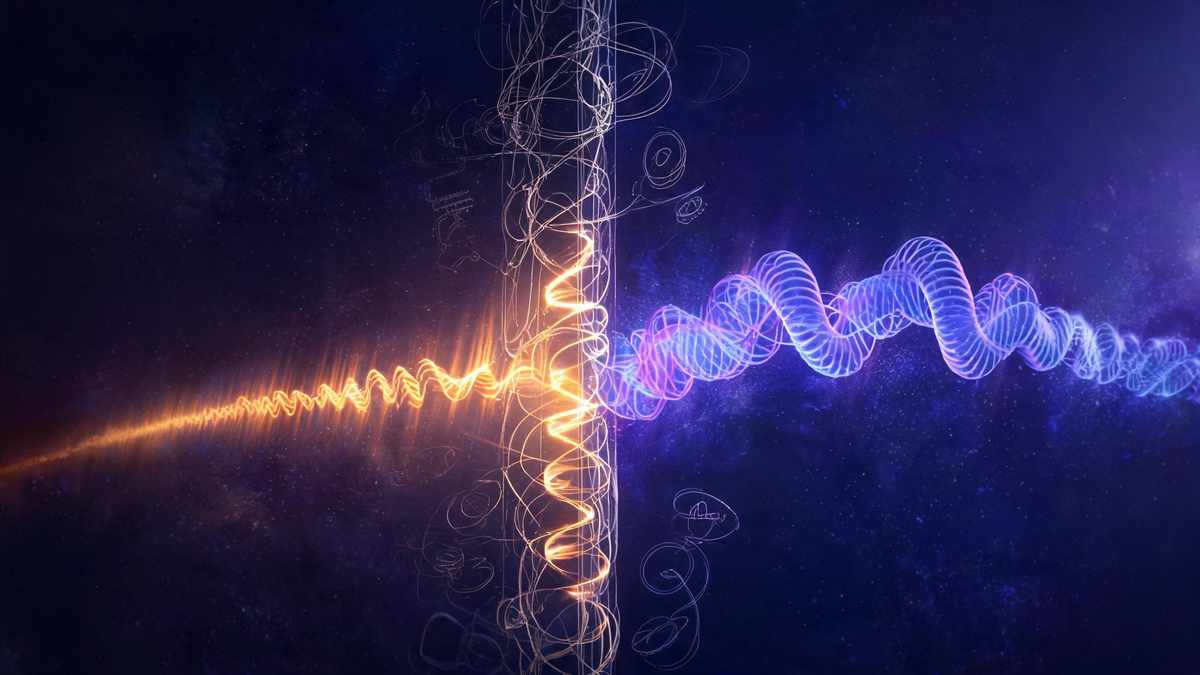
A preprint unveils a gapless photon that hugs an invisible topological boundary, travelling only one way, even though the material on both sides is ordinary vacuum.
22 May 2026, Yanjiang
A single topological twist in the vacuum traps light as a one-way surface wave, even though the material on both sides is empty space.
For a century we have known that light travelling through empty space cannot form surface-bound modes — the kind that hug metal wires or slide along the interface between glass and air. Surface modes demand a material contrast: something on one side different from the other. Or so the textbooks say. In a surprising new preprint, Nemanja Kaloper shows that a single topological ingredient — a Chern‑Simons term — lets vacuum itself host a chiral surface wave that moves relentlessly in one direction, even though nothing material differs across the interface (arXiv:2605.21577). The wave is gapless, its speed is strictly less than the speed of light — set solely by the strength of the Chern‑Simons jump — and it insists on carrying only one of light's two possible handednesses.
Think of a city whose streets have no signage, but where every car must obey a hidden traffic rule: only those whose engines rotate clockwise may proceed, and they may drive east — never west. A driver who tries to go west finds that the road simply does not exist. This is roughly the condition Kaloper places on photons at a Chern‑Simons interface. On both sides of the boundary the physics is ordinary Maxwell electrodynamics — no plates, no wires, no exotic dielectrics. Yet precisely at the interface, a term borrowed from topological field theory — the Chern‑Simons interaction — acts with opposite sign on the two circular polarisation states. One helicity sees a normal vacuum and can radiate away; the other helicity finds itself trapped, bound to the boundary and propagating with an unshakeable sense of direction. The mathematics behind this one‑way rule is as clean as it is unsettling. Unlike traffic, which obeys human conventions, the photon’s asymmetry follows from a purely geometrical term that treats the two polarisations with opposite signs. The result is not a slight preference but a hard exclusion: only one normalisable mode survives.
The calculation itself is an exercise in boundary‑value elegance. Kaloper starts with Maxwell’s equations supplemented by a Chern‑Simons interaction that changes sign at a planar interface — a step‑function in a coefficient usually associated with topology. Solving for wave solutions yields two candidate profiles on each side. For one helicity, the combination results in a wave that decays exponentially away from the interface while propagating along it with a linear dispersion relation omega = v|k|, where the speed v is less than the speed of light and fixed by the interface's topological charge. For the other helicity, no such localised solution exists; the wave either leaks to infinity or fails to satisfy the matching conditions. The surviving one‑way channel is a “surface photon” that has never appeared in electromagnetism textbooks. And it works without any ambient material response.
This last point is what snags the imagination. Surface plasmons, optical Tamm states, Dyakonov waves — all require a contrast in permittivity or permeability. Here the only contrast is in a topological term, a piece of the action that contributes a total derivative in the bulk but leaves a mark at boundaries. The boundary itself has no thickness, no conductivity, no atoms. It is a purely mathematical demarcation: here the Chern‑Simons term is a, there it is b, and the difference does all the work. In that sense the interface is made only of differences, a kind of topological watermark on the vacuum. The gapless photon that rides it is therefore as close to a ghost as a Maxwell wave can get — real and calculable, yet suspended on nothing.
What physical system could actually host such an interface? The sharp step is a convenient idealisation, and Kaloper is careful to work out what it yields. But in any realistic setting the Chern‑Simons term would arise dynamically — from an axion‑like scalar field, for instance — whose value would vary smoothly across space. An important question raised by earlier work on dark domain walls (arXiv:2602.03933) is whether the scalar dynamics would wash out the surface mode. In that study, Kaloper himself examined how an axion field couples to electromagnetism across a domain wall, finding that the effective induced current depends on the scalar profile. A smooth, finite‑thickness transition could broaden or even eliminate the bound state, because the differential chirality would be spread over a region rather than collapsed into a zero‑width boundary. The existence of the surface photon, then, is sensitive to how abruptly the topological coefficient changes — a characteristic that may be difficult to engineer and harder to measure.
And yet, if such an interface could be realised or if it occurred naturally on cosmological scales, the consequences would be striking. This result sits in an interesting tension with the findings of Kaloper’s other parallel preprint on CMB birefringence from vacuum interfaces (arXiv:2605.11065). There, Chern‑Simons boundaries between vacuum regions were shown to rotate the polarisation plane of passing cosmic microwave background photons by a frequency‑independent angle — a signature that current and upcoming CMB experiments are actively hunting. The surface photon studied in the new paper does not yet connect to that observable, nor does it clarify whether the one‑way mode could be excited by ambient radiation and produce a detectable signal. Bridging the gap between mathematical existence and empirical fingerprint remains an open, and pressing, problem.
What the paper does achieve, however, is a kind of conceptual excavation. It reminds us that vacuum is not a featureless void but a stage on which topological distinctions can play the role of material boundaries. A Chern‑Simons interface is, in effect, a boundary between two topological vacua — two regions of space that differ only in a parameter that has no local energetic consequence, yet still reshapes the electromagnetic spectrum. The one‑way photon is the herald of that hidden structure, telling us that light can be steered by something more abstract than glass or metal: by the pure geometry of field configurations.
Historically, physics has learned to distrust the simple idea of an “empty” vessel. The quantum vacuum seethes with virtual particles; the gravitational vacuum bends spacetime; the topological vacuum supports invariants that govern exotic phases of matter. Kaloper’s analysis adds a new chapter to this narrative, showing that even the classical Maxwell vacuum, when tinted by topology, can support a novel species of wave. The surface photon is gapless, massless, and chiral — traits normally associated with edge states in condensed‑matter systems where the bulk is insulating. Here the bulk is literally nothing, yet the edge persists. It is a state that, in a poetic sense, belongs to the boundary itself.
Philosophically, this prompts an unsettling question: if a purely topological interface can bind a wave, then what counts as a “material”? The traditional answer — something with a dielectric constant — becomes insufficient. Perhaps the right notion is that any feature that breaks a symmetry of the vacuum qualifies as a kind of material, whether or not it involves atoms. The Chern‑Simons interface breaks parity and time‑reversal invariance, and the photon responds as if it had encountered a surface. The vacuum, it appears, is not empty of structure but empty of mass; its emptiness is not an absence of law but an abundance of possibility, a canvas on which topological paint leaves a permanent groove.
This shift in perspective does not come without cost. The mode Kaloper describes is a strict consequence of a specific, nondynamical model. In a fuller theory — one that includes a dynamical scalar whose gradient defines the interface — the sharp boundary might blur. The surface state could acquire a mass, or be pushed into the continuum, or morph into something entirely different. One personification that suggests itself is that the vacuum “refuses” to allow the wrong‑handed photon to travel; but this is not will, it is the mathematical consequence of the Chern‑Simons term flipping the sign of the wave‑number constraint for one helicity alone. The refusal is encoded in the equations, not in any agency of space.
If the gapless surface photon is a ghost, then it may be a ghost that can be summoned only under the most delicate conditions. Yet ghosts in physics have a habit of turning into guides. The Dirac sea, the Higgs field, gravitational waves — each was once a mathematical spectre, a solution to equations that seemed too elegant to be real. Kaloper’s chiral surface mode, for now, lives entirely on paper. But it sketches a roadmap for what might be: a device‑independent optical element made solely of topology, a one‑way channel for light that needs no material cladding, a whisper of chirality etched into the vacuum itself.
The next step is clear, even if difficult. If the mode survives in a dynamical model with a smooth interface, then experimentalists can search for it — perhaps using metamaterials that mimic a Chern‑Simons term, or by looking for the tell‑tale polarisation rotation in astrophysical sources. If it does not survive, the exercise will still have sharpened our understanding of how topology and electrodynamics couple at boundaries. In either case, we are left not with a finished answer but with a better question: how much of what we call a “surface” is really about material, and how much is about the rules that govern the vacuum itself? Kaloper’s preprint suggests that the balance may lean further toward the latter than we have been taught.
References
- Nemanja Kaloper, Chiral Electromagnetic Surface Waves on Chern-Simons Interfaces, arXiv:2605.21577
- Nemanja Kaloper, Electromagnetic Couplings of Dark Domain Walls, arXiv:2602.03933
- Nemanja Kaloper, CMB Birefringence from Vacuum Interfaces, arXiv:2605.11065