Imagine an orchestra in which every musician plays from a different score, the violins rushing, the brass chasing itself in frantic loops, and yet—somehow, every time, the final chord arrives precisely on the beat, indistinguishable from any other performance. That is the puzzle of Type Ia supernovae: thermonuclear explosions of white dwarf stars that, despite the staggering violence and diversity of the ignition conditions, produce a near‑identical peak brightness. For decades, cosmologists have treated these explosions as standardisable candles, using them to measure the expansion history of the universe and, in the late 1990s, to discover that expansion is accelerating. But the physical reason why such chaotic events should be so well‑behaved has remained stubbornly opaque. Now, a study led by Krut Patel at the University of Massachusetts Dartmouth offers a first‑principles answer. The key, it turns out, is turbulence.
The team’s work appears in a preprint (arXiv:2605.21575) and marks a step change in how astrophysicists model the deaths of these stellar embers. For decades, the canonical picture of a normal Type Ia supernova, the kind used for cosmology, has been a carbon‑oxygen white dwarf that siphons material from a non‑degenerate companion until its mass creeps close to the Chandrasekhar limit—about 1.4 solar masses, the point at which electron degeneracy pressure can no longer support the star against gravity. At that threshold, the star ignites. What follows is widely believed to be a “delayed detonation”: the thermonuclear flame first burns as a subsonic deflagration, then, after a short delay, transitions into a supersonic detonation wave that rips through the star, synthesising the iron‑peak elements that power the supernova’s brilliant light curve.
That transition—the deflagration‑to‑detonation transition, or DDT—is the “ignition key” of the whole explosion. But in every previous simulation of near‑Chandrasekhar‑mass progenitors, the DDT had to be put in by hand. Researchers would assume that the transition occurred at some prescribed density or at some prescribed fraction of the flame speed, a choice that could be tuned to produce a wide variety of outcomes. As Patel and colleagues put it, all prior models “invoked an ad hoc assumption on the critical process of detonation initiation, and could therefore be tuned to a variety of outcomes.” In other words, the physical foundation for why one particular outcome—the one that matches real supernovae—should emerge was missing. The orchestra could play anything, and the conductor simply declared that the last chord would sound right.
The missing piece is turbulence. Patel’s team, which includes Akshay Dongre and Robert Fisher at UMass Dartmouth, Alexei Poludnenko at the University of Connecticut, Vadim Gamezo at the Naval Research Laboratory, Chris Byrohl at Heidelberg University, and Mark Ugalino at the University of Maryland, has for the first time incorporated into global three‑dimensional hydrodynamical simulations a laboratory‑validated, ab initio mechanism for a turbulence‑driven deflagration‑to‑detonation transition (tDDT). The idea is rooted in a body of terrestrial combustion research: when a turbulent flame generates eddies that are large enough—at least as large as a critical scale known as the Chapman‑Jouguet radius—the local burning can couple to a shock wave and spontaneously form a detonation. This is not a hand‑tuned switch; it is a physical threshold that emerges from the fluid dynamics.
To understand the significance of this, we need to zoom in on the anatomy of the white dwarf’s burning. Once the central density exceeds a critical value—the team explores six different models, with ignition densities spanning a factor of six and ignition topologies ranging from a compact central spark to extended offset configurations—the carbon‑oxygen plasma erupts in a deflagration. The flame front is highly wrinkled, its surface area stretched by turbulent eddies that are themselves driven by the Rayleigh‑Taylor instability as the hot, buoyant ash rises through the dense fuel. In the tDDT picture, the key moment comes when the local turbulent flame volume exceeds the Chapman‑Jouguet scale. The preprint’s analysis shows this clearly: by tracking the evolution of the flame’s progress variable and the ratio of the local turbulent length scale to the critical CJ scale, the exact instant when the green contour of L/LCJ = 1 intersects the blue contour of the flame’s leading edge can be identified. At that intersection, a detonation is born.
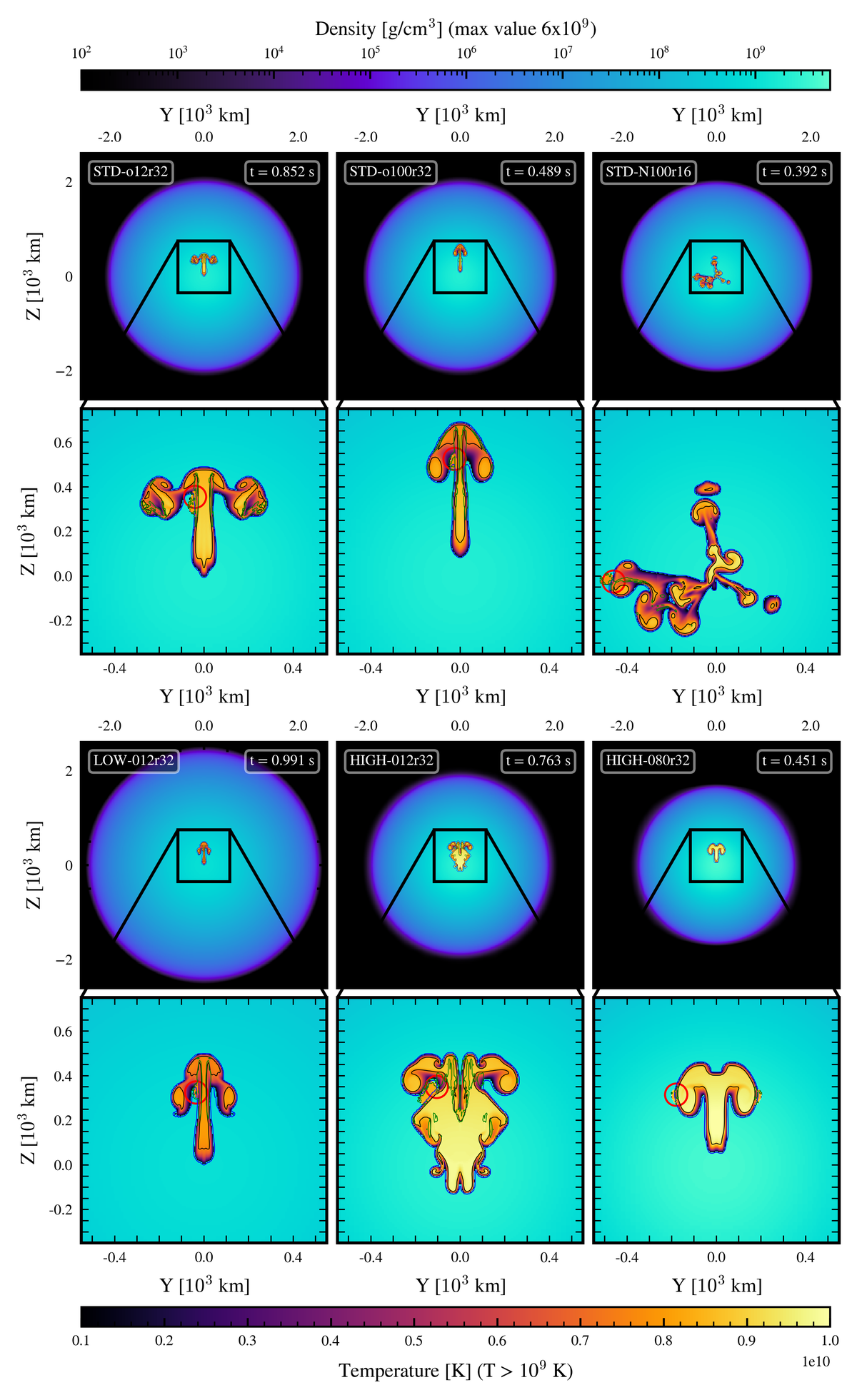
Detonation ignites where the turbulent flame grows large enough to surpass a critical size, shown by overlapping contours on the zoomed slices. This reveals how turbulence drives the sudden transition from slow burning to explosive detonation in white dwarf stars, explaining a key step in supernovae. (Source: arXiv:2605.21575)
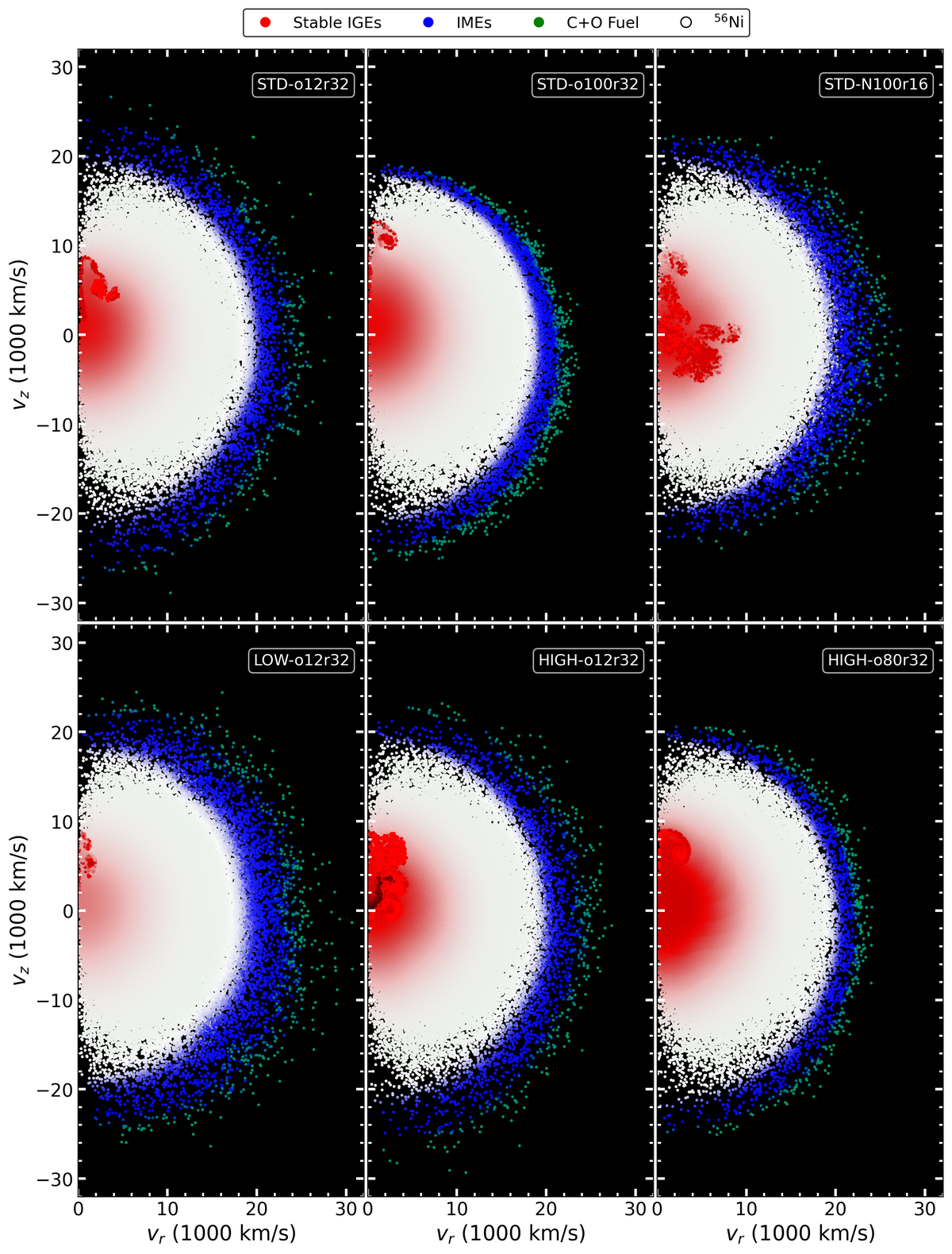
Burning products like iron and nickel segregate into distinct velocity regions as turbulence mixes the white dwarf. This mapping reveals the critical step where a slow burn suddenly triggers a violent detonation, explaining how these supernovae ignite. (Source: arXiv:2605.21575)
The result is a process that is both remarkably efficient and remarkably convergent. “The tDDT detonation mechanism is highly efficient, leading to detonation initiation which is prompt in comparison to most prior work,” the authors note. Even more striking, despite the sixfold variation in initial conditions, all six models converge on nearly identical synthetic spectra at peak luminosity, a spectroscopic match to the overluminous Type Ia supernova SN 1999aa. The turbulence‑driven Chapman‑Jouguet criterion acts like a universal tuning fork: it forces each progenitor, regardless of its initial ignition history, into a common detonation configuration in which the flame is poised at precisely the right velocity and geometry to produce the characteristic elemental yields. This, the team argues, provides “the first physically motivated, self‑consistent pathway for delayed detonation in SNe Ia simulations.”
Think of it like a match in a storm. You can strike the match in a tiny sheltered cavity or in an open, gusty chamber; the initial flame will flicker differently, maybe even go out. But if the wind is sufficiently turbulent—above some critical threshold—the tiny flicker will spontaneously accelerate into a firestorm that consumes the entire environment. In the white dwarf, the “wind” is the turbulent cascade driven by the first stages of burning, and the “match” is the initial deflagration. Once the cascade crosses the CJ threshold, the outcome is deterministic: a detonation that burns through the whole star, synthesising the characteristic mixture of iron‑peak isotopes that will later shine as the supernova’s light curve. This is not a gift from a benevolent tuner; it is an inevitable consequence of the way turbulence organises itself near a critical scale.
The philosophical upshot is as elegant as the physics. For a century, astronomers have treated Type Ia supernovae as standard candles without quite knowing why the candle‑making process was so repeatable. The new results suggest that standardisation is not an accident of the particular binary system that produced the white dwarf, nor a delicate balance of accretion and ignition timing. It is built into the explosion mechanism itself: turbulence, when it reaches the Chapman‑Jouguet point, locks the detonation into a well‑defined channel. Nature, working through the most unruly of phenomena—fully developed turbulence—delivers a crisp, reliable signal.
Of course, this is a first step. The model’s six successful simulations all produce overluminous, 1999aa‑like events. But the delayed detonation paradigm also needs to account for the full range of observed Type Ia brightnesses, as well as the less‑energetic, possibly failed explosions of the SNe Iax class. “Further work is necessary to understand how this mechanism might produce more delayed detonation initiation and potentially fail, thereby yielding SNe Iax,” the authors caution. The next challenge is to explore the parameter space where the turbulence never quite crosses the threshold, or crosses it so late that only a partial detonation occurs, leading to a fainter, more asymmetrical event. That, in a sense, would be the orchestra discovering that sometimes the final chord is not the same—and learning from the exceptions.
What stays with us after reading this work is a certain awe at the economy of physical law. A star on the verge of death, about 1.4 solar masses of carbon and oxygen squeezed into a sphere the size of Earth, finds its final expression not in wild diversity but in a regularised, reproducible spectacle. The turbulence that wracks its interior does not randomise the outcome; it actually standardises it. This is a reminder that chaos, under the right conditions, can be the midwife of order—not through design, but through the relentless, unthinking criterion of a critical scale. Perhaps the cosmic candle shines so steadily because turbulence itself refuses to let it flicker.
References
- K. Patel et al., First-Principles Turbulence-Driven Deflagration-to-Detonation Transition Mechanism for Near-Chandrasekhar Mass White Dwarf Progenitors, arXiv:2605.21575