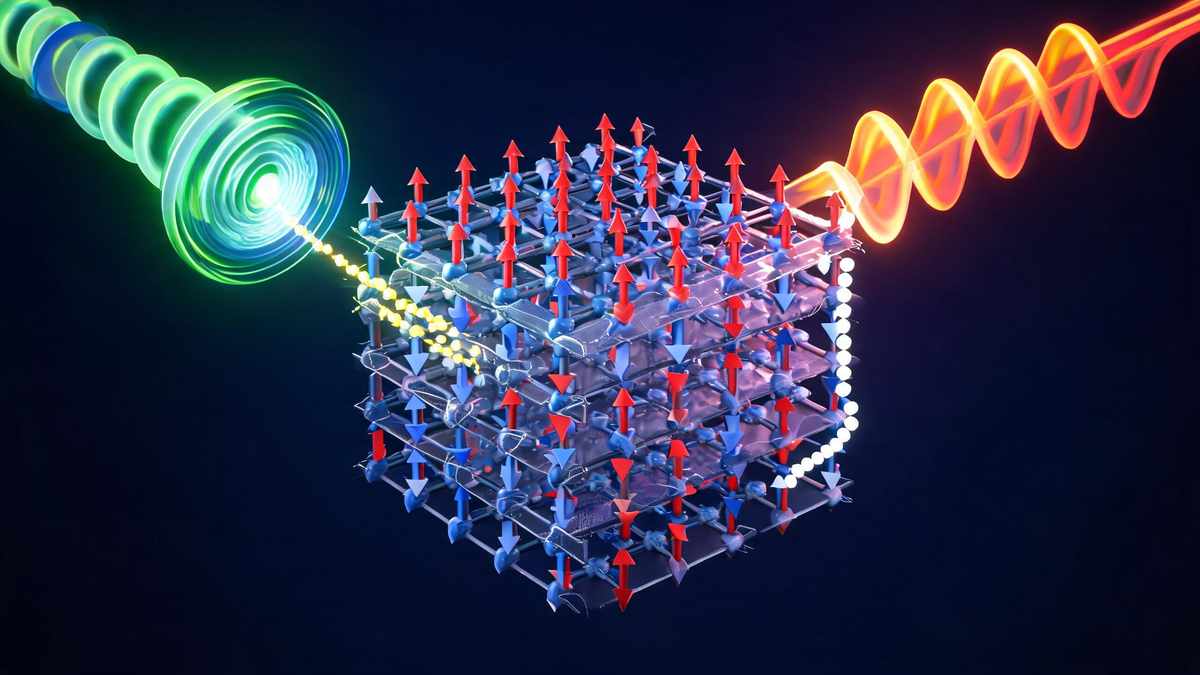
For decades, the bulk photovoltaic effect has obeyed a seemingly unshakeable rule. Shine circularly polarized light on a non‑centrosymmetric crystal, and the material replies with a steady injection current—a stream of electrons pushed into motion by the twist of the light itself. Use linear polarization, and the response is a shift current, where the electron’s very centre of mass makes a tiny, coherent leap during an optical transition. This tidy division of labour, linking the state of light to two fundamentally different charge flows, has been a cornerstone of optoelectronics and topological physics. But what if magnetism could scramble that neat assignment—swap the roles, reverse the sign, and turn the whole script upside down? That is exactly what a team of physicists has now observed. Their work, described in a preprint (arXiv:2605.22518), demonstrates for the first time that in an antiferromagnetic crystal, circularly polarized light generates a shift current, while linearly polarized light generates an injection current—the exact opposite of the conventional wisdom. And, as if to prove the point, flipping the material’s internal magnetic order simply reverses the direction of the flow.
The team, led by Liang Wu at the University of Pennsylvania and with Qi Tian as the first author—alongside collaborators from the University of Tennessee and the Donostia International Physics Center—was not chasing a random anomaly. They were hunting a long‑predicted but never‑seen set of photocurrents that emerge when quantum geometry—the abstract shape of electron wavefunctions in momentum space—is twisted by magnetic order. What they found not only fills a gap in the photocurrent family album; it opens a new window onto how magnetism can sculpt the flow of light‑generated electricity at the most fundamental level, using geometry as its chisel.
The Tangled Dance of Light and Geometry
To appreciate what was turned on its head, we must first step back to the bulk photovoltaic effect itself. Most of us are familiar with the photovoltaic effect in a solar cell: light creates electron‑hole pairs that are separated by a built‑in electric field at a junction. The bulk photovoltaic effect is different. It occurs in a single uniform crystal that lacks a centre of inversion, and it requires no junctions, no doping, no external fields. The current is a direct, intrinsic response of the quantum states themselves. When an electron is excited by light from a filled band to an empty one, its wavefunction performs a complex, rapid dance. The motion of the electron’s centre of mass during that optical transition is not random; it is dictated by the geometry of the involved quantum states.
Two geometric quantities dominate. The first is Berry curvature, which acts like a magnetic field in momentum space, twisting the phase of the electron as its momentum changes. The second is the quantum metric, a measure of the “distance” between nearby quantum states—think of it as the metric of an abstract landscape that the electron traverses. In non‑magnetic materials, the injection current, which grows linearly in time without any need for scattering, is intimately tied to the Berry curvature. The shift current, where the electron literally shifts its position during absorption, is governed by the quantum metric. This mapping is now so firmly established that it has become a touchstone: circular light probes curvature, linear light probes metric.
But that clean mapping rests on a hidden assumption—that time‑reversal symmetry is present, or at least that magnetism is absent. Theorists realized that once a crystal orders magnetically, a third geometric player enters the stage: torsion. In differential geometry, torsion measures how a connection twists independently of curvature. In a quantum solid, it captures the way the phase of wavefunctions links different momentum directions, a kind of corkscrew in the geometric fabric. The theoretical prediction was as elegant as it was startling. In a magnetic crystal, a linear injection current controlled by the quantum metric, and a circular shift current controlled by the torsion, should emerge. Past non‑magnetic rules would be reversed—and, crucially, the currents should reverse sign when the magnetic order is flipped. Nature, it seemed, had written a second act for the bulk photovoltaic effect, one that had never been seen on stage.
How an Antiferromagnet Turned the Tables
To stage that second act, the team chose a van der Waals antiferromagnet, a layered material whose magnetic sublattices point in opposite directions, yielding a robust internal compass—the Néel vector—but zero net magnetization. This choice was strategic. The Néel vector can be reoriented with a modest external magnetic field, offering a clean test of magnetic switching without the complications that large net moments bring.
The measurement combined ultrafast pump‑probe optics with terahertz emission spectroscopy. A frequency‑doubled femtosecond laser pulse, pushing from 800 nanometres into the near‑ultraviolet, struck the crystal, kicking electrons into a non‑equilibrium state that launched a photocurrent. As that current relaxed, it radiated a terahertz electromagnetic pulse, much like a tiny antenna. By measuring the amplitude of this terahertz emission while sweeping the pump polarization from linear to circular and back with a quarter‑wave plate, the researchers could disentangle the signatures of shift and injection currents. In conventional materials, a shift current responds to linear light in a pattern that varies as the cosine of twice the linear polarization angle, while an injection current from circular light typically follows a sine curve. In a magnetic crystal, theory predicted those fingerprints would not simply swap but be replaced by a different set of signatures: a linear injection current varying as the cosine of four times the quarter‑wave plate angle, and a circular shift current varying as a pure sine.
Below about 68 kelvin, where the antiferromagnetic order sets in, the data did precisely that. Instead of the familiar circular‑injection signal, the terahertz field traced a cosine of four times the quarter‑wave plate angle—the distinct hologram of a shift current driven by circular light. Meanwhile, the linear polarization data demanded an injection current. The light‑matter coupling had been inverted, as cleanly as a negative of a photograph. One could say that the crystal had rewritten the contract between photons and electrons—not through any conscious choice, of course, but because the magnetic order had bent the underlying quantum geometry in a way that the theory of torsion had foreseen. Unlike a piece of machinery that can be designed to any specification, the electrons were bound by strict geometric rules. Those rules had simply been redrafted by magnetism itself, as if the map of momentum space had been turned inside‑out.
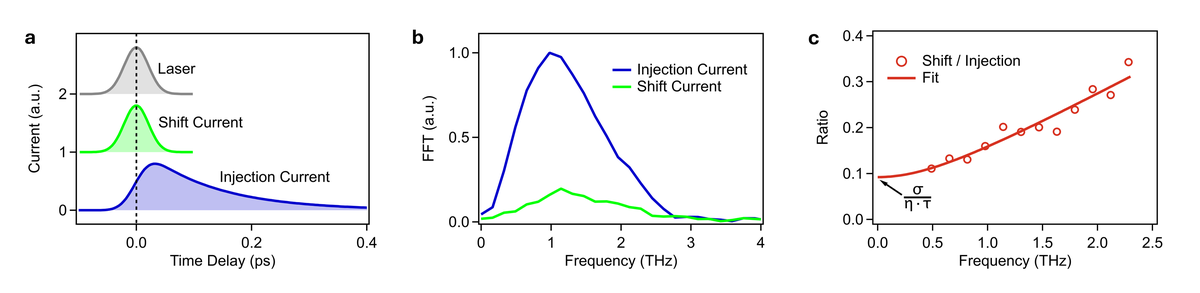
Shift currents and injection currents surge at different paces after a laser pulse. This difference reveals how light can manipulate quantum geometries with a magnetic field. (Source: arXiv:2605.22518)
To banish any doubt that the inversion was a genuine magnetic effect, the team warmed their sample past the ordering temperature. Above 68 kelvin, the novel circular‑shift and linear‑injection signals vanished; only the conventional non‑magnetic response remained. As they cooled again, the contributions grew as a power law of the temperature difference from the transition—a classic scaling law for an order parameter condensing at a phase change—confirming that the Néel vector is the master switch. They also verified that the effect scaled linearly with laser power at low fluences, ruling out the kind of higher‑order nonlinearities that could mimic a swapped photocurrent.
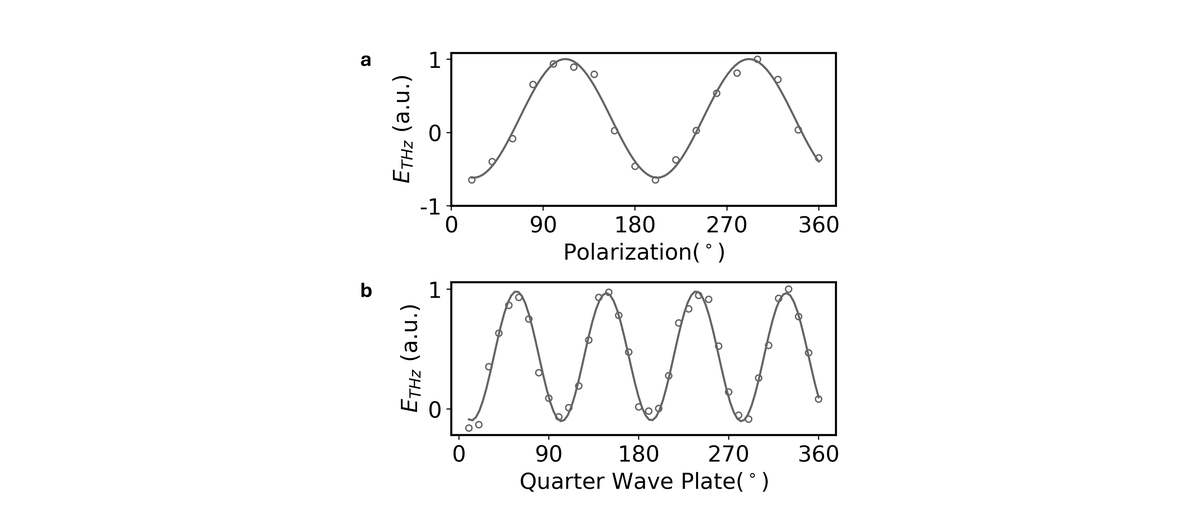
THz emission above Tₙ. Peak THz field at 75 K vs pump polarization. (a) A half-wave plate rotates linear polarization; data fit A cos2θ + B sin2θ, consistent with lattice C₃ symmetry. (b) A quarter-wave plate switches between linear and circular polarization. The excellent cos4φ fit confirms no circularly excited photocurrent: the linear component varies as cos4φ, while any circular component would vary as cos2φ. (Source: arXiv:2605.22518)
And then came the most dramatic demonstration: flipping the Néel vector itself. By applying a small magnetic field to reorient the sublattice magnetizations, the entire photocurrent reversed its direction. It was as if flipping a page in a book turned the flow of ink upside‑down. This magnetic command is more than a neat trick; it stretches the discovery into the realm of antiferromagnetic spintronics, where researchers dream of storing and processing information in magnetic textures rather than in electrical charge. A light‑driven readout of magnetic states—one that complements rather than competes with conventional magneto‑optical effects—could be a quiet addition to the toolkit for fast, low‑power memory.
Why the Map Matters
Yet, as with any new continent, the first landing raises as many questions as it answers. Some might argue that these currents, elegant though they are, remain laboratory curiosities—subtle signals detectable only with state‑of‑the‑art terahertz optics and cryogenic cooling, far from the temperatures at which any practical photodetector or solar cell could operate. A natural question sharpened by earlier theoretical work is whether the torsion‑driven circular shift current can ever be scaled to room temperature, or whether it is intrinsically tied to the frail magnetisms of low‑dimensions.
But the very existence of these currents, emerging from the abstract torsion, is a conceptual leap. For the first time, a photocurrent tied to a geometric quantity even more recondite than the now‑familiar Berry curvature has been observed in a solid. It proves that the torsion is not a mere mathematical curiosity; it can push charge, and magnetism can twist it. In the antiferromagnet, geometry ceases to be a passive backdrop and becomes an active agent, steering currents with the same authority that a valley floor shapes a river.
Perhaps the deepest lesson is that the script of light‑matter interaction is not written once and for all. The tidy dichotomy of circular‑injection and linear‑shift was a chapter, not the whole book. By bringing magnetism into the story, the team has shown that the very same quantum geometry can be repurposed, its torsion and metric coaxed into new alliances. The swapped roles are a tangible consequence of a hidden geometric landscape that magnetic order can sculpt. As the researchers continue to test other layered antiferromagnets, the question shifts from whether such currents exist to how many other magnetic geometries lie waiting to be uncovered—each potentially opening a new, switchable channel for light harvesting or spintronic readout.
We are left not with a final answer, but with a richer question. What other currents, driven by torsion, metric, or yet‑unimagined geometric objects, remain hidden in the magnetic dark? And what would it take to bring them from the cryostat to the sunny rooftops of a future spintronics? The script has been flipped, but the play is only just beginning.
References
- Qi Tian et al., Observation of magnetically switchable quantum geometric photocurrents, arXiv:2605.22518