
Imagine a student in a vast library where every book whispers a different piece of forgotten wisdom. She is trying to read one particular volume—the book of coherent quantum evolution—but the rustle of pages from every other shelf keeps bleeding into her words. In most textbooks, we are taught to ignore the whispers. We bolt the doors, cool the room to near absolute zero, and pretend the library is silent. The trouble, as a new theoretical framework from a consortium of physicists in the United States and Spain now makes clear, is that some libraries have a peculiar architecture: their whispers are loudest at every scale at once, and forgetting them is not an option. A preprint (arXiv:2605.22919) from Carlos Argüelles at Harvard, together with Gabriela Barenboim, Gonzalo Herrera, Tanvi Krishnan, and Héctor Sanchis at the University of Valencia, proves that such scale-invariant noise environments are not a nuisance to be dodged—they are a universal phenomenon, describable by a single number, and they can flip the fate of quantum systems in ways that run from the birth of the cosmos to the next generation of quantum computers.
This is not a story about a single experiment breaking through a barrier. It is a story about a shift in how physicists think about the boundary between a quantum system and the world that surrounds it. For decades, the standard tool for handling an environment that messes with a quantum device has been the Caldeira–Leggett model: you imagine the environment as a collection of harmonic oscillators that interact with your system like a classical friction force plus some quantum jitter. The model works beautifully when the noise has a single characteristic timescale—what physicists call Ohmic dissipation. But many of the most intriguing environments in nature have no preferred scale at all. The quantum critical points that appear when a material hovers between two phases, the quantum fluctuations of fields in an accelerating universe, the neutrino background that permeates space—all exhibit correlations that look the same whether you zoom in by a factor of ten or a factor of a trillion. Treating these cases within the old toolbox felt, in the words of the authors, like “forcing a round peg into a square hole.”
The breakthrough is a uniqueness theorem. Argüelles, Sanchis, and their colleagues show that any environment with exact scale invariance—any bath whose influence is indistinguishable at all lengths and times—is equivalent to what particle theorists call an “unparticle bath.” Unparticles, a notion borrowed from high-energy physics, are objects that carry a continuous scale dimension rather than a fixed mass. The team proves, through a chain of arguments that runs from basic symmetries to the detailed form of the noise kernel, that the memory of the environment—the way it stores information about past system dynamics—is entirely governed by a single scaling dimension d𝒰. In their own words: “We show that such environments are universally described by unparticle baths characterized by a single scaling dimension d𝒰.”
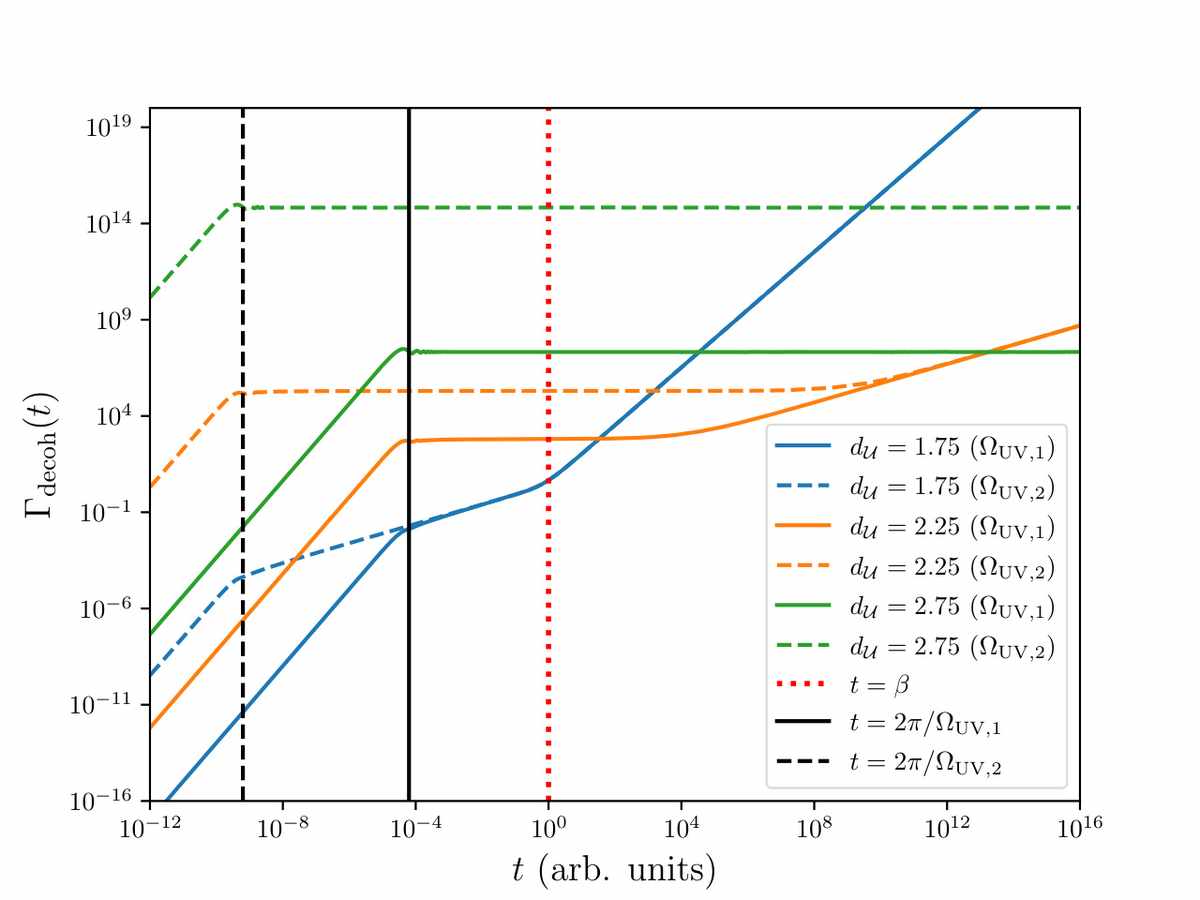
Decoherence grows faster in some environments than others, and raising the maximum frequency slows it down. This insight helps scientists control noise to protect delicate quantum states. (Source: arXiv:2605.22919)
| Quantity | Exponent | Condition |
|---|---|---|
| Spectral density | s = 2dU - 3 | — |
| Dissipation kernel | alphaeta = 2dU - 2 | dU > 1 |
| Noise (high-T) | alphanu = 2dU - 3 | dU > 3/2 |
| Damping | betadamp = 3–2dU | dU ≠ 3/2 |
| Decoherence | gammadecoh = 5–2dU | dU ≠ 2, 5/2 |
| Decoh. rate | deltadecoh = 4–2dU | — |
| Consistency relations | s + gammadecoh = 2; alphaeta + deltadecoh = 2; alphanu + betadamp = 0 |
All scaling exponents for the system depend on just one number. This reveals that decoherence and noise follow simple, universal rules. (Source: arXiv:2605.22919)
What that single number controls is startling. The team derives a fractional generalization of the Caldeira–Leggett master equation, where the time derivative turns into a fractional derivative—a mathematical object that encodes long-range memory. The scaling dimension d𝒰 then carves a map of possible behaviors. There is a thermalization transition at d𝒰=3/2: below this, a system immersed in the bath will spontaneously relax to a thermal state; above it, the bath’s memory is so persistent that the system may never thermalize. At d𝒰=2, one encounters the celebrated Ohmic boundary, where the familiar Caldeira–Leggett physics is recovered. And at d𝒰=5/2, in a thermal environment, a decoherence transition emerges: beyond this value, the bath’s influence becomes so sluggish that quantum superpositions—the fragile threads that distinguish a quantum computer from a classical abacus—are effectively protected. The authors put it succinctly: “The scaling dimension governs a rich phase structure, including a thermalization transition at d𝒰=3/2, the Ohmic boundary at d𝒰=2, and a decoherence transition at d𝒰=5/2 in the thermal regime, beyond which long-time quantum coherence is protected.”
To anchor this abstract machinery in concrete physics, the team unpacks three real-world examples, each drawn from a different corner of the discipline. In a quantum Ising model poised at its critical point—the sort of many-body system that describes magnetic materials on the verge of ordering—the coupling of a probe degree of freedom to the energy operator yields d𝒰=3/2 precisely. The result is a bath that generates the famous 1/f noise, the ubiquitous low-frequency flicker that plagues everything from transistors to gravitational-wave detectors. In a (2+1)-dimensional version of the same model, the conformal bootstrap—a powerful numerical technique rooted in symmetry—constrains d𝒰 to roughly 1.413, a value that places the system just below the thermalization threshold. In inflationary cosmology, the massless fluctuations of the gravitational field and the inflaton during the rapid stretching of de Sitter spacetime produce an effective bath with d𝒰=2, right on the Ohmic line. The framework predicts a linear growth of decoherence for primordial density perturbations, a behavior that may have scripted the quantum-to-classical transition that turned microscopic jitters into the large-scale structure of galaxies. And for high-energy astrophysical neutrinos, the scaling dimension imprints itself on the decoherence rate in a way that depends on the path length travelled: the rate grows like a power of the distance, with an exponent set by d𝒰, offering a potential observational window into the quantum fabric of the neutrino sector.
So far the story sounds like a triumphant synthesis. But a framework this ambitious invites its own scrutiny, and the paper benefits from an unusually honest confrontation with its limits. An important question sharpened by earlier work on non-Markovian dynamics—specifically the careful characterization of memory effects in the open-systems community—is whether the fractional master equation can always be cast into a time-local form that preserves complete positivity, the property that ensures probabilities stay between zero and one. The authors acknowledge that for the marginal case d𝒰=3/2, the perturbative control that sustains their derivation has not yet been quantified with rigorous bounds; the formalism might, in other words, be skating on thin ice at exactly the point where thermalization becomes a live possibility. Moreover, the uniqueness theorem hinges on an assumption of linear system–bath coupling, leaving open the question of how far the unparticle classification extends to strongly coupled or non-linear environments. These are not admissions of weakness; they are guideposts for the next round of theoretical work.
The paper’s own internal genealogy underscores its seriousness. The team’s earlier preprint (arXiv:2604.15445) had already laid out a universal description of decoherence in scale-invariant settings. The present work provides the complete apparatus: the full proof of the universality claim, the explicit form of the memory kernels, the noise correlators at both zero and finite temperature, and the fractional master equation for arbitrary d𝒰. It is, in effect, the rigorous undergirding of a conjecture that was already circulating in the community, and it now opens the door to a unified experimental program. Trapped-ion simulators, with their exquisite control over internal quantum states and their coupling to engineered reservoirs, could test the predicted thermalization and decoherence transitions in a laboratory environment. Neutrino telescopes such as IceCube might search for the telltale decoherence imprint of a scale-invariant primordial bath. And superconducting qubit designers, who already wage war against 1/f noise, now have a theoretical language to understand why that noise arises from a d𝒰=3/2 critical environment and what the precise consequences are for quantum error correction.
What is on offer, then, is not merely a new equation to be solved. It is a common language for quantum noise that cuts across the traditional borders between condensed matter, cosmology, and particle physics. The messy reality of any real-world quantum system—that it never truly stands alone—has been known since the earliest days of the theory. But the realisation that the mess itself can exhibit a kind of elegant universality, governed by a single scaling dimension, is a genuinely new twist. The path forward is clear: refine the perturbative control at the marginal thresholds, push the formalism to strongly interacting baths, and, most urgently, design the experiments that will tell us whether the predicted phase diagram is a correct map of nature or a beautiful mirage. For now, the library of quantum noise has acquired its first card catalogue, and the whispering suddenly sounds less like chaos and more like a conversation worth overhearing.
References
- Argüelles et al., Scale-Invariant Open Quantum Systems, arXiv:2605.22919
- Breuer et al., Non-Markovian dynamics in open quantum systems, arXiv:1505.01385
- Colas et al., In-in formalism for the entropy of quantum fields in curved spacetimes, arXiv:2406.17856
- Argüelles et al., Universal Description of Decoherence in Scale-Invariant Environments, arXiv:2604.15445