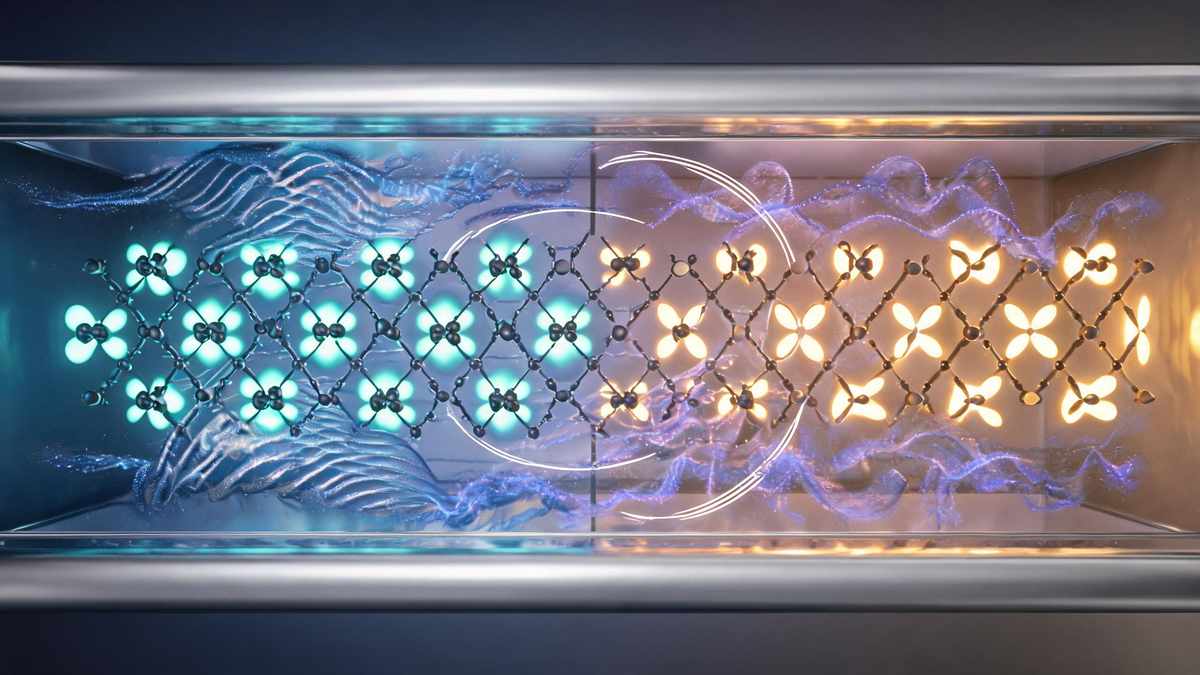
We are used to thinking of empty space as, well, empty. A void. The absence of stuff. But quantum mechanics has been telling us for the better part of a century that this picture is wrong. Even the quietest vacuum seethes with fluctuations — electromagnetic fields that flicker into existence and vanish, leaving measurable traces on whatever matter they touch. Most of the time, these traces are subtle: a tiny shift in an atomic energy level, a minuscule force between two mirrors placed close together. They tweak reality; they do not rewrite it.
A team led by Xiaopeng Li at Fudan University has now shown, in a preprint (arXiv:2605.24439), that under the right conditions, vacuum fluctuations can do something far more dramatic. They can change the fundamental character of a superconductor — transforming a conventional singlet pairing state into an exotic triplet one, without ever injecting a single real photon. The cavity itself, simply by confining the quantum vacuum, engineers a new phase of matter that does not exist in the bare material.
The implications ripple outward from condensed matter physics into the territory of topological quantum computing, where triplet superconductors are prized for their ability to host Majorana modes — quasiparticles that might, one day, serve as the building blocks of a fault-tolerant quantum processor. But before we get to any of that, we need to understand what the vacuum did.
The Material and Its Hidden Susceptibility
The team chose their battleground carefully. They worked theoretically with a class of organic superconductors known as kappa-(ET)₂X, where ET stands for bis(ethylenedithio)tetrathiafulvalene. These are quasi-two-dimensional materials — layered molecular crystals in which electrons hop between molecular sites arranged in a dimerized triangular lattice. The bare hopping parameters are anisotropic; different bonds between neighboring molecules have different strengths. On its own, and at low temperature, the material enters a superconducting state with so-called d-wave symmetry — a singlet state in which pairs of electrons orbit each other in a pattern with the four-lobed symmetry of a d-orbital.
This is a standard story. Organic charge-transfer salts have been studied for decades, and their d-wave superconductivity is well established. But Xin-Xin Yang, Shuai Zhang, Kun Ding, and Xiaopeng Li noticed something that previous work had overlooked: the electronic band structure of this material is unusually sensitive to the polarization of ambient light. Not real light — just the quantum vacuum itself.
Think of the vacuum inside an optical cavity as a sea with an invisible swell. The cavity imposes boundary conditions on which electromagnetic modes can exist between its mirrors, much as a guitar string can only vibrate at certain frequencies. Virtual photons pop in and out of existence, and their polarization — the direction their electric field points — is constrained by the cavity geometry. If you align the cavity along one direction, the vacuum fluctuations predominantly point that way. Align it differently, and the fluctuations point elsewhere.
This is not merely a metaphor. The coupling between light and matter inside a cavity is described by a well-defined effective Hamiltonian, and the strength of that coupling — how much the vacuum field can push electrons around — is captured by a parameter the team calls the effective light-matter coupling squared. When this parameter crosses a threshold, the Fermi surface — the contour in momentum space that separates occupied from unoccupied electronic states — distorts. And when the Fermi surface changes, the delicate competition between different pairing channels shifts.
How the Vacuum Chooses a Winner
Superconductivity is a notoriously fussy phenomenon. Electrons do not pair up arbitrarily; they do so in specific symmetry channels — s-wave, p-wave, d-wave — each corresponding to a different orbital dance. The channel that wins is the one that minimizes the free energy, and that depends sensitively on the shape of the Fermi surface and the interactions between electrons.
In the bare kappa-(ET)₂X material, the d-wave singlet channel wins handily. But the team found that when the cavity is polarized along a particular direction — specifically, the diagonal direction e₁₃ that bisects the x and y axes of the crystal lattice — something remarkable happens. The vacuum fluctuations reshape the Fermi surface in a way that suppresses the d-wave instability and instead promotes a p-wave triplet channel. Above a critical value of the effective light-matter coupling squared, the leading superconducting instability switches character entirely. The singlet state is no longer the ground state. The triplet takes over.
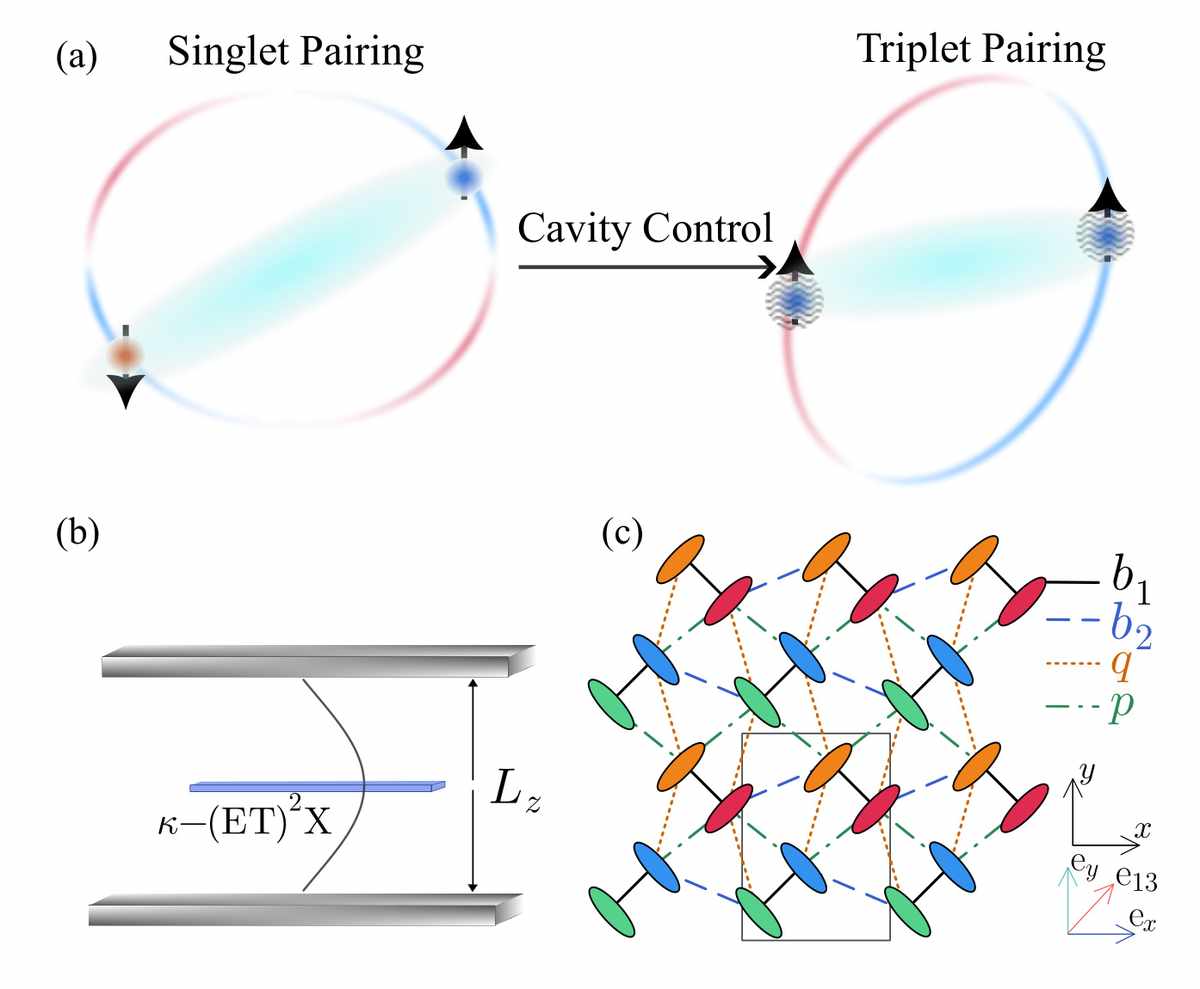
A cavity’s empty space switches the superconductor from a common singlet state into a fragile triplet state. This shows how simple mirror boxes can unlock exotic forms of superconductivity. (Source: arXiv:2605.24439)
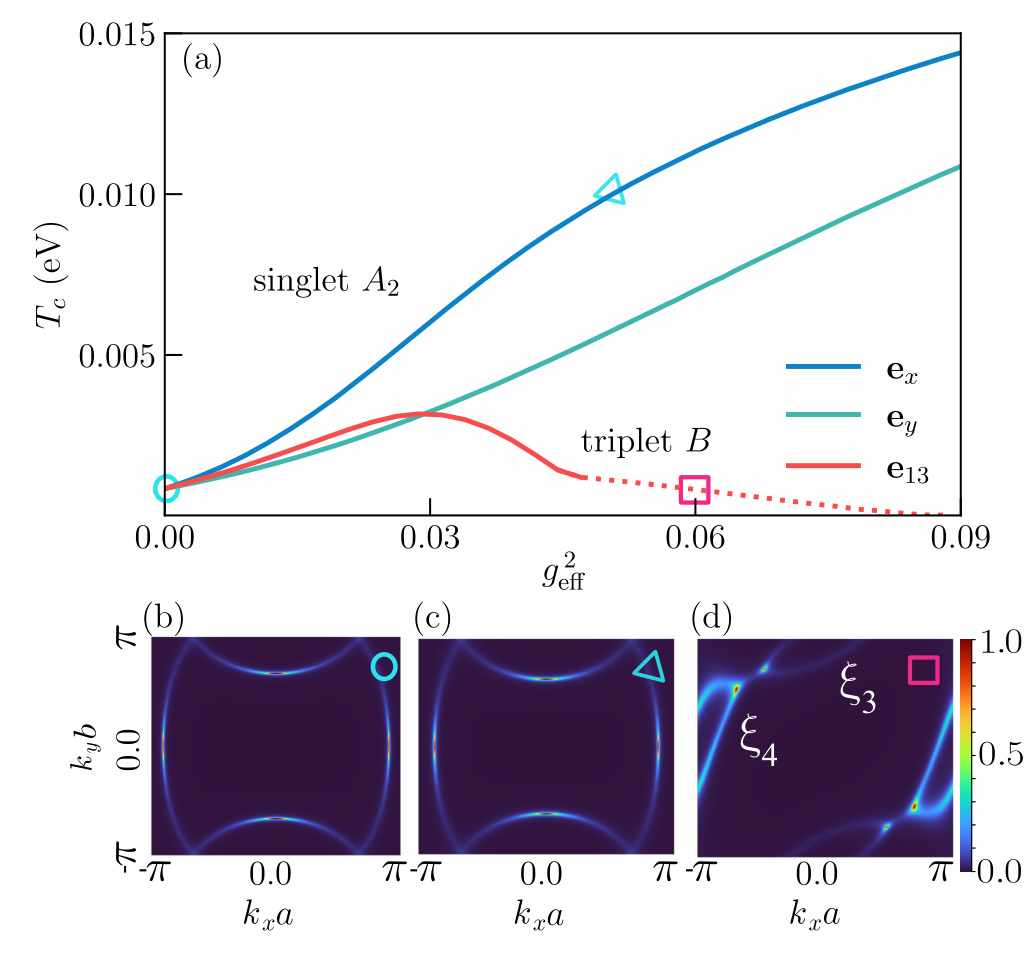
Higher cavity coupling and specific polarizations switch the dominant pairing from singlet to triplet superconductivity. This tunability reveals a new route to engineer exotic superconducting states using light fields. (Source: arXiv:2605.24439)
Let us pause to appreciate what this means. No external laser was fired at the material. No voltage was applied. The only thing that changed was the quantum vacuum itself — its spectral density of modes, its polarization texture — sculpted by the geometry of a surrounding cavity. It is as if, by building a room of a certain shape, you could make water freeze in a different crystal structure. The room does not push on the water. It simply changes what fluctuations are available, and the water, left to itself, chooses differently.
The team solved the linearized Bardeen-Cooper-Schrieffer gap equation for the realistic quasi-two-dimensional band structure — a numerical calculation that maps out which pairing instability has the highest transition temperature as a function of the light-matter coupling. For cavities polarized along the x-direction, the singlet d-wave state persists across the entire coupling range they studied. For the y-direction, the same. But for the diagonal polarization, the transition temperature curve splits: a solid segment for the singlet channel gives way to a dotted segment for the triplet. The switch happens at a coupling value that the team estimates is within reach of current experimental platforms.
This is not a subtle effect. The change in the pairing symmetry produces distinct, measurable signatures in the low-energy quasiparticle spectrum — the distribution of electronic excitations just above the superconducting gap. The team computed the zero-energy spectral function, which maps out where in momentum space the superconducting gap is smallest. In the singlet phase, the spectral weight vanishes along certain directions — the gap nodes characteristic of d-wave pairing. In the triplet phase, those nodes shift, broaden, or disappear entirely, replaced by a different pattern reflecting the p-wave character of the condensate. An experimentalist with angle-resolved photoemission spectroscopy could, in principle, watch the nodes migrate as the cavity is tuned.
The Deeper Question
There is a philosophical thread here worth pulling. For most of the history of condensed matter physics, we have treated the properties of materials as intrinsic — determined by their chemical composition, crystal structure, and temperature. External fields could tweak those properties, certainly: a magnetic field can suppress superconductivity, an electric field can tune a Mott transition. But the vacuum was always the silent background, the stage on which the drama played out. It was not an actor.
What the team at Fudan and the Shanghai Qizhi Institute has demonstrated — theoretically, at least — is that the vacuum can be promoted. By engineering the electromagnetic environment, we can make empty space itself a control knob for quantum phases. The cavity is not just a resonator; it is a symmetry-breaking field, a sculptor of Fermi surfaces, a selector of pairing channels. It acts without acting, by changing what is possible rather than imposing what is actual.
This sits in an interesting tension with the conventional wisdom of cavity quantum electrodynamics. Much of that field has focused on the strong coupling regime, where real or virtual photons hybridize with matter to form polaritons — mixed light-matter quasiparticles with modified properties. The team's mechanism is different. They operate in a regime where the light-matter coupling is substantial enough to renormalize the electronic band structure but not so strong that polariton formation dominates. The vacuum fluctuations do their work indirectly, by reshaping the Fermi surface, which in turn reshuffles the pairing instabilities. It is a gentler, more subtle form of control — and perhaps for that reason, a more broadly applicable one.
What Comes Next
The experimental path forward is not trivial, but it is navigable. The organic superconductors the team modeled have transition temperatures in the range of a few kelvin to perhaps ten kelvin, which means they require cryogenic cooling — but so do most quantum materials of interest. The cavities themselves are standard optical resonators, with mirror separations on the order of the wavelength of the relevant electromagnetic modes, typically in the terahertz range. The coupling strengths the team's calculations require have been achieved in other contexts using split-ring resonators and metamaterial cavities designed to concentrate the vacuum field into subwavelength volumes.
The real challenge is verification. Distinguishing a triplet superconductor from a singlet one requires phase-sensitive probes — measurements that go beyond the critical temperature and gap magnitude to reveal the symmetry of the order parameter. Angle-resolved photoemission, scanning tunneling spectroscopy, and, perhaps most definitively, the Josephson effect in a trijunction geometry can all provide smoking-gun evidence for triplet pairing. The team's predictions for the spectral function give experimentalists a roadmap: look for the disappearance of d-wave gap nodes under diagonal cavity polarization.
There is also a broader question that remains open. The team studied a specific material class — organic superconductors with dimerized triangular lattices — because those systems have Fermi surfaces that happen to be sensitive to polarization-dependent band renormalization. But the underlying physics is general. Any material with an anisotropic band structure and multiple competing pairing channels could, in principle, be steered by a suitably designed cavity vacuum. The periodic table of candidate materials is large, and the space of cavity geometries — with different mirror shapes, metamaterial inclusions, and polarization textures — is essentially infinite.
What the team has provided is not just a prediction for one material, but a proof of principle for a whole approach to quantum materials engineering. Vacuum as sculptor. Cavity as chisel. And the resulting forms — triplet superconductors, topological phases, perhaps even more exotic states that have no name yet — emerging not from what we add to a material, but from what we take away: the assumption that empty space is empty.
References
- Xin-Xin Yang et al., Emergence of Triplet Superconductivity from Cavity Vacuum Fluctuations, arXiv:2605.24439