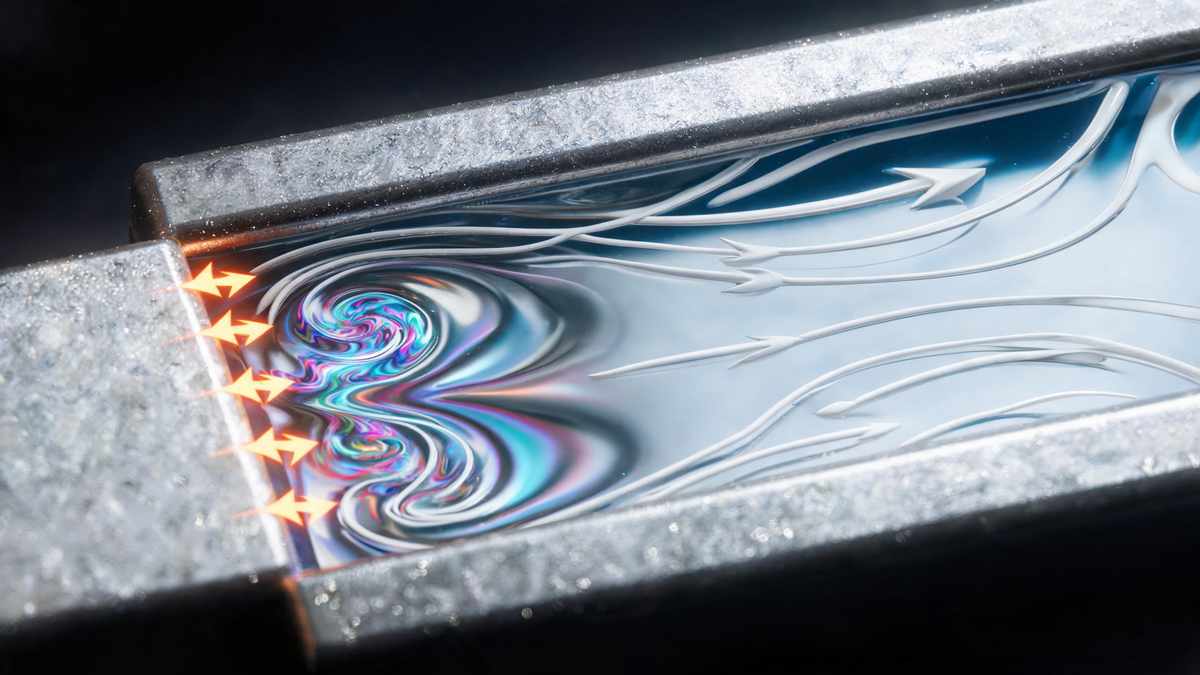
Physics undergraduates encounter a classic demonstration early on: a ferromagnetic rod, suspended by a thin thread, is suddenly magnetized—and rotates. The reason, discovered by Albert Einstein and Wander Johannes de Haas in 1915, is that changing the magnetization flips electron spins, and the conservation of angular momentum forces the crystal lattice to twist in response. That delicate rotation, measured over a century ago, revealed a deep connection between quantum spin and mechanical motion. Now, a preprint (arXiv:2605.25387) by Xin Hu and Mamoru Matsuo at the Kavli Institute for Theoretical Sciences, University of Chinese Academy of Sciences, proposes to harness a similar spin-to-mechanical conversion—but this time, in a liquid.
The insight at the heart of the preprint is that a spin current injected into a confined liquid metal can be converted directly into flow. Instead of rotating a solid rod, the angular momentum carried by the spins drives the liquid’s own internal rotations, ultimately producing a measurable, directed motion—without pressure gradients, moving walls, magnetic fields, or electric currents passing through the liquid itself. The team’s theoretical framework shows that the same Einstein–de Haas torque that once nudged an iron cylinder can, in a different guise, become a pump for microfluidic channels.
To appreciate how this works, it helps to look at the plumbing. The envisioned device is simple: a thin slab of liquid metal—gallium or a similar alloy—sandwiched between platinum contacts. An ordinary charge current in the platinum, via the spin Hall effect, generates a pure spin current that leaks into the liquid at the boundaries. “Spin angular momentum injected from Pt contacts enters the liquid as an Einstein–de Haas torque and is converted through micropolar angular-momentum balance into viscous flow,” write Hu and Matsuo. In other words, the liquid, although it has no rigid lattice to twist, responds to the spin injection by developing a local microrotation—a swirling motion of fluid elements about their own centres—that couples into the bulk flow.
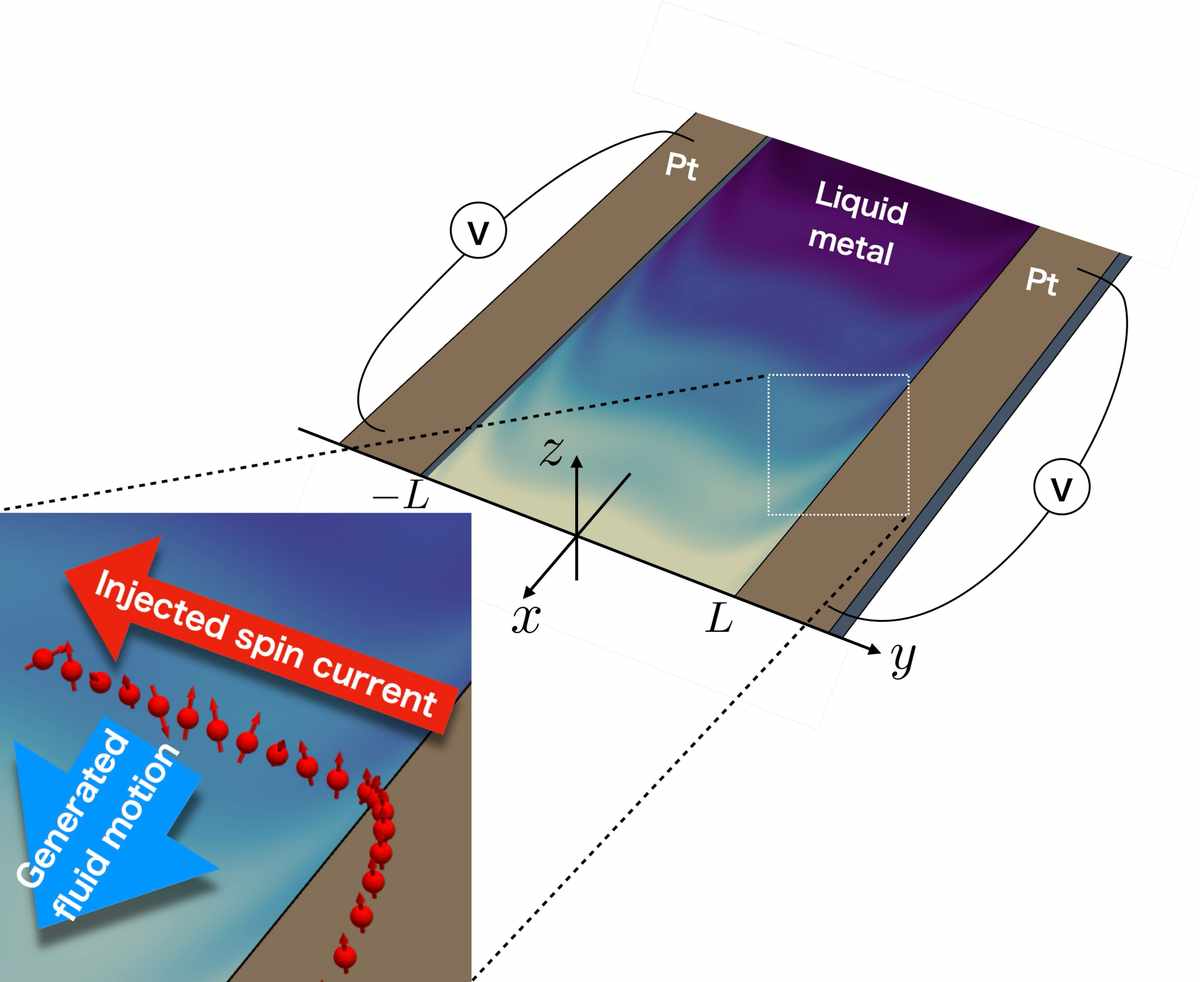
Platinum electrodes inject spinning electrons into a liquid metal, creating a flow. This new method could drive tiny pumps or mixers without moving parts, using only electrical current. (Source: arXiv:2605.25387)
This is not a far-fetched extrapolation; the mathematics is built on micropolar fluid theory, a continuum framework that endows each fluid parcel with its own angular momentum. When spin torque acts on the liquid, it drives a microrotation field that, through viscous coupling, sets the whole channel into motion. The resulting flow pattern has two independent modes: an odd counterflow that opposes the spin injection at each wall, and an even pumping mode that produces a net throughput. It is the even channel that offers the clearest actuator—a direct-current flow that persists as long as spin is injected.
Hu and Matsuo worked out the steady-state velocity profile analytically, and the result is both clean and universal. The normalized mean velocity depends on a single dimensionless parameter: the channel half-width divided by the spin diffusion length. The response follows the function one minus the hyperbolic tangent of that ratio, a shape that rises steeply for narrow channels and saturates for wide ones. This universality means that the essential physics—how far spins travel before relaxing—determines the flow, and that the scaling can be tested by varying the channel size or the liquid-metal composition.
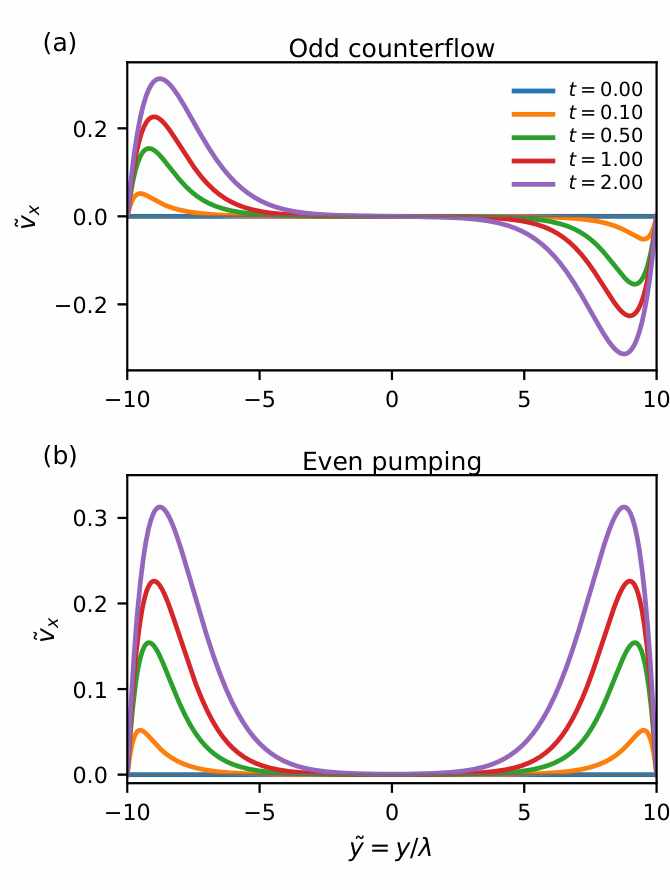
Velocity profiles shift over time in opposite directions for the two channel types. This reveals how spin torque can precisely control fluid flow at microscopic scales. (Source: arXiv:2605.25387)
The device’s frequency response, captured by the spin-mechanical admittance, is equally revealing. When the spin injection oscillates, the liquid can follow only up to a point: at low frequencies, the velocity faithfully mirrors the spin torque, but as the oscillation period shortens below the time needed for momentum to diffuse across the channel, the amplitude rolls off and the phase shifts toward quadrature. The system behaves as a viscous low-pass filter. More subtly, different features of the admittance—a shoulder here, a phase shift there—resolve four distinct timescales: the diffusion of viscous momentum, the transport of spin, the relaxation of microrotation, and the transparency of the interface between the solid contact and the liquid. In principle, a single set of measurements could disentangle all four.
The promise of this proposal is a liquid-metal actuator with no moving parts and no magnets. Microfluidic engineers have long sought ways to propel conducting liquids through tiny channels without mechanical wear, electrolysis, or bulky external coils. A spin-current actuator—entirely electrical, yet never sending a charge current through the liquid itself—would be an elegant addition to the lab-on-a-chip toolkit. Liquid metals, already used for stretchable electronics and thermal management, might be routed, shaped, or stirred entirely by spin injection.
The road from theory to experiment is now clearly marked. The necessary ingredients—platinum electrodes, liquid gallium channels, and spin-Hall injection—are all established technologies. The next step is to build the channel, measure the predicted velocity, and map the spin-mechanical admittance against the theory’s universal curves. For a technique born from a lecture-hall classic, that would be a satisfying demonstration that even century-old discoveries still have new forms to show us.
References
- Hu et al., Microfluidic Actuation by Einstein-de Haas Spin Torque, arXiv:2605.25387