
The quantum computing field is quietly pivoting. After a decade of racing to pile up qubits, the hard‑fought focus is shifting to something less photogenic but vastly more consequential: making gates that intrinsically resist error, rather than relying on an avalanche of error‑correction overhead. A team of physicists at ETH Zurich has just shown what that might look like. In a preprint (arXiv:2507.22112) they report a two‑qubit SWAP gate that is protected not by clever calibration but by the fundamental symmetries of nature itself, and they back the claim with a loss‑corrected fidelity of 99.91% measured across more than 17,000 atom pairs.
Neutral atoms trapped in optical lattices have recently emerged as one of the most promising platforms for quantum computing. Collisional gates, in particular, exploit the gentle interplay between atoms when they briefly overlap, offering a stable mechanism for quantum logic that avoids the need for individually addressed laser pulses. Yet until now, those collisions have been treated as a dynamically fine‑tuned process—a delicate balancing act where any drift in the trapping potential can scramble the gate. The ETH group, led by Tilman Esslinger, took a different starting point. Instead of trying to control every last parameter, they asked: what if the very identity of the atoms—their fermionic nature—could enforce the gate, making it immune to many imperfections by construction?
Earlier this year, two other notable experiments underscored both the progress and the persistent challenges in the field. Senoo and colleagues demonstrated high‑fidelity entanglement in static atom arrays using superexchange interactions, a scheme that is exquisitely sensitive to lattice‑depth noise and requires extensive calibration. Around the same time, Rines and co‑workers showed how to shuttle atoms between sites while preserving pairwise entanglement, a crucial capability for any large‑scale processor. Both results were impressive. Both also reinforced a common headache: entanglement fidelity tends to degrade whenever the atoms’ environment drifts by even a small amount.
The ETH team’s strategy turns that problem inside out by reaching for a concept that is far older than quantum computing: geometric phases. Imagine two identical twins passing through a revolving door. If both try to occupy the same compartment at the same time, their very indistinguishability—perhaps a strict rule that they cannot both stand in the same spot—forces a correlated exit pattern. In the quantum version, two fermionic lithium atoms are brought together on a single lattice site, forming what the researchers call a qubit doublon. Because the particles are identical fermions, their combined state is forced to be antisymmetric under exchange. That antisymmetry carves out a particular subspace—the singlet subspace—within which the Hamiltonian is blind to many of the environmental twists that normally ruin a gate. “We propose and experimentally demonstrate a purely geometric two‑qubit swap gate by transiently populating qubit doublon states of fermionic atoms in a dynamical optical lattice,” the authors write, and they point out that the gate “is intrinsically protected against fluctuations and inhomogeneities of the confining potentials.”
The effect is a quantum holonomy: as the lattice parameters are swept along a closed loop, the system’s state acquires a geometric phase of exactly −pi, independent of the speed or the precise shape of the sweep. That phase flips the states of the two qubits—a perfect SWAP. Crucially, any dynamical phase that would normally accumulate is killed by the combination of time‑reversal and chiral symmetries built into the optical lattice. This is not a matter of fine‑tuning, but a consequence of how quantum mechanics weaves reality. The gate works because symmetry forbids the usual noise‑sensitive detours.
To test the idea, the team loaded pairs of super‑cooled lithium atoms into a tunable double‑well potential and prepared them in a known singlet state. After executing one or many geometric SWAPs, they measured the singlet fraction using a singlet‑triplet oscillation technique that naturally separates true gate errors from atom loss. At the heart of the apparatus sits a dark state that stays almost entirely within the singlet subspace throughout the operation, never leaking into the triplet states where errors would pile up. The loss‑corrected amplitude fidelity—99.91 per cent, with an uncertainty of 0.07 per cent—translates to roughly one error in every thousand operations, a level of performance that would be remarkable even for a single pair of qubits but was demonstrated here across a macroscopic ensemble.
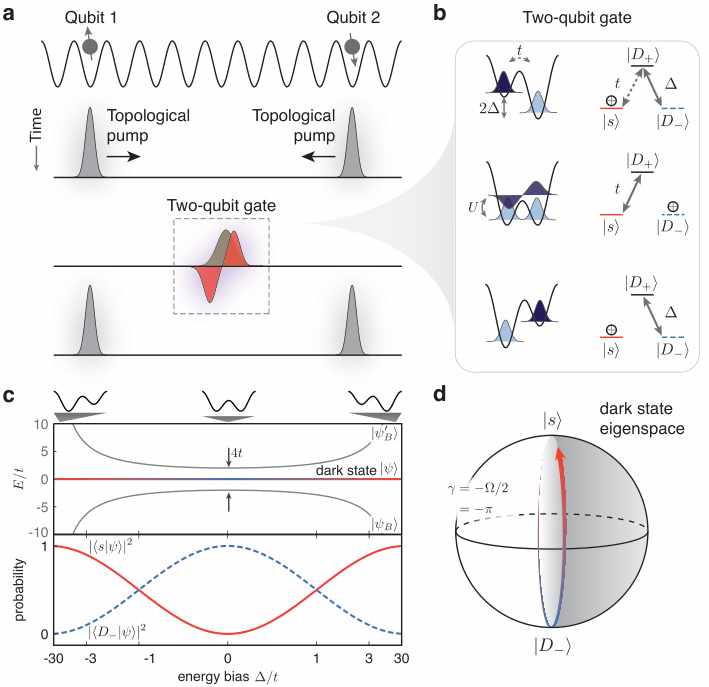
Overlapping two qubits forms a doublon that harnesses quantum statistics to perform a gate. This geometric phase shields the gate from errors, a vital step for reliable quantum computers. (Source: arXiv:2507.22112)
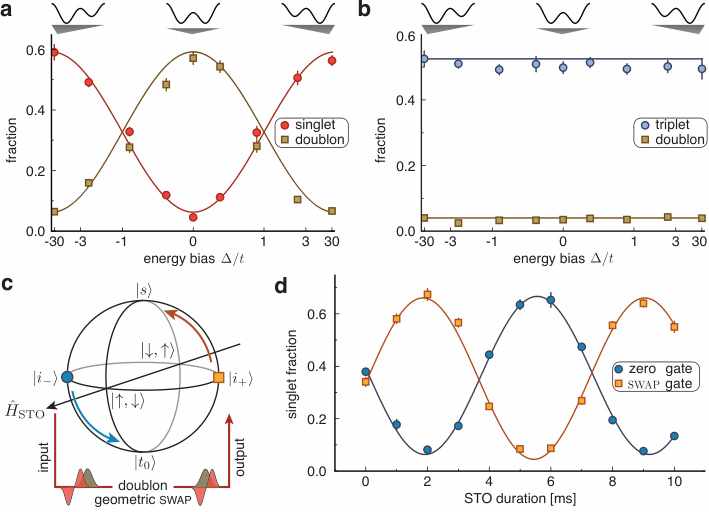
A doublon state appears only at a specific lattice setting, while the triplet remains unchanged. This precise control enables a protected quantum gate that resists errors. (Source: arXiv:2507.22112)
This fidelity was extracted from an exponential decay fit as a function of the number of consecutive gates. Because the fit inherently corrects for state‑preparation and measurement imperfections, the reported number reflects the gate’s own error rate, not the experimentalist’s clumsiness at loading the atoms. In an additional noise‑immunity test, the team deliberately added tunable tunnelling noise to the lattice potential and watched the raw fidelity barely budge. When the noise was cranked high enough to degrade a conventional superexchange gate, the geometric gate remained nearly unperturbed.
Yet the story is not one of unqualified triumph. The same symmetries that protect the gate also constrain it: the geometric protection applies only to parameter variations that respect time‑reversal and chiral symmetry. Fluctuations of the on‑site Hubbard interaction U, which can arise from imperfect control of the scattering length or the lattice depth, break those symmetries and remain a dominant error source, as the authors themselves acknowledge. Moreover, the experimental validation of noise resilience was primarily performed for tunnelling‑amplitude noise; other potential drifts—magnetic field gradients, optical‑lattice phase jitter—were not systematically tortured. This gap leaves open a question that earlier work on high‑fidelity array gates has sharpened: can a single protection mechanism cover the multitude of noise channels that a real‑world quantum computer will face?
There is also the matter of compatibility with atom motion. The ETH team envisions coupling their gate to recently developed topological pumping techniques, which could shuttle logical qubits around a large lattice without losing coherence. The demonstration by Rines et al. of a logical architecture that unites motion and in‑place entanglement already showed that such integration is feasible. The geometric gate, if it can be shown to withstand the disturbance of transport, might add the missing ingredient of intrinsic robustness. This is an appealing prospect, but it remains to be tested.
The work marks more than just a milestone in gate fidelity. It rewires the conversation about what fault‑tolerance can look like. Instead of layering classical error‑correction codes on top of noisy quantum hardware, the community is increasingly exploring “hardware‑efficient” schemes that exploit the system’s own symmetries at the physical level. The ETH group’s geometric gate embodies that philosophy in a particularly elegant way. “This work introduces a new paradigm for quantum logic, transforming fundamental symmetries and quantum statistics into a powerful resource for fault‑tolerant computation,” they conclude.
Perhaps one day, whenever a quantum processor is built from these ingredients, the atoms will not merely execute gates—they will dance a tightly choreographed geometric routine that forgets the clock, ignores the background noise, and yet still delivers the right answer. The cathedral of fault‑tolerant quantum computing will not rise in a day, but each stone of protected logic inscribed with symmetry brings the blueprints into sharper focus.
References
- Yann Kiefer et al., Protected quantum gates using qubit doublons in dynamical optical lattices, arXiv:2507.22112
- Senoo et al., High‑fidelity entanglement and coherent multi‑qubit mapping in an atom array, arXiv:2506.13632
- Rines et al., Demonstration of a Logical Architecture Uniting Motion and In‑Place Entanglement, arXiv:2509.13247