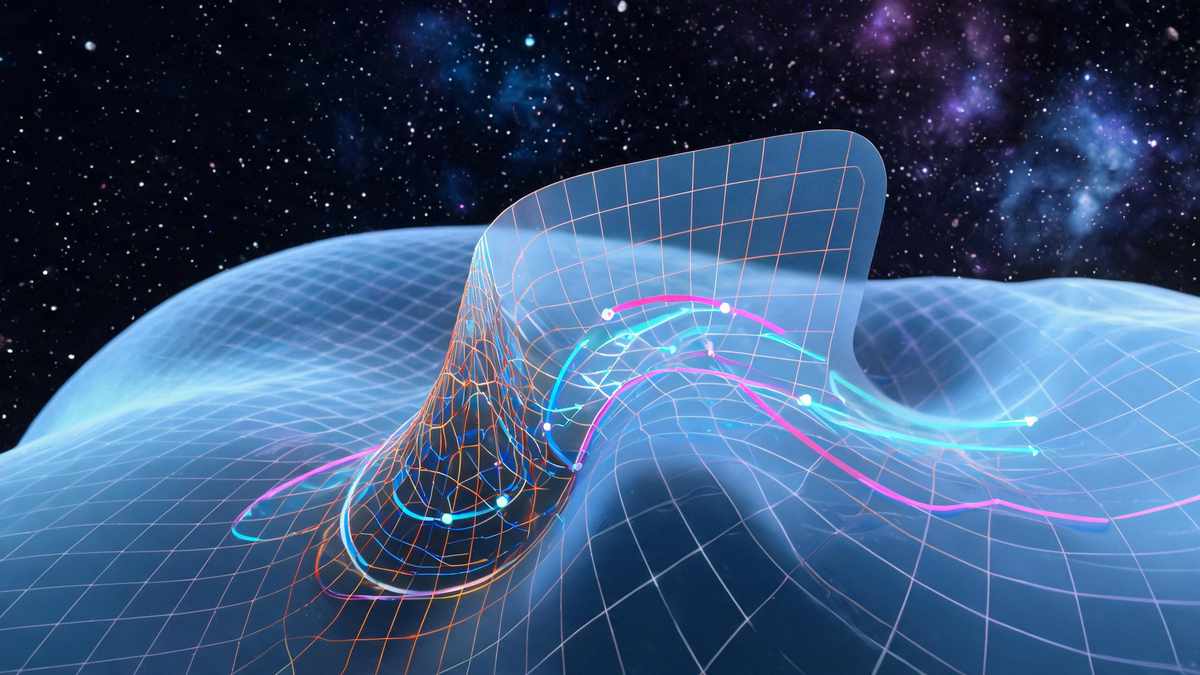
If you’ve ever tried to flatten an orange peel onto a tabletop, you know something important about geometry: the distortions are inevitable, but the orange’s roundness is not an illusion. The trick is to tell the difference between a crease that belongs to the peel’s shape and one imposed by the flattening. In differential geometry, a similar problem has haunted mathematicians for decades. Every connection — the mathematical object that tells vectors how to rotate and stretch as they travel across a curved space — can look sick in one coordinate system and healthy in another. The question was always: when is the sickness real, and when is it just a bad choice of map?
Now, a team led by Moritz Reintjes at the City University of Hong Kong, together with Blake Temple of the University of California, Davis, has given a definitive answer. In a preprint (arXiv:2412.08928) that they call the culmination of their theory of the RT-equations, they define a new geometric invariant: a connection’s essential regularity. This is the highest level of smoothness the connection can attain, not in some special atlas, but in the coordinate system best suited to it. More importantly, they provide a computable procedure to actually find that atlas. The work doesn’t just sharpen a philosophical principle — it settles, with mathematical rigour, a long-standing problem about how to classify singularities in Einstein’s theory of gravity.
The craft of seeing through bad maps
The anxiety about coordinate artefacts is as old as general relativity itself. When Karl Schwarzschild first solved Einstein’s field equations in 1916, his metric contained a terrifying surface where time seemed to freeze and radial distances became imaginary. For decades, physicists argued over whether this “Schwarzschild singularity” was a physical boundary where spacetime ended, or merely a coordinate choice that had gone wrong. We now know it’s the latter — the event horizon is well behaved in a better set of coordinates. But not all singularities are so forgiving. At the centre of a black hole, curvature invariants blow up regardless of how you slice the manifold. That’s an essential singularity; you can’t map it away.
The trouble is that for many physical situations — the shock waves that ricochet through stellar interiors, the cusps that form in some cosmological models — the connection components are too rough to fit into the usual smoothness categories. They live in spaces where the old mathematical machinery for distinguishing removable from essential singularities simply didn’t work. You could stare at a connection with components that jump or peak at certain points, and not know whether the roughness was telling you something deep about the spacetime, or was just a blemish in your coordinates.
Reintjes and Temple’s answer to this is both conceptual and practical. Conceptually, they argue that a manifold by itself does not carry an intrinsic level of regularity — smoothness is not a property of the points alone. It is the connection that brings regularity into geometry. They write: “the essential regularity of a connection marks the point at which an intrinsic level of regularity enters the subject of geometry.” That is a startling claim. It means that what we usually think of as a passive backdrop — the manifold — is, in a sense, silent about its own smoothness until a connection speaks through it.
The kernel of the idea
The mathematical engine behind this insight is the system of partial differential equations they have been developing for over a decade, the RT-equations. These equations encode what happens to a connection’s components when you change coordinates, and they do so in a way that separates the genuine curvature from the coordinate wobble. Earlier work by Reintjes and Temple had already shown that if you start with a connection whose components are in the Lebesgue space (L^p) — essentially meaning they’re only slightly less tame than square-integrable — you can use the RT-equations to iron out some of the roughness, step by step, across overlapping coordinate patches. What was missing was an invariant notion of “as smooth as it gets.”
The new paper supplies that invariant. It proves that every affine connection possesses an essential regularity, a geometric property independent of the starting atlas. Then it provides a “checkable necessary and sufficient condition” for determining whether a connection has reached that best possible form. In plain language: you take the connection and its Riemann curvature tensor, compare their relative regularity, and if they match in a precise sense, you’re done — the singularity you see is genuine. If not, you run the RT-equations and move to a better atlas.
Think of it like a photograph gradually coming into focus. The first image is blurry, and you might blame the camera. The RT-procedure tells you how to adjust the lens — the coordinate system — until the blur settles to a minimum. That minimum is the essential regularity; what remains blurry is not a fault of the camera but a feature of the object. (Of course, unlike a camera, the “object” here is a geometric structure, and the blur-producing maths is encoded in differential equations.)
A checkable truth
The authors do not leave the procedure as a theoretical curio. They show how to implement it for connections that arise in Einstein’s general relativity, particularly those that describe shock waves — surfaces where density and pressure jump abruptly, making the connection components merely locally bounded but not differentiable. Such shocks are not confined to astrophysics; they appear in the early universe and in the superfluid interiors of neutron stars. Until now, there was no systematic way to determine whether a shock’s associated gravitational singularity was removable by a clever change of coordinates, or was an essential part of the matter field’s behaviour. The essential regularity test cuts through that ambiguity.
One prominent example involves cusp singularities in cosmological models — regimes where the expansion rate of the universe changes suddenly at some cross-section. If that sudden change is a genuine physical feature — say, a phase transition — the singularity should be essential. If it’s an artefact of a particular time-slicing, a better choice of coordinates should eliminate it. Reintjes and Temple’s framework gives the first rigorous criterion for making that call for any connection with (L^p) components, as long as (p) exceeds the underlying dimension.
An important question sharpened by earlier work on weak continuity of curvature in (L^p) (Chen et al., arXiv:2108.13529) is whether the regularization procedure requires an implicit improvement in the curvature’s own regularity that may not always occur. The RT-equations generate a new atlas by solving for the coordinate transformation that relates the old and new connection components; in principle, this operation could transfer irregularity into the curvature. Chen et al.’s analysis of weak continuity suggests that, under the assumptions of the current paper ((p>n)), any such irregularity remains controlled; the two frameworks, when brought into dialogue, converge on a consistent picture. The essential regularity concept appears to be logically self-contained when the connection starts off with a certain minimal degree of integrability.
A separate strand of research on low-regularity Lorentzian geometry, represented by the Lorentzian splitting theorem of Braun et al. (arXiv:2507.06836), explores the consequences of relaxing smoothness assumptions for the metric itself — dropping down to (C^1)-differentiability, which is a step below the usual (C^2). Braun’s work asks how much of the structure of spacetime, including its causal properties, survives when the metric only has one continuous derivative. In their dialogue with the essential regularity theory, an unsettled tension remains: Braun and colleagues question whether a connection’s essential regularity can always be realised without pushing the metric below the (C^1) threshold, where even the light cones lose their crispness. The question is not whether Reintjes and Temple’s procedure works, but whether the “best” atlas it produces might sometimes lower the metric’s regularity in ways that physicists would find unacceptable. This is precisely the kind of cross-pollination that a new invariant invites — and it is, for now, an open door rather than a closed one.
What intrinsic regularity means for geometry
The authors’ claim — that the essential regularity of a connection is the point at which intrinsic regularity enters geometry — carries a philosophical weight that mathematicians and physicists will likely debate for years. It upends a long-standing intuition: that a manifold is, a priori, a smooth object, and that any lack of smoothness in the fields defined on it is a defect of those fields. Reintjes and Temple’s perspective suggests instead that the manifold may be entirely neutral about its own differentiability; it is the connection that bestows a regularity structure upon it. This is a relational view of geometry, closer in spirit to the way general relativity already makes matter and geometry co-determine each other.
The road ahead is clear, even if the timeline remains uncertain. The immediate task is to compute the essential regularity for a wider class of physical connections, including those that arise in numerical relativity, where shock-capturing algorithms are notoriously plagued by coordinate singularities that masquerade as physical ones. A robust computational implementation of the RT-equations could become as valuable to relativists as Riemann solvers are to fluid dynamicists — a tool for identifying and removing coordinate artefacts without guessing. More speculatively, the idea that regularity is not an attribute of the container but of the contained may find echoes in quantum gravity, where spacetime itself is expected to emerge from a more fundamental, non-geometric substrate. There, the question of what it means for connectivity to be “rough” or “smooth” is still entirely open.
What is already clear is that Reintjes and Temple have given mathematicians and physicists a new lens. They have identified a property of connections that survives every possible coordinate translation, no matter how badly chosen the starting atlas. And in doing so, they have demonstrated that geometry’s essence is not what you first see, but what remains after you’ve done everything possible to see it fully.
References
- Moritz Reintjes, Blake Temple, The essential regularity of singular connections in geometry, arXiv:2412.08928
- Chen et al., Weak continuity of curvature for connections in (L^p), arXiv:2108.13529
- Braun et al., A Lorentzian splitting theorem for continuously differentiable metrics and weights, arXiv:2507.06836