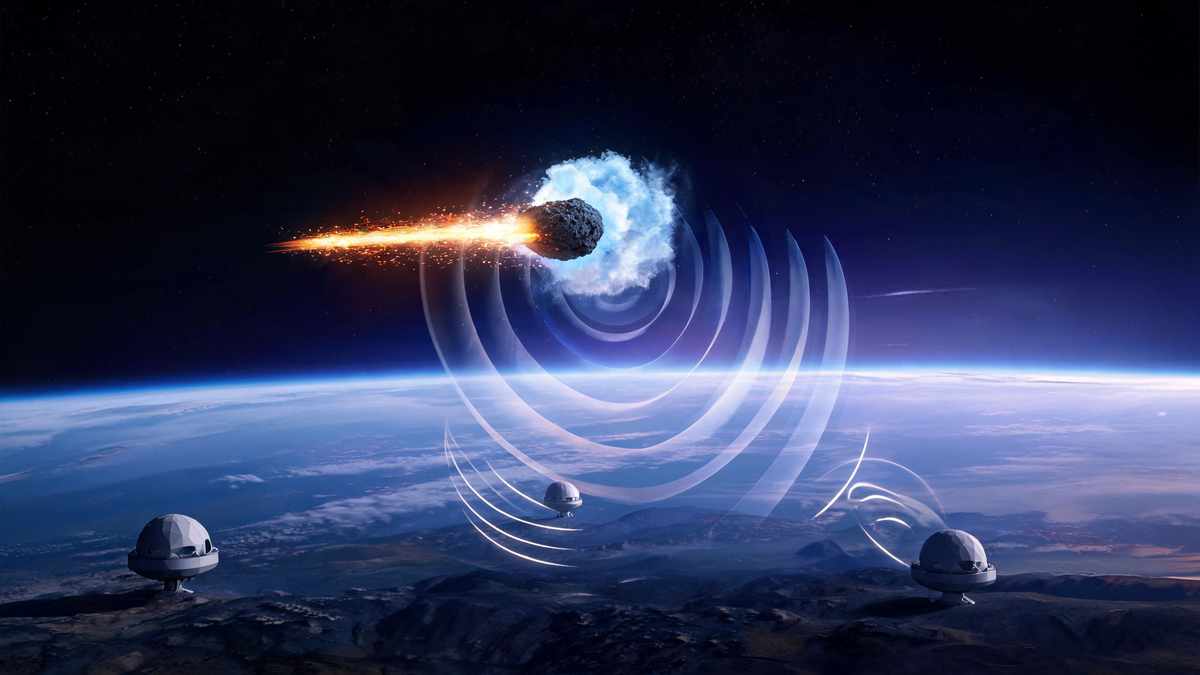
Could a pebble, plunging through the near-vacuum of the upper atmosphere, generate a thunderclap that travels for hundreds of kilometres? It shouldn’t. At 92 kilometres altitude the air is so thin that a centimetre-scale object should pass through it like a knife through mist — every molecule a lone bullet, no collective wave. Yet a preprint (arXiv:2605.29150) from Elizabeth A. Silber, Reynold E. Silber, and a team of international collaborators reports an observation that contradicts that expectation. The event — an earthgrazing fireball that streaked across the northern European sky — left behind not just a luminous trail, but a sustained cylindrical shock wave, detected by three infrasound arrays, and a puzzle that forces us to rethink how small bodies interact with a planetary atmosphere.
The first hint that something was extraordinary came from the source size. Weak‑shock modelling of the infrasound signals indicated that the acoustic source was roughly thirty metres across — the size of a school bus — pulsing from a nucleus with a mass of only about 45 grams. At 92 km, the ambient atmosphere offers a mean free path measured in metres; a solid object a few centimetres wide should see individual molecules, not a fluid, and the effective blast radius would be comparable to the object itself. The contrast is startling.
To understand why, recall that atmospheric entry is customarily divided into flow regimes using the Knudsen number — the ratio of the mean free path to the body size. Above about 100 km, for objects smaller than a human head, the flow is free‑molecular: the object ploughs through a sparse gas that never builds up ahead of it. No shock, no compression, just a gradual erosion. Below that, as the atmosphere thickens, the flow transitions to continuum, and a bow shock can form. A 45‑gram meteoroid at 92 km should sit squarely in the transitional or free‑molecular regime, incapable of sustaining a coherent shock front.
But this simple picture — a passive solid body slicing through independent molecules — is complicated by the fact that many meteoroids are not solid rocks. They are porous, volatile‑rich agglomerates, more like dirty snowballs than cannonballs. When heated, they do not merely ablate; they erupt, releasing ancient ices and gases that can radically alter the local flow field.
The fireball’s optical signature provided the first clue that this was no ordinary meteoroid. Multiple all‑sky cameras — including one operated by amateur astronomer Klaas Jobse in Oostkapelle, the Netherlands — captured a luminous trail that extended 164 kilometres along its near-horizontal path. The light curve showed early fragmentation and a fading tail, while the dynamic pressure at which the object began to disintegrate was exceptionally low. Such behaviour, the authors note, is characteristic of a cometary body or a porous, volatile‑bearing carbonaceous chondrite — not a dense stony meteorite. Nitpicking aside, what the cameras recorded was not the familiar swoosh of a shooting star; it was a hypersonic object that, for a few seconds, built itself a miniature atmosphere out of its own vapour.
While the cameras watched the light, three infrasound arrays in the Netherlands — EXL, DBN, and CIA — were listening. They picked up a narrow N‑wave signal, the unmistakable acoustic fingerprint of a shock. Cross‑correlation of the waveforms across the array elements allowed the team to geolocate the source points along the trajectory, clustering them near the fireball’s lowest altitude of 91.3 km. The shock was not a single point but a cylindrical line source — a sustained, moving shock envelope radiating sound downward.
How could such a small object sustain a shock? Silber and colleagues turned to the particle line density — the number of gas molecules per metre along the shock front. The required density to maintain a shock within a metre‑scale source diameter is substantial. The team examined every possible contribution: ambient atmospheric molecules, ablation products, thermal evaporation. Each fell short. Only when they added the flux of volatiles — water, carbon dioxide, and other ices sublimating from the meteoroid’s interior — did the total particle density cross the threshold needed to support a shock. Instead of a bare nucleus, the object’s outgassing inflated the effective collision cross‑section to tens of centimetres, reducing the local Knudsen number from the free‑molecular range into the slip‑flow or continuum regime, exactly where a shock can form.
This is not a matter of the meteoroid “wanting” to shout; it is a straightforward consequence of gas dynamics: a dense cloud of vapour acts as a piston, compressing the oncoming flow and generating a coherent pressure wave. Unlike a permanent atmosphere, however, this cocoon is fleeting — it exists only for the seconds the object is violently heated. Yet in those seconds it transforms the rarefied thermosphere into something that behaves, locally, like a fluid.
Sceptics might question whether the 30‑metre blast radius is a robust inference, given the uncertainties in weak‑shock modelling and the sparse infrasound coverage. But the independent geolocation from three well‑separated arrays — each providing redundant travel‑time and back‑azimuth constraints — makes it difficult to dismiss the signals as coincidental noise. Moreover, the narrow N‑wave shape is a reliable indicator of a shock rather than turbulent wake or fragmentation noise. The evidence for a thermospheric shock is compelling.
This single event chips away at a long‑standing assumption: that small, low‑density meteoroids cannot generate continuum flow in the rarefied upper atmosphere. For decades, meteor physics has treated centimetre‑scale objects as passive projectiles whose ablation is governed solely by the sporadic impact of individual molecules. The Silber team’s results suggest that even a modest budget of volatiles — water ice from the early solar system, perhaps, or carbonaceous compounds — can transform the local flow regime, enabling phenomena previously reserved for much larger or lower‑flying bodies. The implications extend beyond meteor astronomy. In planetary defence, small volatile‑rich impactors could produce unexpectedly strong atmospheric blasts, complicating risk assessments. For spacecraft reentry, the outgassing of composite materials might foster shock‑driven heating in ways not captured by current models.
The thermosphere, long thought of as a silent, frictionless sieve, may hide a secret: it is a stage where ancient ice, heated to incandescence, sculpts its own aerodynamic shield and shouts across the sky. The question posed by this earthgrazing fireball is not merely whether a pebble can scream; it is how many other volatile‑bearing fragments, unseen and unheard, have been shouting all along — and what stories about the primordial solar system their whispers might tell. The next time a comet slings a stone into our atmosphere, it may be worth listening not just with cameras, but with microphones tuned to the voice of vanishing ice.
References
- Elizabeth A. Silber et al., Shock wave formation in the thermosphere by an earthgrazing fireball: Empirical evidence for volatile-enhanced hydrodynamic shielding, arXiv:2605.29150