What makes a quantum state truly quantum? For decades, we’ve been taught that entanglement is the definitive mark—the spooky connection that defies any classical account. Yet a new analysis of top quarks produced at the Large Hadron Collider suggests a much richer answer. There is not one kind of quantum correlation but a whole ladder of them, and entanglement is only a middle rung. Below it sits discord, a fainter yet more resilient bond that can persist even when entanglement vanishes. Above it rise steerability and Bell nonlocality, increasingly stringent tests of how much the world refuses to obey any hidden‑variable playbook. And then, off to the side entirely, is a property the researchers call magic—a measure of just how far a state strays from the classical simulations that our computers find tractable. A preprint (arXiv:2602.15115) by a team led by Yoav Afik at the University of Chicago, working with physicists from Rochester, Madrid, and CERN, has now mapped this entire hierarchy for top‑antitop pairs. For the first time, we can see where nature draws the line between mere quantumness and the genuinely inexplicable.
The Rungs of Correlation
Think of these correlations as a set of increasingly severe interrogation methods. Discord is the gentlest: even when two particles are unentangled—when their joint state can be written as a classical mixture of independent pieces—their separate pieces may still carry a memory of having once been together. This memory, revealed only through careful measurement of one particle conditioned on results from the other, cannot be explained by any classical joint probability distribution. It is as if two strangers who have never met give answers that betray a shared, hidden history. (Unlike human strangers, this shared history is not a forgotten telephone call; it is a structural fact about the quantum state itself.)
Steerability ups the ante. Here, one observer—by choosing what to measure on her particle—can literally steer the remote particle into an ensemble of states that would be impossible to prepare classically. Imagine a puppeteer who, with a flick of her wrist, can force a marionette to dance a tango, a waltz, or a jig, but only if the strings are truly quantum. Bell nonlocality is the final rung: the correlations are so strong that no local hidden‑variable model can ever reproduce them, even in principle. When a system passes the Bell test, we know that nature has given up on being intuitive.
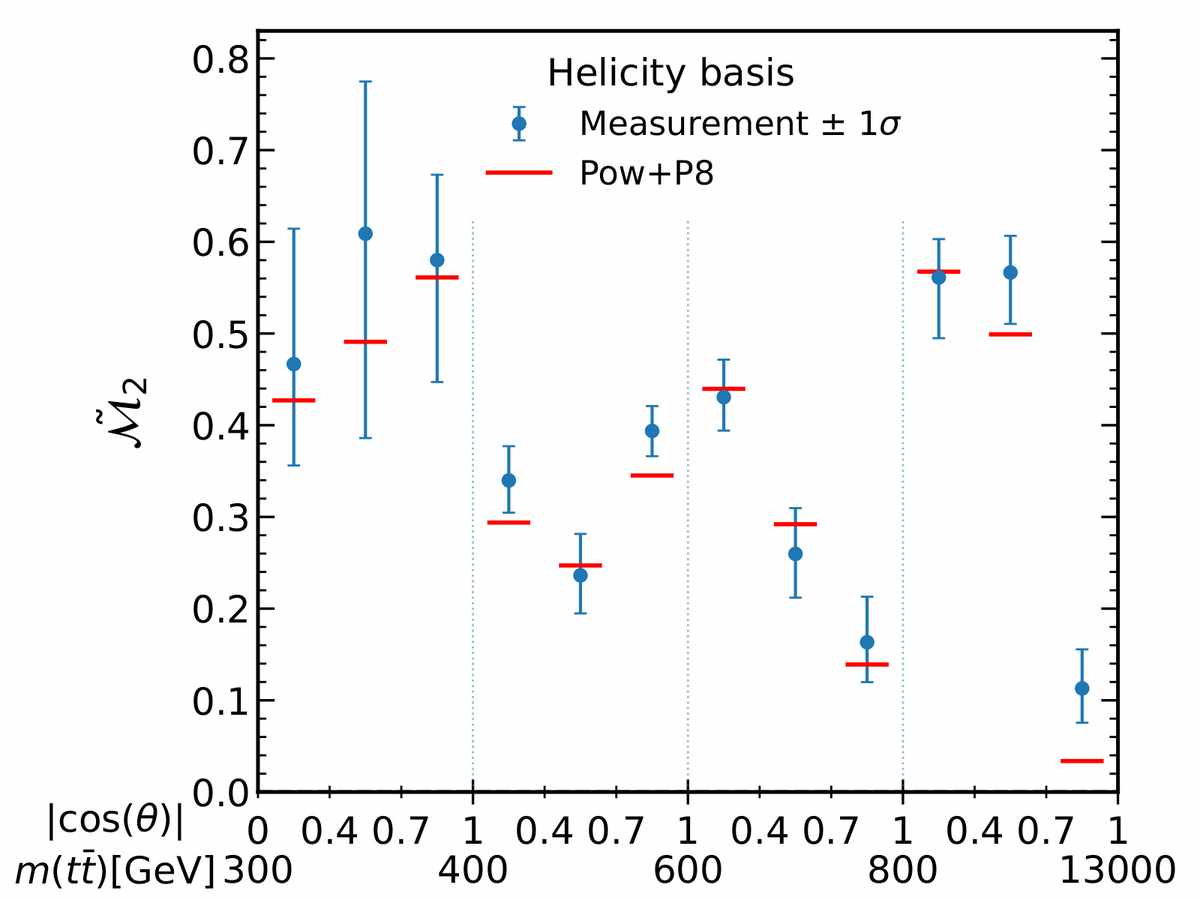
Afik and colleagues have climbed every one of these rungs. Using the doubly differential spin density matrix of top quark pairs—measured by the CMS experiment and resolved in the helicity and beam bases—they evaluated four observables: quantum discord, a steering marker, a Bell correlation marker, and a quantum magic number. The hierarchy emerged precisely as theory had predicted: discord is the easiest to spot, then steerability, with Bell nonlocality the hardest. And magic, famously orthogonal to the whole business, sits alongside like a wildcard that tells you whether the state is a resource for quantum computation.
Measured quantum correlations in top quark pairs climb above zero and match theoretical predictions. This confirms a subtle quantum behavior in nature’s most massive particles, advancing our understanding of fundamental reality. (Source: arXiv:2602.15115)
Collider as Quantum Lab
The Large Hadron Collider was never intended to be a precision quantum‑optics bench. It smashes protons into protons at energies of 13 trillion electronvolts, and among the debris, pairs of top quarks—the heaviest known elementary particles—fly away in a shower of smaller jets. Their spins, however, carry a clean quantum imprint. Because the top quark decays so quickly, its spin information is passed on to its decay products before the blizzard of QCD washes everything into chaos. The CMS collaboration had already reconstructed the full spin density matrix for these pairs in two different measurement bases: the helicity basis, which projects spins along each quark’s direction of motion, and the beam basis, which aligns spins with the proton beam axis.
The team examined the data in bins of the pair's invariant mass and the cosine of the top quark's production angle relative to the beam. In the helicity basis, quantum discord roared into view with a significance exceeding five standard deviations in many regions. That alone is remarkable: it means we are seeing a genuinely quantum correlation in a system where we never thought to look for it, and it is present even when the state is strictly separable—no entanglement at all. Steerability, too, emerged, albeit more tentatively, with a significance just above three standard deviations in the highest‑mass bin. Bell nonlocality, however, remained stubbornly absent, exactly as theory predicts for the current data. Magic, measured via the second stabilizer Rényi entropy, exceeded five standard deviations across the board, signalling that the top‑pair state could not be efficiently simulated by a classical stabilizer algorithm.
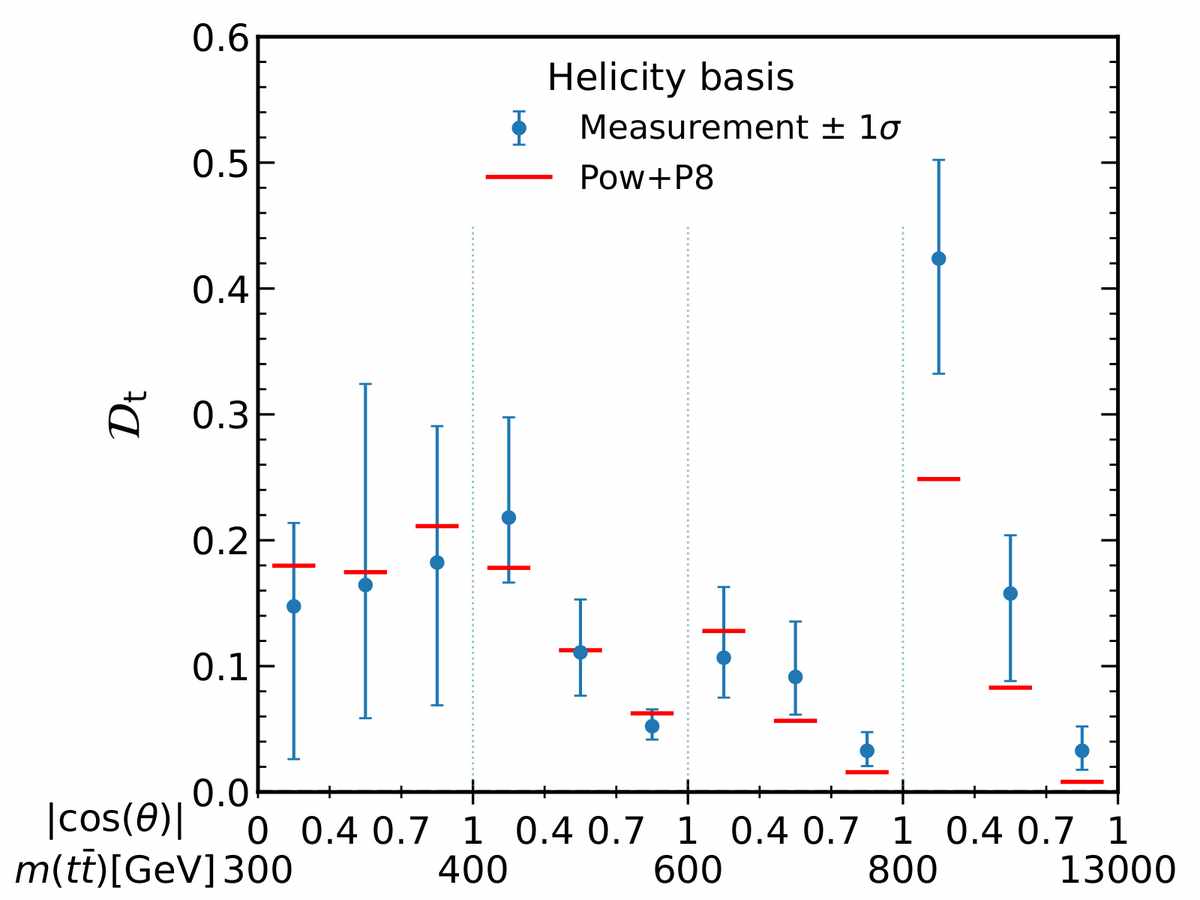
Quantum discord remains nonzero in top quark pairs even where steering and Bell correlations drop to zero. This hierarchy reveals that weaker quantum effects are more widespread, deepening our understanding of quantum behavior in high-energy particle collisions. (Source: arXiv:2602.15115)
Seen this way, the ladder is real. But there is a catch—one that Afik and his collaborators candidly acknowledge. The helicity basis, as they note, can yield “fictitious quantum states” after one averages over the phase space. That is not a cosmetic issue; it means the state one reconstructs may not correspond to any physically prepared state of a single event. When they rerun the analysis in the beam basis, which guarantees a bona fide quantum state, the discord signal remains strong and the magic persists, but the steerability signal evaporates below the threshold. The ladder is there, but one of its middle rungs is suddenly missing.
A Steerable Claim?
This tension is exactly where the dialectic sharpens. An important question raised by earlier work on quantum information in top quarks—including studies by Afik himself—is whether the helicity basis can be trusted for correlation hierarchies that depend on a minimization over all possible measurements. Quantum discord, for instance, is defined by optimizing over projective measurements on the antiquark; in the helicity basis, the authors perform this minimization, but the resulting number may not represent the discord of a physically realizable state. In the beam basis, where the state is well‑defined, the steering marker falls below the threshold, and the hierarchy loses one of its middle rungs—though the steering values remain elevated in some bins.
The steering criterion itself imposes another subtlety. It is most formally defined for states with zero net polarization—a condition not fully satisfied by the data—though the precise impact of small residual polarizations has not been quantified here. Small residual polarizations can mimic steerability, inflating the significance. Viewed through the lens of the team’s 2022 paper on quantum discord and steering at the LHC, the evidence for steerability must be treated as a tentative first sighting rather than a confirmed breakthrough. The adversarial dialogue that the authors have nurtured in their own papers—publishing their criteria, then testing them against real data—is a model of how to confront these interpretational challenges honestly.
What this challenges is our instinct to treat entanglement as the only quantum resource worth measuring. If discord can be robustly detected in a state that is not entangled, then perhaps we have been climbing the ladder from the wrong end. The bottom rung, not the top, might be the more fundamental fact about the quantum world—a kind of irreducible memory that survives the death of entanglement and that no classical mimic can ever reproduce.
Magic: The Wildcard
Magic is the odd property out. It does not belong to the hierarchy at all; it is a resource theory of its own, quantifying how much a quantum state can serve as a fuel for fault‑tolerant quantum computation. The team evaluated it using the second Rényi entropy of the stabilizer state overlap—a measure that works perfectly for pure states. Top quarks, however, are produced in a mixed state, part of a turbulent proton‑proton collision. Applying a pure‑state magic monotone to a mixed state is, as the authors of "The magic of entangled top quarks" have pointed out, not strictly justified—the version used here has been adapted for mixed states through the stabilizer Rényi entropy, though questions remain about its interpretation. The observed statistical significance of magic might thus reflect an artifact of the mixedness rather than a genuine resource. Still, the signal is large, and the qualitative conclusion—that top quarks carry non‑stabilizerness—is almost certainly correct.
Perhaps the most subversive insight of the entire analysis lies not in the raw numbers but in the ordering. Discord, the most forgiving member of the family, is the only one that survives every basis choice and every phase‑space cut. Entanglement requires more care, steerability still more, and Bell nonlocality has not yet appeared. The ladder, it seems, has a reliable bottom rung and an increasingly shaky ascent. In a world that has fetishized entanglement as the emblem of quantum weirdness, this is a quiet reversal. Quantumness, the team’s work suggests, is not a single switch that flips on when particles talk to each other. It is a spectrum—a graded membership in a club whose entry requirements tighten as you climb.
The forwards‑looking question, then, is not whether the LHC can beat Bell. It is whether we can learn to read the bottom rungs at all, to understand discord and magic as resources in their own right, and to perform these measurements in bases that do not smuggle in artefacts. After all, the ladder is still being built. Some rungs are provisional; some may break under closer inspection. But the fact that we can now reach out and touch them, in a machine built for a different purpose altogether, means the conversation between collider physics and quantum information has only just begun.
References
- Afik et al., Experimental characterization of the hierarchy of quantum correlations in top quark pairs, arXiv:2602.15115
- Afik et al., Quantum information with top quarks in QCD, arXiv:2203.05582
- Afik et al., Quantum discord and steering in top quarks at the LHC, arXiv:2209.03969
- White et al., The magic of entangled top quarks, arXiv:2406.07321