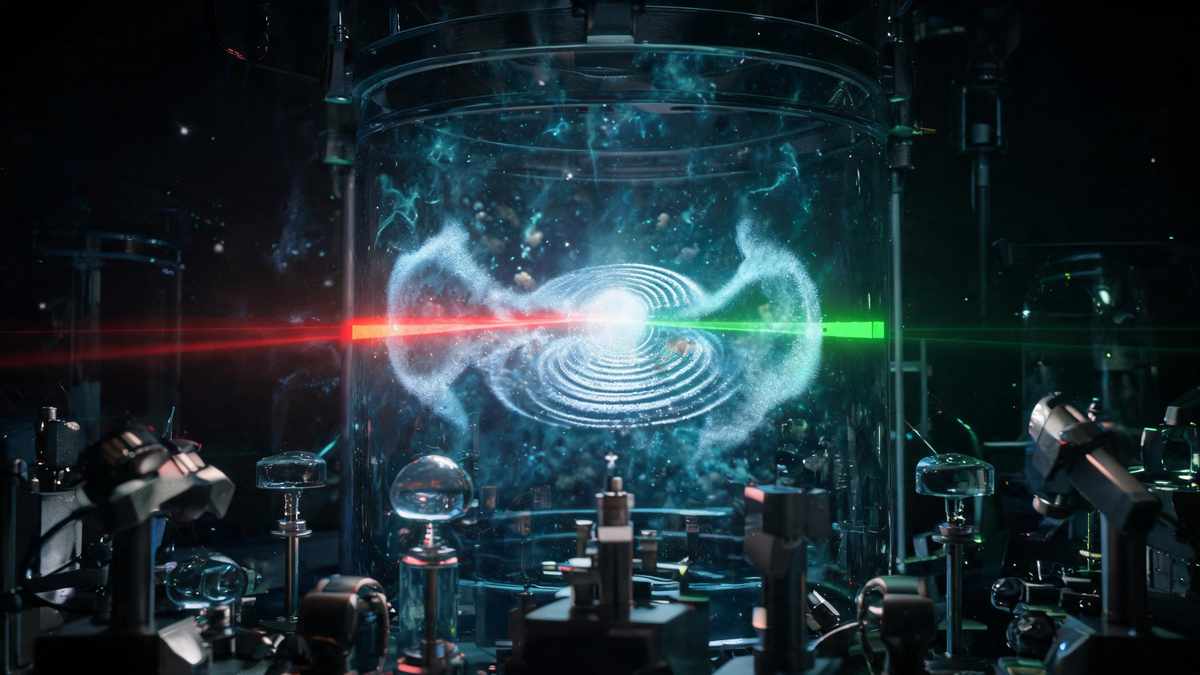
In a darkened lab, a cloud of rubidium atoms hovers in a vacuum chamber, cooled to a whisper above absolute zero. Laser pulses split each atom’s quantum wave into two ghostly copies that trace separate paths through space. When the paths finally merge, the atoms produce an interference pattern as delicate as ripples on a pond. That pattern is not just a pretty picture—it might be trying to tell us something about dark matter.
A preprint (arXiv:2606.00237) from Leonardo Badurina and Kathryn M. Zurek at Caltech’s Walter Burke Institute for Theoretical Physics proposes a fresh way to listen to that whisper. Their work casts matter-wave interferometers as open quantum systems that reveal dark matter not through a violent collision, but through the subtlest of quantum shortcuts: phase shifts and decoherence. As the authors write, “dark matter can reveal itself through phase and decoherence between spatially separated wavepackets, even when negligible energy deposition or resolvable recoil occurs.”
For decades, dark matter hunters have built ever-larger detectors designed to catch a single particle bumping into a nucleus. Those experiments assume that dark matter behaves like a stream of discrete bullets. But many theories also allow dark matter to be a diffuse, wave-like field—something that sloshes through the entire galaxy. The two regimes have typically demanded separate theoretical toolkits, fragmenting our understanding. Badurina and Zurek bridge that gap by treating the interferometer as an open system coupled to a dark matter environment, using a formalism called Schwinger‑Keldysh that tracks the forward and backward time evolution simultaneously. The result is a single framework that works for both heavy, particle‑like dark matter and ultralight, wave‑like candidates.
At its heart, an atom interferometer works much like a traditional light interferometer. An atom’s quantum wavefunction is split, sent along two different paths, and later recombined. The way the two halves interfere reveals any tiny disturbance they encountered along the way—a shift in relative phase, or a loss of fringe contrast (decoherence). The team’s key insight is that these two channels are not symmetric. When dark matter passes through the interferometer, it imprints itself on the atom’s wavefunction through an ‘influence functional’—a mathematical object that sums up all possible interactions. The part of this functional that governs decoherence is far more sensitive to the quantum statistics of the dark matter particles than the phase part is.
Here’s where things get wonderfully strange. If dark matter consists of bosons, then the quantum rules allow many particles to pile into the same state, enhancing their collective effect. The influence functional shows that this pile‑up amplifies the decoherence of the atomic wavefunction. If, instead, dark matter is made of fermions, the Pauli exclusion principle forbids two particles from sharing the same state, effectively capping the decoherence. The phase shift, by contrast, grows only linearly with the number of dark matter particles, regardless of their statistics. One channel hears a choir, the other counts heads.
You could think of it as a pair of microphones tuned to the same quiet signal. The phase microphone behaves like a standard amplifier: double the number of dark matter particles and the voltage climbs by a factor of two, never more. The decoherence microphone is a quantum-statistical instrument that registers the amplified collective hum when bosons are present, but records a muffled, clipped version when fermions are there instead. This is not a literal sound wave—nothing vibrates in the ordinary sense. It is a quantum correlation that leaves a measurable scar on the interference pattern, a scar whose texture carries information about what kind of particle caused it.
The structure emerges naturally from the mathematics of the Schwinger‑Keldysh path integral. The influence functional contains terms that represent the sum over all dark matter states; in the decoherence channel these terms pick up combinatorial factors that reflect Bose enhancement or Pauli blocking, while the phase channel remains linear. This asymmetry is a robust prediction of the framework and has no classical analogue. It means that an interferometer sensitive enough to detect decoherence could, in principle, distinguish whether dark matter obeys Bose or Fermi statistics—an astonishingly subtle feat for a tabletop experiment.
But the real world is never as clean as a path integral. The framework deliberately keeps the dark matter’s own coherence time in play, which means it can describe situations where the dark matter field changes slowly enough that the atom “remembers” its history, a non‑Markovian regime that simpler treatments often miss. This is important because if the dark matter wave is coherent over times longer than the interferometer sequence, the usual Markovian approximations break down. The paper provides a systematic way to go beyond those approximations and include corrections that matter for the heaviest particle masses.
Yet the clean continuous‑time formulation also reveals what has been left out. Earlier experimental proposals, such as the MAGIS‑100 100‑meter atom interferometer, have emphasized that the instrument is not truly continuous—it takes snapshots at discrete moments. Other theoretical work on broadband atom gradiometers has shown that when the dark matter signal varies faster than the sampling rate, aliasing can fold phantom signals into the data, distorting the evidence. The present framework sidesteps those sampling effects by treating the environment as continuously influencing the atom, a natural starting point for building intuition. But as the authors note, discrete‑time effects and wavepacket manipulation during the interferometer sequence are not yet incorporated. That is the next frontier: to weave the elegant open‑system physics into the gritty reality of pulsed atomic fountains.
A related strand of theory has considered whether an oscillating dark matter field could cause atoms to momentarily violate the equivalence principle, inducing a telltale phase shift. Those calculations treated only the phase channel and assumed a classical background. The Badurina–Zurek work goes further, capturing both phase and decoherence from the same unified action, and it does so without ever treating the dark matter as a classical source. The payoff is that the same formalism that yields the familiar phase shift also reveals the decoherence fingerprint, a new window that no previous single approach could open.
What does any of this mean for the human quest to understand what the universe is made of? If dark matter reacts so weakly that it can slip through a mountain of germanium without a single detectable recoil, our best hope may be to listen to the quantum silence it disturbs. Matter‑wave interferometers are already among the most sensitive instruments on the planet, capable of measuring accelerations to billionths of a g. Turning them into dark matter detectors requires not just building bigger machines, but building a sharper language to describe what those machines might hear. The Caltech team has given us that language.
The immediate next step is to marry the continuous‑time elegance of the open‑system framework to the discrete‑time pulse sequences that real interferometers use. Teams working on MAGIS‑100, AION, and related projects are already refining the signal‑processing techniques needed to reconstruct aliased spectra. If theorists can adapt the influence‑functional approach to include the stroboscopic nature of these experiments, the community will have a single, coherent pipeline that reaches from the Lagrangian of dark matter to the raw interference fringes recorded in the lab. In the meantime, the picture painted by this preprint suggests that the quantum statistics of dark matter are not a far‑off, philosophical curiosity—they are a concrete experimental observable, waiting for the right ear.
References
- Badurina and Zurek, Matter-Wave Interferometers as Open-System Dark Matter Detectors, arXiv:2606.00237
- Abe et al., Matter-wave Atomic Gradiometer Interferometric Sensor (MAGIS-100), arXiv:2104.02835
- Badurina et al., Super-Nyquist ultralight dark matter searches with broadband atom gradiometers, arXiv:2306.16477
- Gué et al., Violation of the equivalence principle induced by oscillating rest mass and transition frequency, and its detection in atom interferometers, arXiv:2401.14742