
Imagine a room full of compass needles, all trembling in the Earth’s magnetic field. Ask them to point north, and each will wobble independently, its tip tracing tiny, jittery circles. The average direction from all of them might be reasonably accurate, but the noise—the irreducible scatter—is simply the consequence of thermal agitation. Now imagine you could make those needles not just point, but somehow whisper to one another, so that when one jitters left, another jitters right in perfect synchrony, cancelling out the wobble. Collectively, the compass would become hypersensitive, its average direction steadier than any single needle could achieve. This, in essence, is what spin squeezing does to an ensemble of quantum particles. And in a preprint (arXiv:2606.02500) published this week, a team led by Lawrence W. Cheuk at Princeton University has achieved it for the first time with molecules—specifically, polar calcium monofluoride (CaF) molecules trapped in a tweezer array.
The whispering, of course, is not real. It is not a matter of the molecules conspiring; it is a consequence of the way quantum mechanics allows uncertainty to be redistributed among many particles. But the metaphor holds: when you force a collection of quantum spins into a collective state where their individual uncertainties are suppressed while their mutual correlations are enhanced, you get a measurement tool that exceeds the classical limit. The Princeton team’s work brings this tool to a class of particles long seen as ideal candidates for quantum sensing, but stubbornly resistant to collective entanglement.
For decades, polar molecules have been eyed as the dream platform for precision measurements. Their strong electric dipole moments make them exquisitely sensitive to electromagnetic fields, and their complex internal structure couples them to forces that could hint at physics beyond the Standard Model. Yet that very strength—the same long‑range dipolar interactions that promise sensitivity—has historically been the enemy of entanglement. Molecules would interact, all right, but in ways that scrambled their quantum states rather than organizing them. It was as if a troupe of dancers, stepping onto a stage, immediately collided in a chaotic heap. What the Princeton group has done is teach the dancers a choreography.
The trick was to encode the spin‑½ qubit not in the electronic or nuclear spin, as is commonly done in atoms, but in two rotational states of the CaF molecule. Rotation is an inherently collective property of a molecule’s constituent atoms, and because the molecules carry a permanent electric dipole, their rotational states are coupled directly by a distance‑dependent dipolar exchange interaction. This natural coupling provides the “whisper” between the compass needles—an interaction that, with careful handling, can be sculpted to generate metrologically useful entanglement.
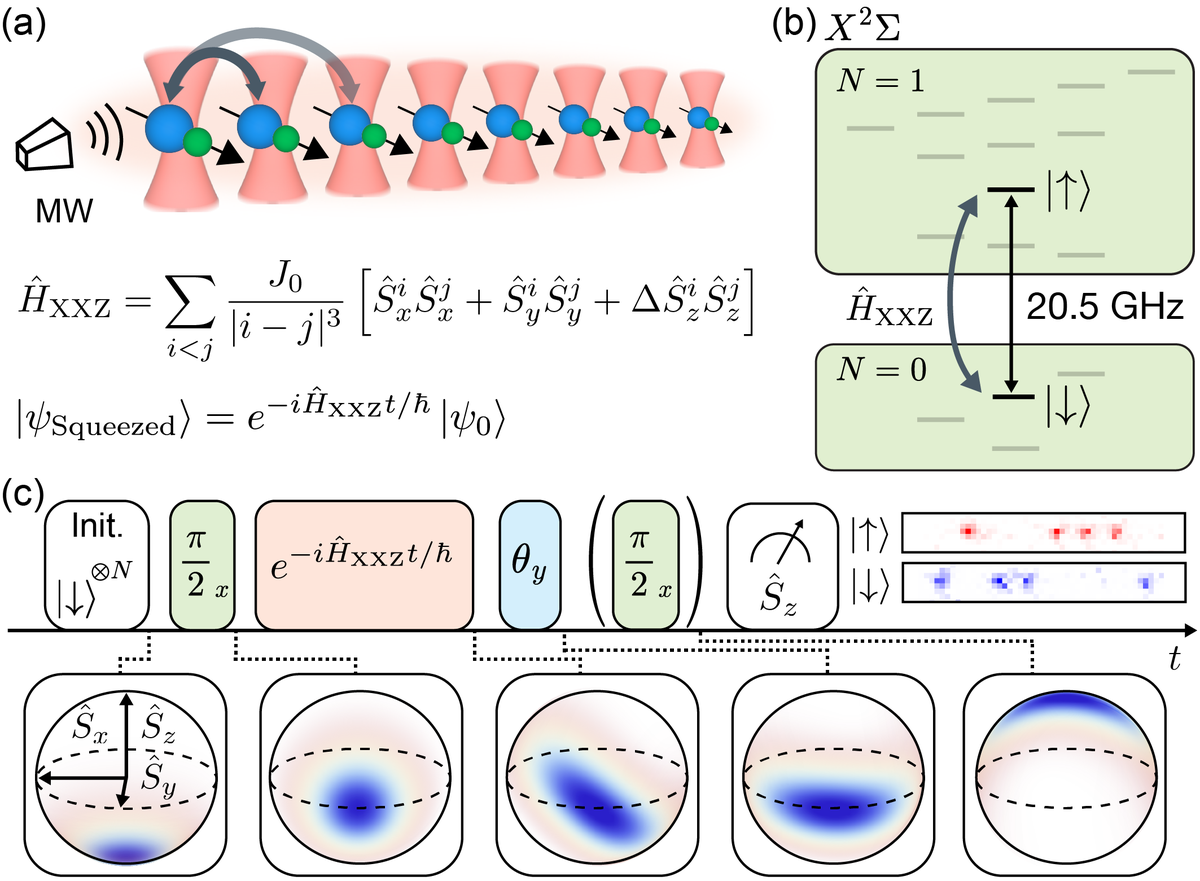
Microwave pulses squeeze collections of molecules into a quieter quantum state. This reduced noise boosts precision for next-generation sensors and tests of fundamental physics. (Source: arXiv:2606.02500)
To turn the raw interaction into a squeezing tool, the team employed two layers of control. The first was dynamical decoupling—a sequence of carefully timed microwave pulses that effectively filters out environmental noise while preserving the coherent spin‑exchange dynamics. Think of it as a strobe light that freezes the jitter of a dancer mid‑pirouette, allowing the intended choreography to unfold undisturbed. The second was Floquet engineering: by periodically modulating the microwave pulses, the researchers transformed the natural dipolar interaction into a whole family of effective spin Hamiltonians known as XXZ models. In these models, the exchange between neighboring molecules can be tuned from purely isotropic (all directions equivalent) to strongly anisotropic, letting the experimenters dial in the character of the entanglement.
The choreography yielded clear experimental signatures. The team measured a metrological gain of 3.0 decibels—the standard way of quantifying how much a quantum state improves the signal‑to‑noise ratio over the best classical strategy. That number, while modest in absolute terms, is a landmark: it is the first time spin squeezing has been observed in a molecular system. The squeezed state was not just a theoretical curiosity; the researchers used site‑ and spin‑resolved imaging to peer directly into the quantum correlations. What they saw were patterns of non‑classical connection: genuine bipartite entanglement and even Einstein–Podolsky–Rosen steering, a particularly stringent form of quantum correlation where measurements on one half of the system appear to influence the state of the other half in a way that cannot be explained by any classical common cause.
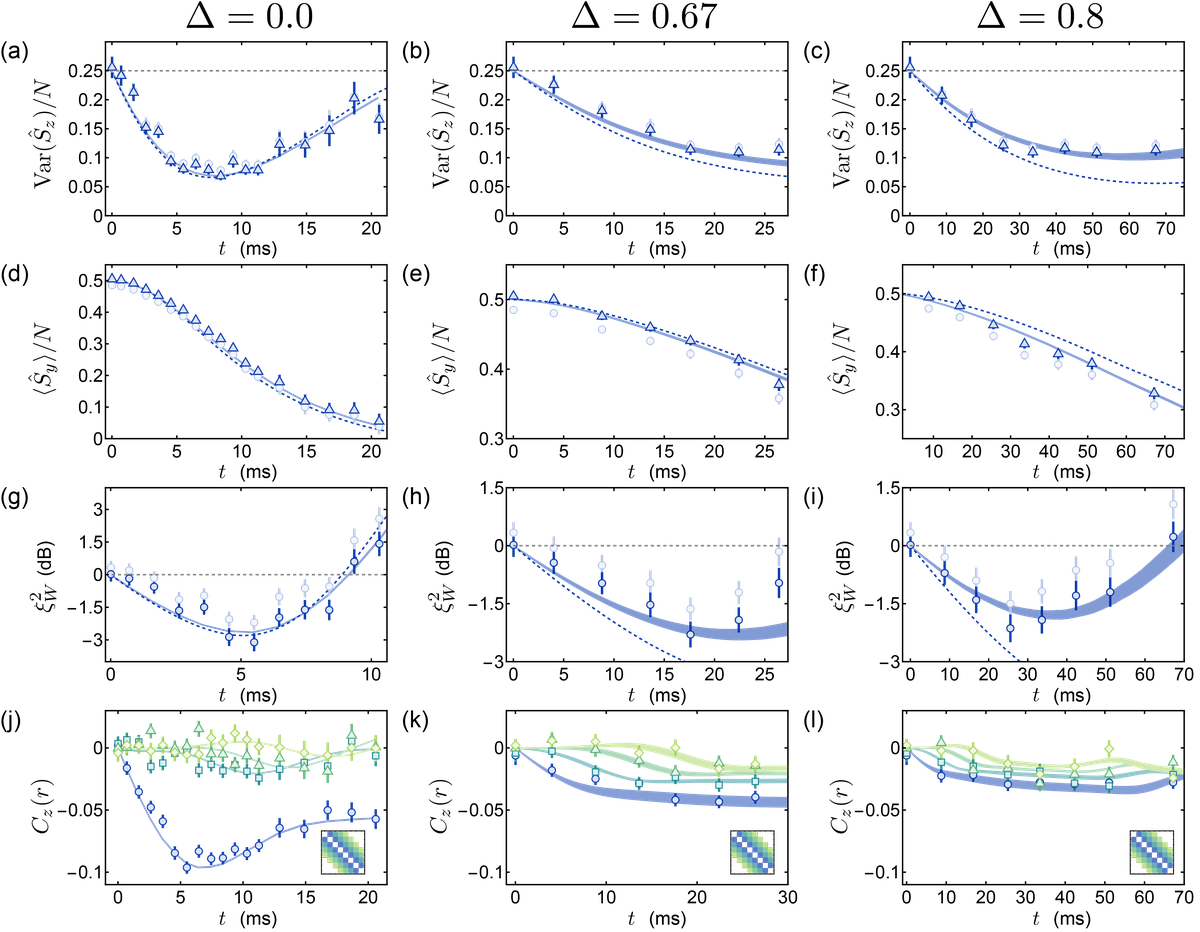
Stronger Ising interactions produce deeper and faster spin squeezing. This matters because stronger squeezing improves the precision of molecular quantum sensors. (Source: arXiv:2606.02500)
To make the squeezed states practically useful, the molecules cannot be left to chatter forever; the same interactions that create the correlations eventually cause decoherence. The Princeton team solved this by transferring the spin‑squeezed state into a pair of hyperfine levels—internal states that do not interact via the dipole force. Once stored there, the metrological enhancement persisted for up to 100 milliseconds, a thousand‑fold longer than the squeezing dynamics themselves. This is ample time to, say, move the molecular array into a region where one wants to measure a tiny magnetic field gradient, or to probe for subtle violations of fundamental symmetries.
An important question, however, hovers over these results. Earlier theoretical work by Koyluoglu and colleagues explored the conditions under which locally interacting spins can approach the Heisenberg limit—the ultimate precision bound that quantum mechanics allows, where the measurement error scales inversely with the number of particles rather than its square root. In the present experiments, the squeezing did not reach this regime; the metrological gain, while a landmark for molecules, remained at about 3 decibels—a factor of roughly two in signal-to-noise—rather than growing with the system size. The paper does not provide a detailed, quantitative noise budget that would pinpoint the decoherence pathways limiting the scaling. Without such a budget, it remains unclear whether the obstacle is technical—imperfect pulse shapes, residual motional heating, inhomogeneous fill of the tweezer array—or something more fundamental about the interaction itself. That the observed spin–spin correlations are predominantly short‑ranged, and that the Floquet‑engineered XXZ models have begun to show hints of the extended correlations expected near the Heisenberg point but have not yet fully realized them, suggests there is room to grow.
The team itself points the way forward. Their numerical simulations, incorporating realistic noise and disorder, indicate that with moderate improvements in lattice filling, microwave pulse fidelity, and decoherence rates, the squeezing could deepen substantially—perhaps enough to push into the regime where precision improves with particle number. If so, molecular tweezer arrays would graduate from being a platform for demonstrating entanglement to a practical tool for quantum‑enhanced sensing. They could become the compass needles we imagined, but now with the collective sensitivity to detect a magnetic field so faint that it has never been measured.
There is something philosophically satisfying in this progression. For decades, the strangeness of quantum mechanics was a narrative obstacle: we learned to accept that a particle could be in two places at once, but we could not do anything useful with that fact unless we could choreograph it. The Princeton experiment shows that molecules—messy, rich, and temperamental as they are—can be taught the steps. They can be made to share their uncertainty, not as a bug, but as a resource. This is not merely a technical milestone; it reopens a question that has simmered at the edges of quantum science: how much of nature’s fundamental structure can we probe, not by building bigger machines, but by learning to talk to the smallest ones more gently?
What the compass needles have whispered to one another in this first demonstration is still faint. But the whisper is there. The challenge now—and the invitation—is to amplify it into a roar that can be heard across the gap to new physics. The molecules have learned to squeeze; the road from a whisper to a roar is now open.
References
- Connor M. Holland et al., Creating and Probing Spin-Squeezed States of Molecules, arXiv:2606.02500
- Koyluoglu et al., Squeezing Towards the Heisenberg Limit with Locally Interacting Spins, arXiv:2506.16973