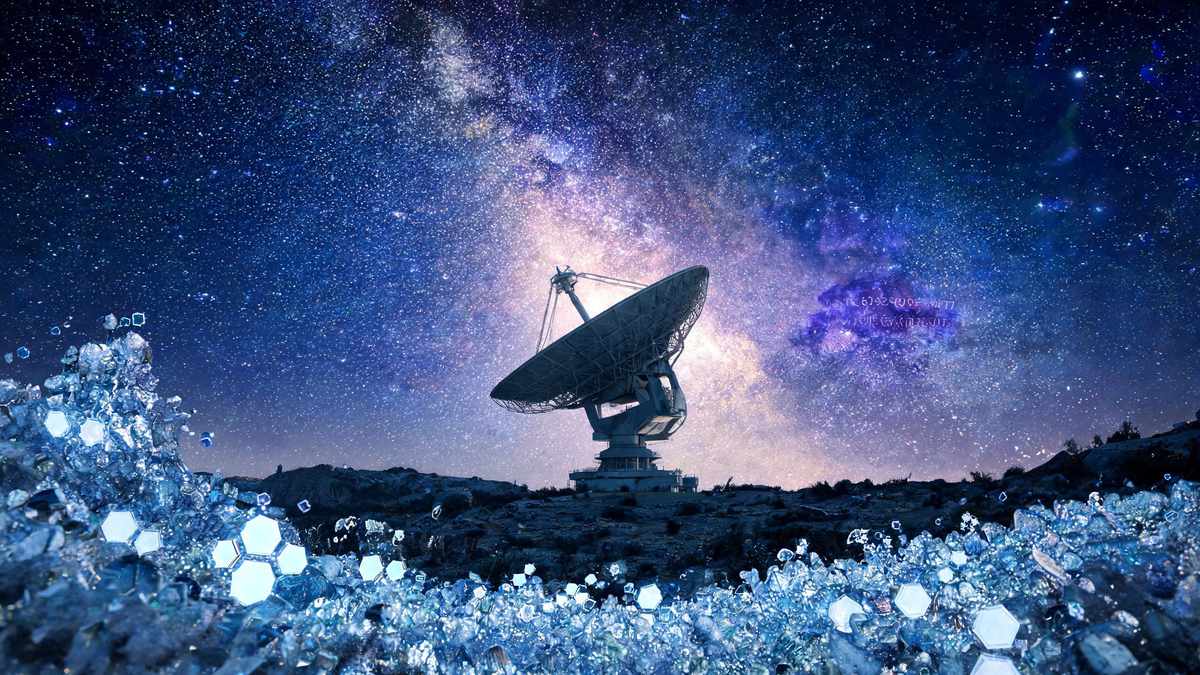
On a high, wind‑scoured plateau in central Spain, the Yebes 40‑metre radio telescope tilts its dish toward the centre of the Milky Way. A few hundred kilometres south, on a snow‑dusted peak in the Sierra Nevada, the IRAM 30‑metre telescope does the same. Together they listen, night after night, to the faint radio whisper of molecules drifting between the stars. Most of what they hear is the dull hiss of cosmic static and the well‑known signatures of simple compounds — water, carbon monoxide, a handful of others. But earlier this year, buried in the noise, a signal appeared that no one had ever seen before. It belonged to a molecule that, on Earth, we associate with something far more intimate than the cold vacuum of space: sugar.
A team led by Izaskun Jiménez‑Serra at the Centro de Astrobiología (CAB, CSIC-INTA), working with collaborators at the Universidad del País Vasco, the University of Extremadura, Radboud University, the Universidad Complutense de Madrid, the Max‑Planck‑Institut für extraterrestrische Physik, RIKEN, and other institutions, has detected the first sugar molecule in the interstellar medium. The molecule is erythrulose, a four‑carbon ketose — a small, chiral sugar that, until now, had never been spotted anywhere beyond our own planetary neighbourhood. “We report the discovery of erythrulose, a chiral four‑carbon ketose, in the ISM,” the team writes in a preprint (arXiv:2606.03313). The detection came from ultra‑sensitive, broadband spectral surveys of the Galactic Centre molecular cloud G+0.693‑0.027, a region already famous for harbouring a rich inventory of complex organic molecules.
For anyone who thinks of interstellar space as an empty, sterile void, the news may come as a surprise. But astrochemists have long suspected that sugars — the very molecules that form the backbone of DNA’s “deoxyribose” and RNA’s ribose — might be cooked up not in warm little ponds on the early Earth, but on the surfaces of microscopic dust grains drifting through the dark. Laboratory experiments that try to simulate prebiotic chemistry often struggle to produce enough monosaccharides to account for the sugar inventory that the origin of life would have required. Yet meteorites that fall to Earth today contain ribose, glucose, and other sugars, hinting that those molecules formed somewhere before the meteorites’ parent bodies even existed. The interstellar medium was the obvious suspect, but until now no sugar had ever been caught red‑handed in the act.
How Does a Sugar Form in Empty Space?
The answer, it turns out, is that space is less empty than its name suggests. In cold, dense clouds like G+0.693, carbon monoxide and other simple molecules freeze onto the surfaces of silicate and carbonaceous dust grains, building up icy mantles only a few dozen molecules thick. Ultraviolet light and cosmic rays break some of those molecules apart, creating radicals — highly reactive fragments that can recombine into more complex species. The team's quantum chemical calculations, paired with kinetic Monte Carlo simulations, show that erythrulose can grow on these icy grains from just two ingredients already abundant in G+0.693: glycolaldehyde and ethylene glycol, both two‑carbon molecules. The reaction pathway is surprisingly efficient: a series of hydrogen‑abstraction and radical‑recombination steps first links the two building blocks, then rearranges them into the four‑carbon sugar.
Unlike the familiar sugars we keep in our kitchens, erythrulose is a ketose — a sugar with a ketone group rather than an aldehyde. But in water, ketoses readily isomerise into aldoses, the form that ribose and deoxyribose take. If interstellar erythrulose were delivered to the early Earth inside meteorites or cometary material, exposure to water would have converted some of it into the aldoses that biology eventually adopted. This single molecule, therefore, opens a credible chemical pathway from the cold, radiation‑drenched surfaces of interstellar dust grains all the way to the building blocks of the first genetic molecules.
A Bias Towards Four Carbons
One of the most intriguing details in the paper is what the researchers did not find. Despite the extreme sensitivity of the Yebes and IRAM surveys, they saw no trace of three‑carbon sugars — dihydroxyacetone, glyceraldehyde, or any close analogue. Erythrulose, a four‑carbon sugar, was at least eight times more abundant than its smaller cousins would have to be to escape detection. This is not merely a statistical curiosity; it points to a fundamental chemical preference. On icy grains, the two‑carbon building blocks glycolaldehyde and ethylene glycol are plentiful, and the specific radical‑recombination pathways that lead to four‑carbon products are kinetically favoured. Nature, it seems, found a route to four‑carbon sugars that bypasses the three‑carbon stage altogether.
Jiménez‑Serra emphasises that the models are only the beginning. The team has already begun planning deeper surveys, using even more sensitive instruments, to search for the three‑carbon sugars that must exist at some level if the theoretical picture is correct. Finding them — or continuing to find nothing — will sharpen our understanding of interstellar organic chemistry.
A Thread in the Origin‑of‑Life Tapestry
The discovery does not answer the question of how life began. But it does tighten one of the loosest threads in the story. For decades, origin‑of‑life researchers have puzzled over where the first ribose came from. The detection of erythrulose in a starless molecular cloud — the kind of environment that eventually gives birth to stars and planets — makes it plausible that proto‑planetary disks inherit a supply of sugar from their interstellar nurseries. That sugar, locked inside icy grains, would later be incorporated into comets, asteroids, and eventually the surface of a young Earth. The idea that a key ingredient for life might have been sprinkled onto our planet from space has been around since the days of Svante Arrhenius. Now, for the first time, we have direct evidence that at least one sugar is present in the right kind of environment to make the story work.
And there is a quiet poetry to it. If the same chemical processes that brew erythrulose in G+0.693 also operated in the Sun's natal cloud — and there is every reason to think they did — then our Solar System, too, may have been laced from birth with the chemical sweetness that now runs through every living cell on Earth. The raw material for life may be far more universal than we once imagined.
The Search Continues
The team’s next goal is to look for sugars in other molecular clouds and in the planet‑forming disks around young stars. They will also try to improve the sensitivity of future observations, perhaps with the help of the next generation of radio telescopes like the Square Kilometre Array. If they can find erythrulose — and eventually, perhaps, the three‑carbon sugars — in a variety of environments, the case for a cosmic origin of life’s sugars will grow much stronger. For now, the discovery stands as a reminder that the most familiar molecules in our own bodies can turn up in the most unfamiliar places, and that the story of life on Earth may have begun long before the Earth itself was born.
References
- Izaskun Jiménez‑Serra et al., Detection of a four‑carbon sugar in interstellar space, arXiv:2606.03313