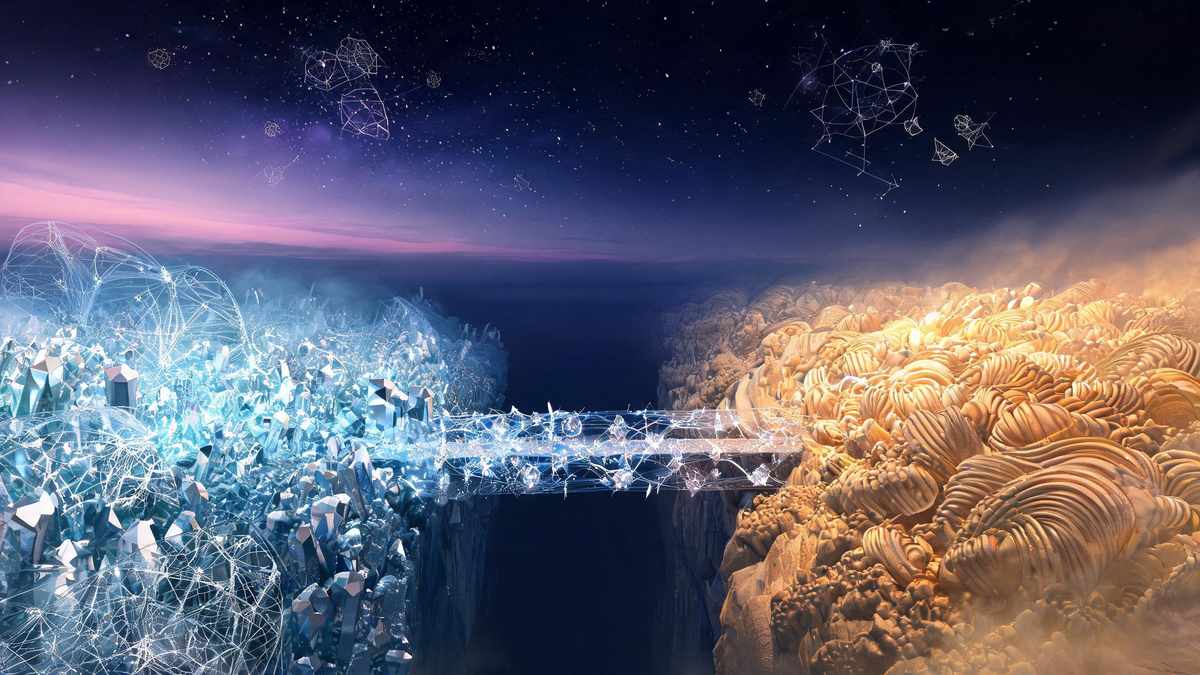
For centuries, navigators puzzled over two ancient maps drawn by seafarers from opposite ends of the globe. Both purported to chart the same archipelago, yet their coastlines, currents, and safe passages were rendered in marks so alien — jagged ideograms on one, curling scrolls on the other — that no one could prove they depicted the same geography. It was easy to suspect an equivalence; much harder to cross the gap and demonstrate it.
So, lots of idle fun comparing ancient maps — but how do you actually prove they are the same? The answer, it turns out, is not to keep squinting at the paper, but to build a systematic key: a rule that translates every mark on one map into the language of the other, turning conjecture into consensus.
Now you know how it feels to work on the local Langlands program. For four decades, mathematicians have gazed at two monumental constructions. On one side stands a structure of symmetries: sheaves on the stack of Langlands parameters, a kind of atlas of all possible ways that numbers can arrange themselves in p‑adic worlds. On the other sits a space of geometric shapes: D‑modules on the moduli stack of G‑bundles, a continent of differential equations governing the behaviour of arithmetic objects. The Langlands philosophy — one of the grand unifying visions of modern mathematics — insists that these two descriptions are not merely similar, but identical in their deep structure; that a dictionary exists mapping every statement about symmetries to a statement about differential equations, and vice versa.
The trouble was that nobody had built a dictionary that worked at the level of entire categories — the mathematical ecosystems that house all maps and transformations between objects. There were partial transliterations, heuristic mappings, but a full categorical equivalence remained a stubborn folklore conjecture. A team including Ian Gleason (National University of Singapore), Linus Hamann (Harvard University), Alexander Ivanov (Ruhr-Universität Bochum), João Lourenço (Université Sorbonne Paris Nord), and Konrad Zou (Sorbonne Université) has now erected the missing bridge. In a preprint (arXiv:2606.02799), they construct a single functor — which they call pitch — that faithfully translates between the sheaf‑theoretic and differential‑equation sides. The paper resolves the conjecture and, in doing so, demonstrates that the most direct route often sidesteps the heaviest machinery.
The Two Faces of Local Langlands
To understand what has been achieved, we need to inhabit the two worlds for a moment. On the “automorphic’’ side, D‑modules on the moduli of bundles encode the solutions of differential equations that govern p‑adic representations — the sort of arithmetic that emerges when one studies numbers modulo a prime power. On the “Galois’’ side, sheaves on the stack ICG capture the continuous symmetries of number fields. The local Langlands correspondence is the long‑held conviction that these two languages are genuine dialects of the same deep arithmetic.
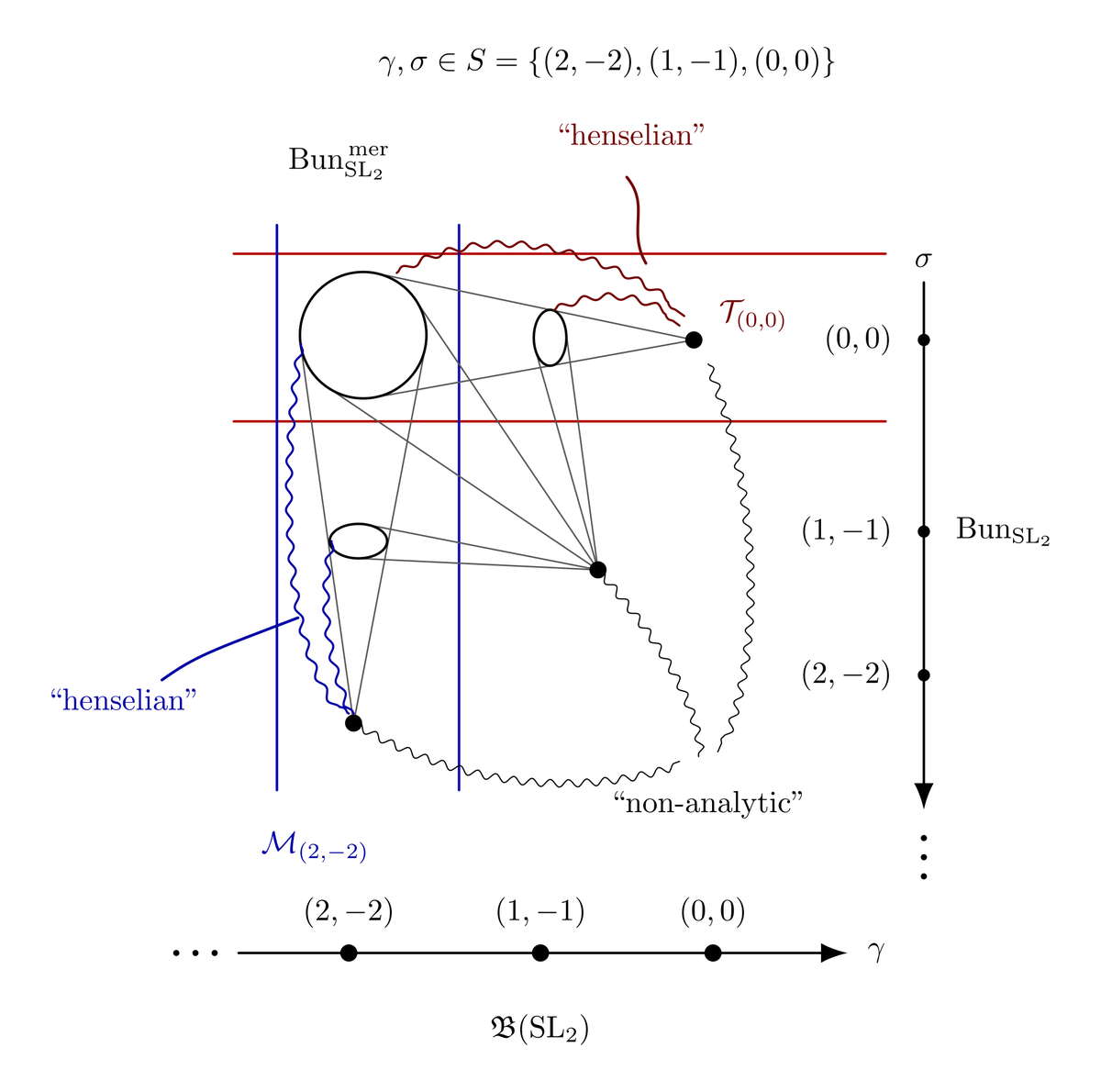
This picture depicts the (gamma,sigma)-strata of Bunon{SL2}mer, where gamma,sigma run over the set S={(0,0),(1,-1),(2,-2)}. There are a total of 6 strata indexed by (sigma,gamma) subject to the condition gamma geq sigma. If gamma> sigma, then the strata is analytic: they are depicted by a circle and two smaller ellipses in the figure above. The remaining strata are given by gamma=sigma and are thus non-analytic: we depict them by bullet points in the above picture. The blue parallel lines surround the locus calM(₂,₋₂) inside Bunmeron{SL2} where sigma varies through S and gamma=(2,-2), and whose unique non-analytic point is indexed by sigma=gamma=(2,-2), corresponding to the bottom left vertex of the vertical cone. Similarly, the red parallel lines surround the locus calT(₀,₀) of Bunmeron{SL2} where sigma=(0,0) and gamma runs through S, and whose unique non-analytic point is indexed by sigma=gamma=(0,0), corresponding to the top right vertex of the horizontal cone. The square enclosed by the red and blue lines contains a circle depicting the stratum given by sigma=(0,0) and gamma=(2,-2). (Source: arXiv:2606.02799)
The crux of the story is the switch from “the two sides should be equivalent’’ to “here is the exact functor that makes them so’’ — and the gathering of evidence that led to that construction. The functor pitch is a universal translator: feed it a sheaf on ICG, and it returns a D‑module on BunG, preserving all the higher structure that mathematicians need to perform calculations. The team wastes no time putting it to work: they immediately deduce a splitting of the semi‑orthogonal decomposition on BunG, and they show that the bridge respects Eisenstein functors — central building blocks of the automorphic theory.
Underlying this whole premise, though, is the fact that the two categorical enhancements — the sheaf‑theoretic and the D‑module‑theoretic — were built from the same arithmetic bedrock, each chosen for its technical convenience. Gleason and colleagues demonstrate that the translation can be made purely through the geometry of the spaces involved, without invoking the outer layers of formalism that most experts would have reached for.
A Kimberlite Bridge
The method by which pitch is constructed is as revealing as the result itself. It pulls together two of the most striking developments in recent geometry: Peter Scholze’s “analytification’’ functor, which places algebraic geometry on a continuous analytic footing akin to calculus, and Ian Gleason’s theory of “kimberlites.” Kimberlites are a class of geometric objects that arise naturally when one studies p‑adic spaces; they provide a flexible scaffolding for rigid analytic geometry, a kind of crystalline skeleton upon which sheaves can be hung.
Earlier work on the Riemann extension theorems for pseudorigid spaces — explored by João Lourenço (arXiv:1711.06903) — had raised the question of whether certain sheaf‑theoretic constructions could be made without invoking heavy topological machinery. Gleason and collaborators answer that question in the affirmative. They show that pitch can be defined directly from the geometry of kimberlites, without needing the formidable apparatus of prismatic cohomology, developed by Bhargav Bhatt and Scholze (arXiv:1905.08229), which unifies many cohomological frameworks. The kimberlite route is more elementary — in the mathematician's sense of being closer to first principles — and relies on the intrinsic structure already present in the Fargues–Fontaine curve, together with Gleason's earlier geometric work on kimberlites (cf. Gleason, arXiv:230...).
The proof, while substantial, is built on explicit geometric constructions. The argument weaves together explicit algebraic maps — relying on Scholze's analytification functor and Gleason's theory of kimberlites — that eventually intertwine the two categories. This does not mean it is easy — the technical depth remains immense — but the conceptual clarity is exceptional. The team has given the community something that feels almost inevitable in retrospect: a bridge whose existence was long suspected but whose construction required a new kind of geometry.
What makes this bridge particularly valuable is that it immediately allows mathematicians to translate insights between the two silos. A vanishing result for the cohomology of local Shimura varieties on the automorphic side can now be recast as a statement about Langlands parameters, and vice versa. The team provides unconditional applications already: a splitting of the semi‑orthogonal decomposition on BunG and a proof that the dictionary is compatible with Eisenstein functors. These are not mere technical lemmas; they are the first steps toward a unified computational language for the entire local Langlands correspondence.
The Open Gate
For all its power, the bridge is not yet complete. The equivalence pitch is unconditional, but its full potential depends on a single outstanding conjecture: the “linearity conjecture.” If true, it would mean that pitch is not just an equivalence of categories, but an equivalence that respects the action of the spectral Hecke algebra — essentially, that the dictionary also translates the operators that govern Hecke symmetries. Proving this conjecture would unlock new vanishing statements for the cohomology of local Shimura varieties, which are central objects in the study of automorphic forms and the broader Langlands program, and would guarantee perverse exactness for Hecke operators.
The team is explicit about what remains to be done. This honesty is characteristic of the best work in the field: the geometric Langlands program has always advanced by precisely delineating the frontier between what is known and what is still a guess. By isolating the linearity conjecture as the single obstacle separating the current result from a complete correspondence, the authors have given the community a clear target. The reward for proving it would be a categorical equivalence that fully intertwines the spectral side with the automorphic side, and with it, a raft of new tools that could reshape arithmetic geometry.
Mathematics, at its most profound, is the art of recognizing hidden sameness. A ring is the same as a field under certain conditions; a geometric shape is the same as an algebraic equation. Here, two vast continents of arithmetic geometry turn out to be not separate at all, but adjacent faces of a single crystalline mountain. The functor pitch is the first map that shows how to climb from one side to the other. Whether the linearity conjecture will be the final switchback remains to be seen. But for now, the bridge stands.
References
- Gleason et al., On the Schematic and Analytic Constructions of the Local Langlands Category, arXiv:2606.02799
- Lourenço, The Riemannian Hebbarkeitssätze for pseudorigid spaces, arXiv:1711.06903
- Bhatt et al., Prisms and Prismatic Cohomology, arXiv:1905.08229
- Le et al., Local models for Galois deformation rings and applications, arXiv:2007.05398