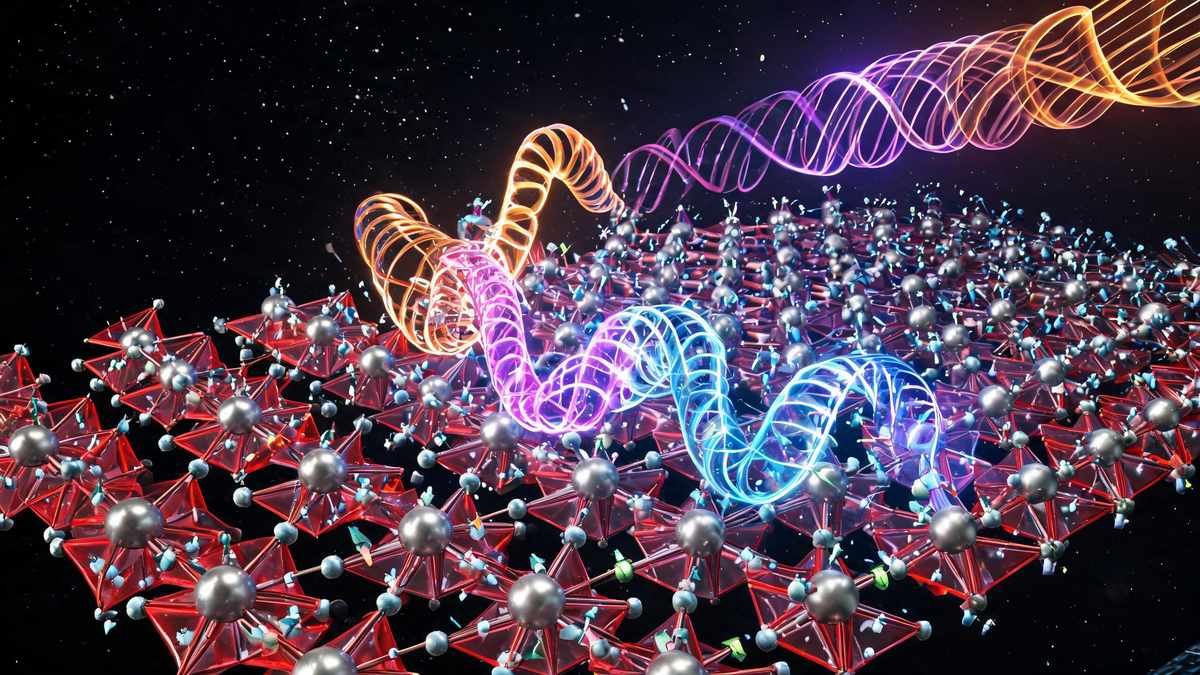
What if the quiet hum of atoms in a crystal carried a secret magnetic life? For decades, condensed‑matter physics treated lattice vibrations as neutral jiggles — mere shifts of ionic charge that could push electrons around but never carry a magnetic signature of their own. Spin, we were taught, belongs to electrons; phonons are spin‑free. A new experiment on the transparent perovskite strontium titanate shatters that tidy separation. In a preprint (arXiv:2606.03908), a team led by D. Pelc at the University of Zagreb, with collaborators in Minnesota, Korea, and Dresden, demonstrates that in metallic SrTiO₃ the phonons themselves acquire a pronounced handedness — a chirality that couples them directly to electron spin. The discovery rewrites the textbook on how vibrations can influence conduction, and it may finally explain why this dilute metal becomes a superconductor at all.
Conventional electron–phonon coupling is a story of electrostatics. As an ion moves, the positively charged background shifts, producing a local electric field that scatters electrons. Because the displacement is along the phonon’s propagation direction, only longitudinal modes were thought to matter. Transverse polar modes — vibrations perpendicular to the wavevector — were considered invisible to conduction electrons. Spin never entered the picture. “Now, you are probably thinking that this makes sense,” because a magnetic field, after all, couples to magnetic moments, and a phonon has none. That is exactly what the Zagreb team set out to test, and what they found was anything but expected.
They focused on the softest polar phonons in the tetragonal phase of SrTiO₃, modes where the titanium atom and its surrounding oxygen cage move in antiphase — the so‑called Slater mode. Using far‑infrared light at temperatures near 1.3 kelvin and magnetic fields up to 30 tesla, they watched how the material absorbed radiation at frequencies around 1 milli‑electronvolt — corresponding to sub‑terahertz photons. In insulating undoped SrTiO₃, the absorption spectrum showed no detectable magnetic signature, confirming the standard view. But when the crystal was doped with electrons — transforming it into a metal with a modest sea of carriers — something remarkable appeared. The absorption split into two branches whose intensity depended on whether the light was circularly polarized left‑handed or right‑handed. The phonon, in other words, had developed a chirality.
That chiral response is the fingerprint of a spin‑mediated coupling. Photons with circular polarization carry a handedness that can flip an electron’s spin. In the metal, the polar phonon and the spin‑flip excitation of conduction electrons hybridize, so the resulting collective mode carries both a lattice and a spin character. The team calls this a spin‑chiral electron‑phonon coupling. The effective magnetic moment of the hybrid mode reaches several Bohr magnetons — comparable to that of a free transition‑metal ion — despite originating from an atom that, at first glance, has no unpaired spins. It is as if the crystal’s collective vibration has learned to spin, not out of will but out of the unavoidable entanglement between motion and magnetism that special relativity writes into every atom’s behaviour.
Staying on the subject of surprising properties, this finding lands in the middle of a decades‑old mystery: why does strontium titanate superconduct? The material is not a conventional superconductor in any sense. It becomes superconducting at an anomalously low carrier density — hundreds of times more dilute than in ordinary metals — yet its transition temperature, although modest at a few hundred millikelvin, is far higher than what standard phonon‑mediated pairing would allow for such a dilute electron gas. The conundrum has resisted explanation since the phenomenon was first reported in 1964. The present work offers a resolution. The extracted spin–chiral coupling strength, roughly 400 milli-electronvolts per ångström, matches independent ab initio calculations and, crucially, is large enough to produce the observed superconducting critical temperatures across much of the doping range.
However, an important question raised by earlier experiments lingers at the lowest carrier densities. Bretz‑Sullivan and colleagues, studying superconductivity in the dilute single‑band limit of reduced SrTiO₃, found evidence that a single phonon mode may not be sufficient to account for pairing when there are only a few electrons per cubic micron. The new data agree in part: the coupling extracted by the Zagreb team, while strong, still falls short of what would be needed to explain the very bottom of the superconducting dome. A complementary study by Fauqué and collaborators on the role of polarization fluctuations points to a similar gap — multiple degrees of freedom may conspire to produce pairing. The authors acknowledge this openly, noting that the spin‑chiral mechanism on its own cannot explain the full dome; other contributions, perhaps from softer structural instabilities or from plasmon‑phonon mixing, likely join the dance at the most extreme dilutions.
This is not a flaw but a nuance, the kind of productive tension that marks an honest advance. The discovery that a lattice vibration can carry a magnetic personality opens fresh territory. Spin‑chiral coupling should appear generically in any metal with polar phonons and spin‑orbit interaction, from layered oxide heterostructures to Dirac semimetals. It adds a new knob to the spintronics toolkit: if a vibration can generate a net magnetic moment, then a carefully tailored acoustic wave might one day flip spins without any external magnetic field.
Perhaps the deepest implication is philosophical. For decades, condensed‑matter physicists have sorted phenomena into neat categories: charge, lattice, spin, orbital. Each had its own language, its own excitations. The transverse polar phonon was a lattice beast; the spin‑flip belonged to the magnetic zoo. SrTiO₃ shows us that beneath the categories, the creatures interbreed. The crystal is not a passive backdrop for electronic drama; it is an active participant, its very breathing endowed with a sense of left and right. When the next generation of experiments probes those hybrid modes with higher resolution, we will not simply be confirming the prediction — we will be eavesdropping on a conversation between the cathedral of the lattice and the quantum soul of the electron, a dialogue we are only beginning to hear.
References
- N. Somun et al., Spin-chiral electron-phonon coupling in metallic strontium titanate, arXiv:2606.03908
- T. Bretz-Sullivan et al., Superconductivity in the dilute single band limit in reduced Strontium Titanate, arXiv:1904.03121
- B. Fauqué et al., The polarisation fluctuation length scale shaping the superconducting dome of SrTiO₃, arXiv:2404.04154