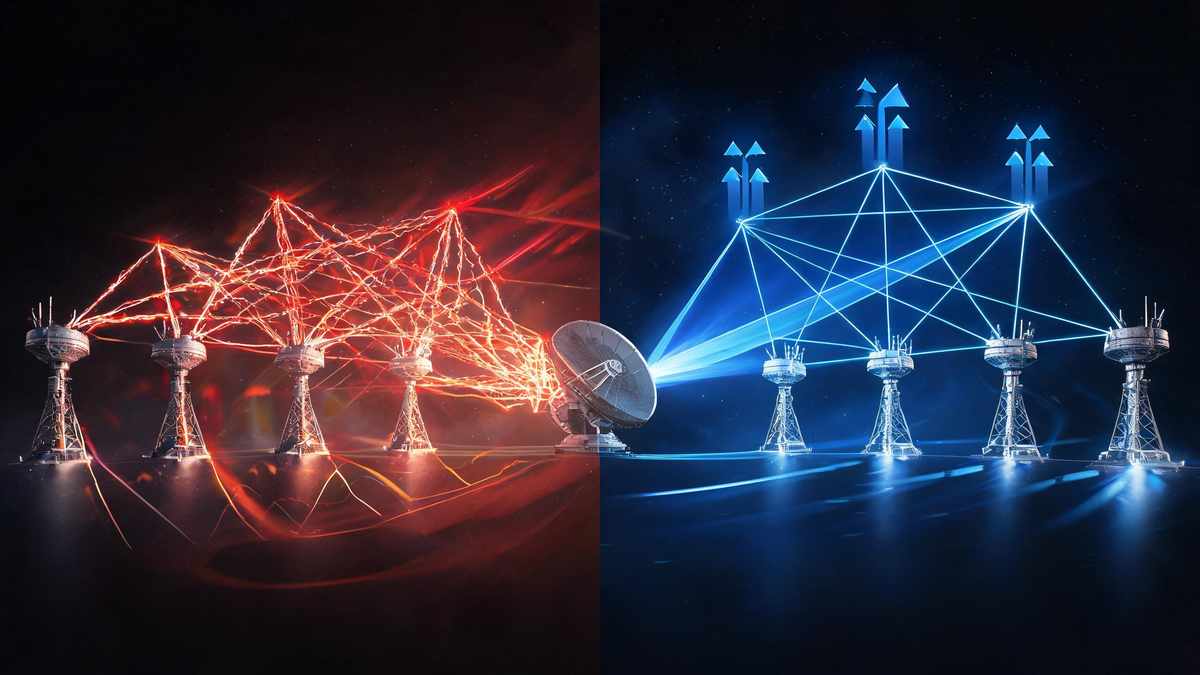
Think of a group of delivery drivers, each trying to send packages through a different door of a warehouse that is constantly rearranging its loading bays. Every driver can see only the state of the door directly in front of them — is it open? blocked? — but has no idea what the others are facing. They must choose their actions independently, with no time to coordinate. The result, perhaps unsurprisingly, is chaos: the rate at which information can flow through the warehouse plummets as more drivers are added, collapsing exponentially with the size of the team.
This toy picture captures the essence of a classical multiple access channel with causal channel state information at the transmitters (CSIT) — a standard model in communication theory that describes many real-world networking scenarios. The long-standing assumption has been that the capacity of such channels decays catastrophically when the number of users grows, because decentralized transmitters cannot coordinate their state-dependent encodings. A preprint (arXiv:2606.05412) from a team led by Syed A. Jafar at the University of California, Irvine turns that assumption on its head. Yuhang Yao and Jafar show that giving the transmitters access to quantum entanglement can produce a multiplicative capacity advantage that grows exponentially with the number of users — a gain that not only dwarfs the modest few-percent improvements previously known, but fundamentally rewrites what is possible in classical communication networks.
The key insight is surprisingly straightforward to state, even if the mathematics behind it is formidable. In a classical MAC with causal CSIT, each transmitter knows its own local channel state but cannot share that knowledge with others before sending. The lack of coordination means that the transmitted signals can clobber each other at the receiver, and the sum capacity — the total reliable information rate — can fall to near nothing as the number of transmitters increases. Quantum entanglement, however, enables a form of distributed coordination that allows the transmitters to suppress interference as efficiently as if they had full knowledge of every state — even though each still sees only its own. In astrophysical terms, it is the difference between a telescope array that simply sums independent snapshots and one that performs phase-coherent interferometry — but here the quantum correlations are used not to reconstruct a faint signal, but to cancel out a strong and structured source of interference.
The team constructs explicit channel families — all with binary inputs, outputs, and states — where the classical capacity decays exponentially with the user count K, while the entanglement-assisted capacity remains constant. The ratio between the two yields multiplicative gains that are nothing short of stunning. With five users, the quantum advantage exceeds a factor of 21; with seven users, it surpasses 88. Even a modest expansion of the state alphabet while holding K fixed at three produces unbounded multiplicative gains. These numbers are not just larger than previously observed; they cross into a regime where entanglement ceases to be a tiny tweak and becomes the dominant source of capacity.
An obvious concern is whether such gains survive in the messy presence of real-world noise. The paper addresses this by examining how the advantage holds up when the entangled qubits suffer from depolarization — a generic noise model. The result is remarkably robust. Even if each entangled qubit completely depolarizes with a probability of about 30 percent, the exponential capacity advantage remains intact. This robustness flows from the structure of the protocol itself: the entanglement is used only on the transmitter side, not to transmit the messages directly, so the classical part of the channel stays untouched. The entangled correlations serve as a coordination resource that is resilient to partial degradation, a property that makes the scheme far more than a theoretical curiosity.
To appreciate why this result is so unexpected, it helps to revisit the history of quantum-enhanced communication. For decades, the canonical example has been the superdense coding protocol, where entanglement allows two classical bits to be sent over a single qubit — a factor-of-two improvement at best. In multiple access settings, the best-known gains hovered below six percent. Physicists and information theorists had largely resigned themselves to the notion that entanglement offers unremarkable advantages in truly classical networking. The new work, as James McKenzie once described in his assessment of quantum technology investment, exemplifies how a specific architectural insight — here, the use of entanglement purely as a transmitter-side coordination tool — can unlock gains that the broader community had dismissed as unrealistic.
One might imagine, as if comparing the situation to Heisenberg’s fortnight on Helgoland, that the historical narrative of quantum-assisted capacity will eventually admit multiple interpretations. Just as Heisenberg’s seaside epiphany is both celebrated and debated for its role in the birth of matrix mechanics,...will shape how future engineers think about the role of quantum coherence in distributed coordination tasks. The core tension, as the authors acknowledge by engaging with related works, is that the classical capacity lower bound they use may not be tight. An important question raised by earlier work on virtual signaling of CSIT via non-signaling assistance (arXiv:2506.17803) is whether the classical capacity could be higher than assumed — and if so, whether the exponential advantage partly reflects a distributed computation gain rather than a pure multiple access phenomenon. Similarly, the framework of quantum and no-signaling cooperation between transmitters (arXiv:2509.08219) raises the possibility that the advantage may not be unique to entanglement; a broader class of non-signaling resources might produce comparable scaling.
These are not weaknesses of the paper so much as invitations to refine the boundaries. The work sits in an interesting tension with the earlier discovery that quantum entanglement assistance can activate the zero-error capacity of classical channels with causal CSIT (arXiv:2603.20416), where the gain was already striking but did not display the exponential scaling achieved here. Together, the two papers sketch a landscape where entanglement is not merely an additive resource but a multiplicative one whose leverage grows with the complexity of the coordination task.
From a physicist’s vantage point, what is most provocative is the philosophical shift the result embodies. For a field that had long regarded entanglement as a fragile curiosity for foundational experiments, the discovery of exponential, noise-robust capacity gains repositions it as an engineering principle. The question is no longer simply whether entanglement can offer minor improvements; it is whether tomorrow’s communication networks will be designed from the ground up to exploit distributed quantum correlations. The mathematical structure underlying the advantage — the ability of entangled transmitters to simulate a centralized encoder — may turn out to be a general phenomenon that surfaces in many distributed computation problems, far beyond the narrow confines of MACs.
The road ahead is clear, even if the timeline remains uncertain. Experimental demonstrations of even a few entangled transmitters coordinating classical transmissions would be a watershed. And because the protocol uses binary alphabets and tolerates substantial noise, it is closer to implementation than one might fear. The same framework can be studied in more general network topologies; early work on enhancing sum capacity via transmitter cooperation already hints at broader applicability. Perhaps, in a future not too distant, the architecture of 6G or 7G cellular networks will include protocols explicitly designed to harness entanglement-assisted coordination — turning what once seemed a quantum oddity into a mundane piece of telecommunications infrastructure.
The story of quantum-assisted communication has always been one of humbling surprises. From superdense coding to the activation of zero-error capacity and now to exponential gains, the narrative has repeatedly undermined the intuitive belief that classical limits are final. Yao and Jafar’s work does not just present a larger number; it reframes the conversation. Entanglement, it turns out, is not a small nudge — it is a force multiplier that grows with the scale of the challenge. And that, in a nutshell, is why the warehouse of information theory just became a much larger and more exciting space to explore.
References
- Yuhang Yao et al., Unlocking Exponential and Unbounded Robust Gains in Shannon Capacity of Classical Multiple Access Channels with Causal CSIT via Quantum Entanglement Assistance, arXiv:2606.05412
- Jafar et al., Virtual Signaling of CSIT via Non-Signaling Assistance, arXiv:2506.17803
- Nam et al., Enhancing Sum Capacity via Quantum and No-Signaling Cooperation Between Transmitters, arXiv:2509.08219
- Yao et al., Quantum Entanglement Assistance Improves the Capacity and Activates the Zero-Error Capacity of Classical Channels with Causal CSIT, arXiv:2603.20416