Cast your mind back to your first quantum mechanics class. You learned that even a perfect laser has a fundamental limit to its quietness. That limit is shot noise — the random arrival times of photons, a jitter that quantum mechanics will not let you suppress. Squeezed light is a clever workaround: it reduces noise in one aspect of the light wave, at the cost of increasing noise in a complementary one. Think of it as trading uncertainty in one quadrature (say, amplitude) for increased uncertainty in the complementary quadrature (phase), or vice versa.
For decades, researchers have produced squeezed light using bulky crystal resonators or optical fibers. But a practical, chip-scale source remains a long-sought goal. Now, a team led by Jie Li at Zhejiang University has shown that a simple semiconductor microcavity — a tiny layered structure — can do the job using nothing more than the natural vibrations of its crystal lattice. Their work appears in a preprint (arXiv:2408.09323) on arXiv.
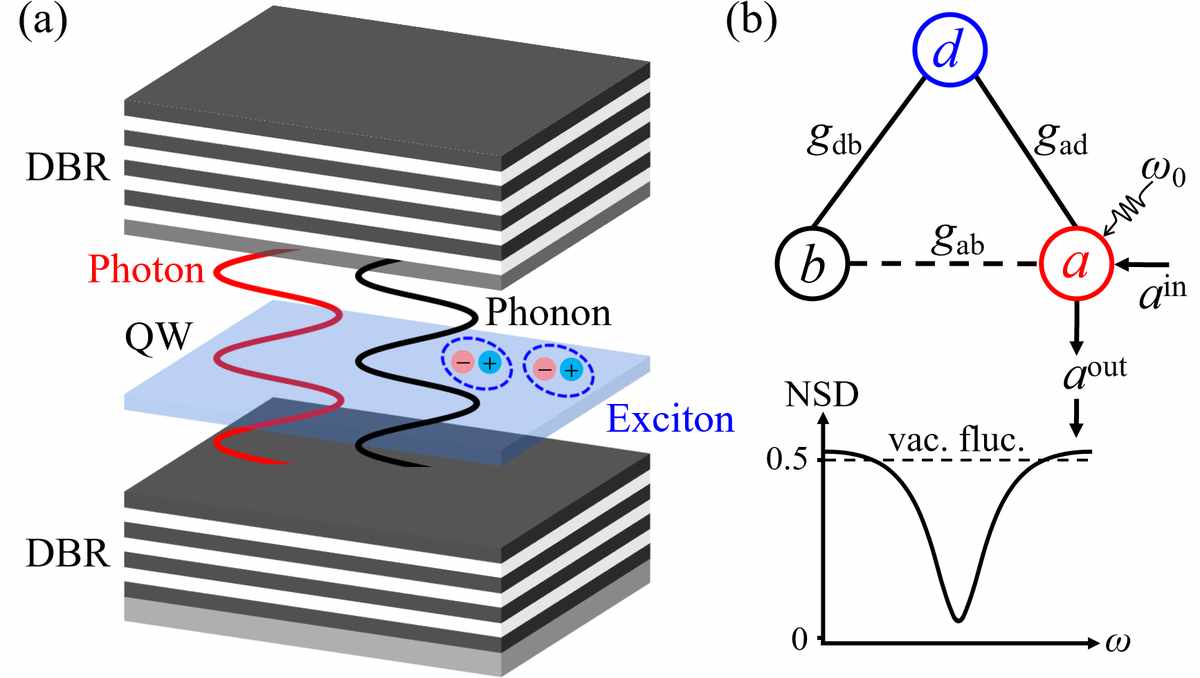
The device is a standard piece of semiconductor physics: a quantum well, where electrons and holes are confined to a thin layer, embedded inside an optical cavity — two mirrors that trap light. Inside this sandwich, three actors interact: cavity photons, excitons (bound pairs of an electron and a hole), and phonons (quantized vibrations of the crystal lattice). The key is an interaction called the deformation potential: when a phonon passes through the lattice, it briefly squeezes or stretches the crystal, changing the energy of any exciton it meets.
Think of the crystal lattice as a crowded dance floor. When dancers push and shove, they create patterns of movement — these are phonons. In a normal material, this jostling is random noise that ruins quantum coherence. But in the microcavity, the excitons feel that push very strongly. The phonons induce a correlated wobble in the excitons, and that correlation imprints onto the light bouncing between the mirrors, squeezing it into a quieter quantum state. Unlike dancers who can only push in one direction at a time, phonons act simultaneously on all spatial directions of the crystal — the analogy captures the idea of vibration-driven correlation, but the actual effect is a quantum mechanical transformation, not a mechanical shove.
The team's calculations show how this works mathematically. The strong exciton-phonon coupling makes the exciton respond nonlinearly. That nonlinearity is transferred to the cavity photons, producing a quadrature-squeezed output field — meaning the quantum noise in one aspect of the wave (say, its amplitude) is reduced below the standard quantum limit. The effect is not trivial: the deformation potential interaction is usually weak in bulk semiconductors, but inside a microcavity, the confined geometry amplifies it enormously.
The researchers also uncovered a second important role: the coupling between excitons and cavity photons shapes the squeezing spectrum, determining which optical frequencies get squeezed most. More strikingly, it protects the squeezing from thermal noise, which would otherwise wash it out at room temperature. This is a crucial advantage — many squeezed light sources require cryogenic cooling or complex feedback loops.
(Source: arXiv:2408.09323)
Using currently available semiconductor parameters, the authors find that substantial squeezing can be achieved across a bandwidth of tens of gigahertz. That is enough to cover many practical applications — from quantum sensing and metrology to gravitational wave detection and biological measurements. The device would operate at near-room temperature, a massive simplification over established methods.
This work does not claim to have built the device. But it provides a clear theoretical recipe, using materials — gallium arsenide quantum wells in optical microcavities — that are already manufactured in labs worldwide. The road from calculation to experiment is often long, but this paper shows a promising and concrete path. Among the many proposals for chip-scale quantum light sources, the semiconductor microcavity approach stands out because it exploits a well-understood, readily available platform. The vibrations that once seemed like noise may become the quietest light of all.
References
- Xuan Zuo et al., Squeezed light in a semiconductor microcavity, arXiv:2408.09323