
A weather model can run for weeks predicting a hurricane’s path, only to have its forecast collapse into an unchanging, bland average after a few days. This is not a bug; it is chaos. In a chaotic system, tiny uncertainties balloon into complete ignorance, and any classical simulation that attempts to outrun them eventually burns through its memory. But what if memory itself could be encoded not as classical bits, but as the subtle, entangled whispers of qubits? A team led by Peter Coveney at University College London, with first author Maida Wang, has taken the first concrete step toward answering that question. In a recent preprint (arXiv:2606.13422), they lay out a two‑stage quantum framework that, for the first time, provides a rigorous path to practical quantum advantage in predicting chaotic systems—from turbulent flows to the weather.
Every chaotic system, after forgetting its precise starting point, settles into a statistical shape: the invariant measure. This measure encodes all multi‑point correlations—how the wind speed at one location relates to the pressure at a distant location, for instance. Capturing these correlations is the key to accurate, long‑range predictions. Classical machine‑learning methods, such as the deep neural network FengWu or the linear chaos model of Cheng et al., already exploit such statistics, but they face a fundamental barrier: storing the full joint correlations requires a table with entries that grow exponentially with the number of variables. The quantum idea is to store them not in a table, but in the probability amplitudes of a quantum state—a Q‑Prior.
Think of the invariant measure as a dice with a billion faces, each face a possible configuration of the atmosphere. To remember how often two remote weather stations see correlated wind shifts, a classical computer must roll that dice an astronomical number of times—enough to fill a table far larger than the visible universe. The quantum approach, by contrast, rolls the dice once, but the outcome is not a single face; it is a superposition of all faces at once. A parametrised quantum circuit on as many qubits as there are spatial variables is trained so that measuring a few Pauli operators reveals the joint correlations buried in the invariant measure. Storage that would be exponential in a classical memory becomes compact in the complex numbers of a quantum wavefunction. Of course, a superposition is not a table—you cannot simply inspect it. The challenge is to extract the correlations you need without destroying the quantum advantage. This is not a failure of information; it is the fundamental tension of quantum measurement.
The UCL team proves that extraction can be done with provable quantum advantage. The trick is to prepare two identical copies of the Q‑Prior state and measure them jointly in a Bell measurement—the same type of measurement that underpins quantum teleportation. For any post‑hoc choice of which correlation you want to read, a fixed number of such two‑copy shots suffices, independent of the number of qubits. In stark contrast, any classical protocol that reads the same full‑Pauli correlation from a single copy would need a number of copies that grows exponentially with system size—a proven quantum‑classical separation in copy‑measurement complexity. Unlike dinner guests who can simultaneously occupy multiple conversations, quantum states vanish as soon as they are measured, so the joint measurement must be handled with care. Yet the payoff is dramatic: what a classical machine can do only by repeating an experiment an exponential number of times, a quantum machine with two copies can do in a few thousand shots.
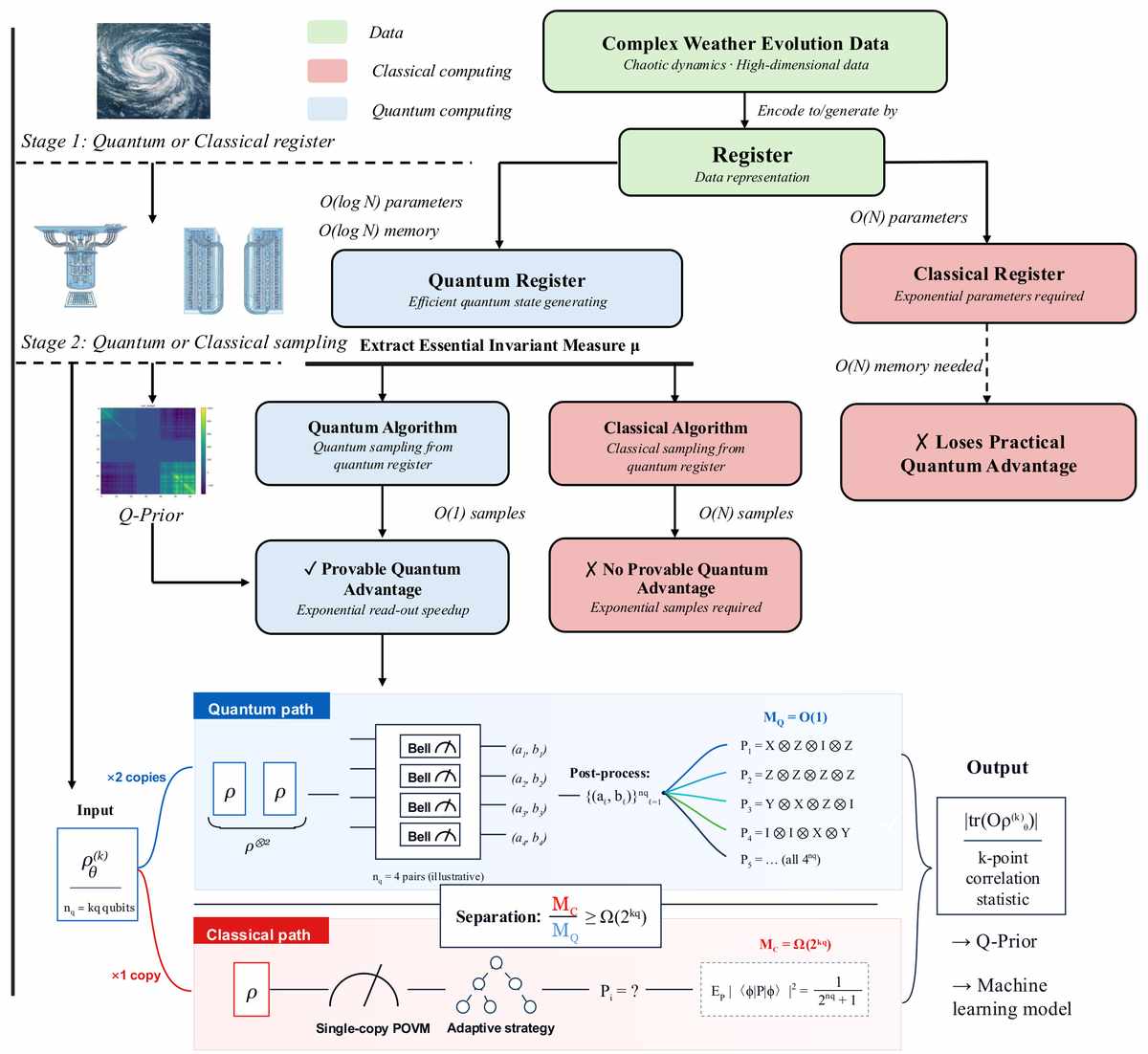
A compact quantum memory stores information far more efficiently than any classical method, and a clever measurement extracts it with exponentially fewer samples. This efficiency is crucial for making quantum machine learning practical for predicting chaotic systems. (Source: arXiv:2606.13422)
The team didn’t stop at theory. They ran the two‑copy protocol on IQM superconducting processors, using up to a dozen qubits per copy on a twenty‑qubit chip and later scaling to sixteen‑qubit copies on a larger fifty‑four‑qubit machine. In simulation, the Bell method extracted correlations with a copy‑pair cost over a million times smaller than the best classical‑shadow scheme—and this separation grew with the register size. On the real hardware, the team recovered large‑coherence values within the expected tolerance, though small signals were limited by noise. The key point is that the quantum advantage is not merely asymptotic; it is already visible on today’s devices.
The team then put the framework to work on two scientifically meaningful tasks. In medium‑range weather forecasting using the ERA5 reanalysis dataset, they trained a diagonal k≤2 Q‑Prior to steer a Koopman‑based roll‑out model. The result: the quantum‑informed forecasts improved anomaly‑correlation skill by as much as 39 percent over purely classical Koopman and other baselines, and prevented the long‑horizon collapse onto a static mean field that plagues classical forecasts. Notably, the improvements held across the full ten‑day forecast window. This sits in an interesting tension with deep‑learning weather models such as FengWu (Chen et al.), which achieve strong performance but are purely classical. The UCL team’s improvement does not yet exploit the exponential separation—it uses only diagonal correlators—but it demonstrates that even modest quantum information can materially lift forecast accuracy. An important question, sharpened by the DySLIM framework (Schiff et al.), is whether the Q‑Prior implicitly learns the invariant measure in a stable way, or if the quantum advantage could eventually be combined with explicit stability guarantees.
The second case study probed turbulent channel flow, where the classic challenge is to capture directional coherence—the tendency of velocity vectors to align over long distances. This is a non‑diagonal correlation invisible to magnitude‑only classical statistics. The team’s Q‑Prior, trained on velocity phase fields, extracted this coherence via the same two‑copy Bell protocol. They recovered it accurately in simulation and on hardware, confirming that quantum‑informed models can access structural features of chaos that classical tools simply cannot see. The directional coherence is a named, observable signature of the invariant measure, and extracting it with a fixed number of copies—regardless of how many spatial cells are resolved—is a practical demonstration of the quantum–classical separation in action.
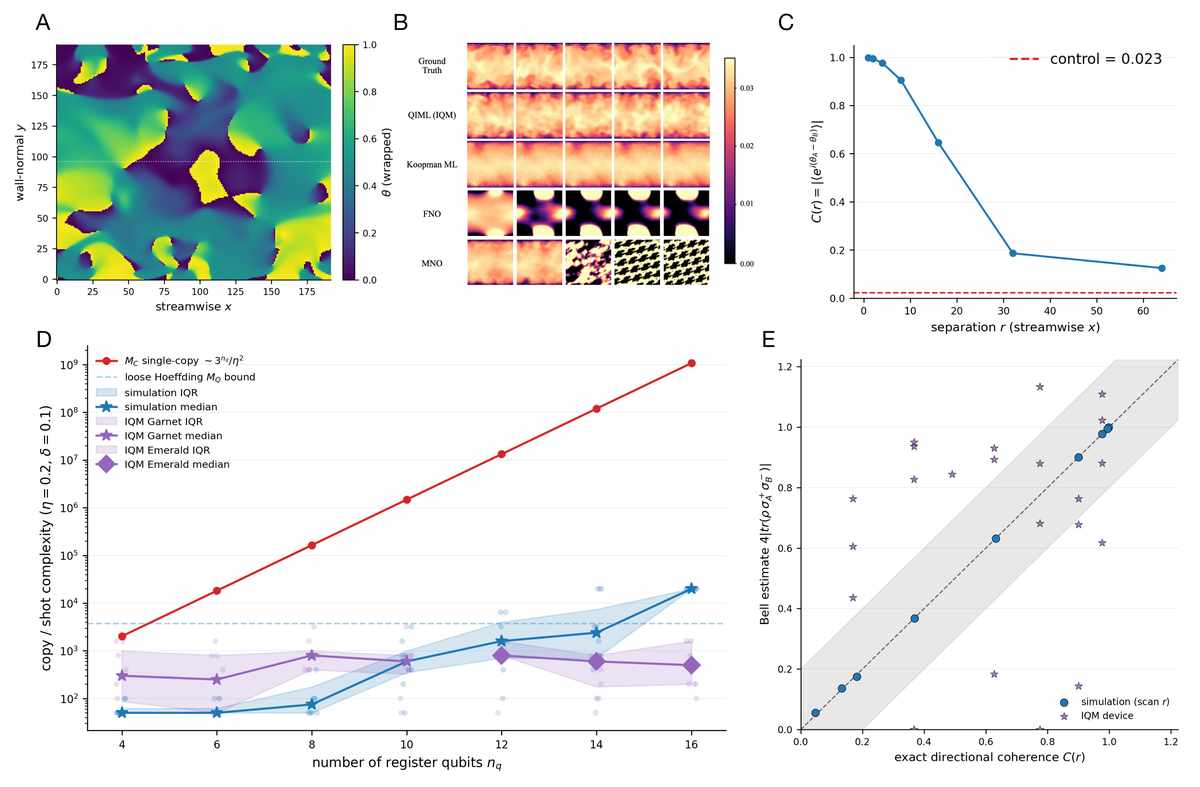
Quantum-informed machine learning accurately forecasts the swirling patterns of turbulent flow, while standard models quickly lose accuracy. This suggests quantum computers could someday improve predictions of chaotic systems like weather and climate. (Source: arXiv:2606.13422)
What the team has achieved is a crisp, testable target: a quantum advantage in read‑out that scales with system size. They acknowledge, with a candour that strengthens the work, that end‑to‑end runtime advantage is not yet in sight; the exponential gap remains untapped in the weather study, and the definition of advantage is couched in copy‑measurement complexity rather than wall‑clock time. Yet this humility is precisely what makes the roadmap credible. The road from a copy‑measurement separation to a genuine end‑to‑end speedup will require better hardware and tighter integration, but the direction is clear.
This work is not a claim that quantum computers will forecast the weather next year. It is something more honest and, perhaps, more exciting: a demonstration that the mathematical heart of quantum information—entanglement and non‑locality—can be harnessed to see chaos in a new light. The two copies are not a gimmick; they are a window into a world where the very act of measurement, performed judiciously on two entangled siblings, can extract correlations that classical machines, no matter how large, cannot efficiently access. The question now is how to widen that window, and what new insights into turbulence, climate, and other chaotic phenomena will stream through it.
References
- Maida Wang et al., Foundations of Practical Quantum Advantage in Quantum-Informed Machine Learning for Predicting Chaos, arXiv:2606.13422
- Chen et al., FengWu: Pushing the Skillful Global Medium-range Weather Forecast beyond 10 Days Lead, arXiv:2304.02948
- Schiff et al., DySLIM: Dynamics Stable Learning by Invariant Measure for Chaotic Systems, arXiv:2402.04467
- Cheng et al., Learning Chaos In A Linear Way, arXiv:2503.14702